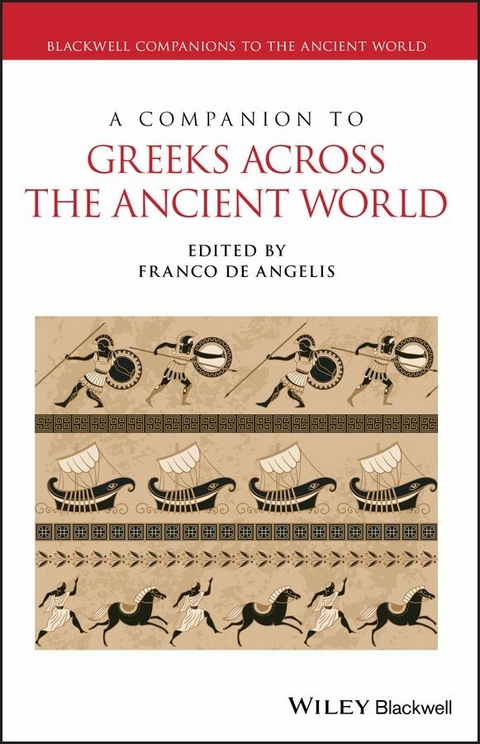
A Companion to Greeks Across the Ancient World (eBook)
John Wiley & Sons (Verlag)
978-1-118-34137-7 (ISBN)
An innovative, up-to-date treatment of ancient Greek mobility and migration from 1000 BCE to 30 BCE
A Companion to Greeks Across the Ancient World explores the mobility and migration of Greeks who left their homelands in the ten centuries between the Early Iron Age and the Hellenistic period. While most academic literature centers on the Greeks of the Aegean basin area, this unique volume provides a systematic examination of the history of the other half of the ancient Greek world. Contributions from leading scholars and historians discuss where migrants settled, their new communities, and their connections and interactions with both Aegean Greeks and non-Greeks.
Divided into three parts, the book first covers ancient and modern approaches and the study of the ancient Greeks outside their homelands, including various intellectual, national, and linguistic traditions. Regional case studies form the core of the text, taking a microhistory approach to examine Greeks in the Near Eastern Empires, Greek-Celtic interactions in Central Europe, Greek-established states in Central Asia, and many others throughout Europe, Africa, and Asia. The closing section of the text discusses wider themes such as the relations between the Greek homeland and the edges of Greek civilization. Reflecting contemporary research and fresh perspectives on ancient Greek culture contact, this volume:
- Discusses the development and intersection of mobility, migration, and diaspora studies
- Examines the various forms of ancient Greek mobility and their outcomes
- Highlights contributions to cultural development in the Greek and non-Greek world
- Examines wider themes and the various forms of ancient Greek mobility and their outcomes
- Includes an overview of ancient terminology and concepts, modern translations, numerous maps, and full references
A Companion to Greeks Across the Ancient World is a valuable resource for students, instructors, and researchers of Classical antiquity, as well as non-specialists with interest in ancient Greek mobilities, migrations, and diasporas.
Franco De Angelis is Professor and Distinguished University Scholar at the University of British Columbia. He specializes in the development of ancient Greek culture outside Greece, both in terms of similarities and differences with its place of origin. His most recently published work on the subject is Archaic and Classical Greek Sicily: A Social and Economic History (New York: Oxford University Press, 2016). He is currently preparing new books on the relationship between Classical antiquity and New World migrations and diasporas and on rethinking cultural transfers in the pre-Roman western Mediterranean.
Franco De Angelis is Professor and Distinguished University Scholar at the University of British Columbia. He specializes in the development of ancient Greek culture outside Greece, both in terms of similarities and differences with its place of origin. His most recently published work on the subject is Archaic and Classical Greek Sicily: A Social and Economic History (New York: Oxford University Press, 2016). He is currently preparing new books on the relationship between Classical antiquity and New World migrations and diasporas and on rethinking cultural transfers in the pre-Roman western Mediterranean.
Notes on Contributors
Gianfranco Adornato is Professor of Greek and Roman Art and Archaeology at the Scuola Normale Superiore, Pisa. He was Visiting Scholar at the Getty Research Institute, Los Angeles (2012), member of the scientific committee of the Royal Museums in Turin (2015), and Visiting Palevsky Professor at the University of California, Los Angeles (2018). His main fields of interest are: Archaic, Classical, and Hellenistic Art (he edited Scolpire il marmo. Importazioni, artisti itineranti, scuole artistiche nel Mediterraneo antico, Milan 2010); Archaic Rome, architecture, and cults; the Western Greek world and its colonization (he is author of Akragas arcaica. Modelli culturali e linguaggi artistici di una città greca d’Occidente, Milan 2011, and scientific director of the Locri Survey); artistic practice and drawings in the ancient world; the reception of Greek art in Roman contexts (he co‐edited Restaging Greek Artworks in Roman Times, Milan 2018); aesthetics and technical terminology in literary sources; and Winckelmann and ancient literary sources.
Gerassimos G. Aperghis obtained degrees in Engineering from Cambridge and Caltech. After a career in computers, he received a Doctorate in Ancient History from University College London in 2000. His dissertation, The Seleukid Royal Economy, was published in 2004. Since 2005 he has been an Honorary Research Fellow at University College.
Frank Bernstein studied in Düsseldorf and Oxford. Following positions at the universities of Duisburg, Mainz, and Bielefeld, he now holds a Chair for Ancient History at the Johann Wolfgang Goethe‐Universität Frankfurt am Main. His teaching seeks to pay tribute to a political reading of the legacy of the classical world in line with the Nietzschean approach. His research covers both Greek and Roman history. Bernstein is particularly interested in the political history of religions (see his work on the Ludi publici, Stuttgart: Franz Steiner Verlag, 1998) and the complex phenomenon of “Archaic Greek Colonization” (such as his study Konflikt und Migration, St. Katharinen: Scripta Mercaturae Verlag, 2004). Recent projects include an analytical study of the pragmatics and semantics of collective oblivion, as a prelude to preparing a monograph which will seek to offer contrasting considerations on the irritating particularity of pacification among the Greeks and the Romans.
Pia Guldager Bilde† was, before her untimely death on January 10, 2013, Associate Professor at Aarhus University. From 1993 to 2002, she was Director of the Museum of Antiquity at that same university. She took part in the Nordic excavations of the Castor and Pollux temple on the Forum Romanum in Rome (1983–1985), and led the excavations of an imperial villa at Lake Nemi south of Rome in 1998–2002. Between 2002 and 2010, she was Director of the Danish National Research Foundation’s Centre for Black Sea Studies.
Andrew Brown is Assistant National Finds Advisor for Iron Age and Roman Coinage at the British Museum. He holds a PhD in Archaeology from the University of Bristol focused on the Iron Age Troad and is Iron Age lead for the Çaltılar Archaeological project.
Michela Costanzi is Associate Professor of Greek History and Archaeology UPJV‐Université d’Amiens, E.A. 4284 TrAme. She is Director of the French archaeological mission at Halaesa, Sicily. Her publications deal with the foundation of Greek cities in the Mediterranean, especially Sicily, southern Italy, and Libya, with a particular interest in secondary foundations (cities established by Greeks who did not come from the Greek homeland, but from already founded cities). She is also interested in other types of non‐Greek foundations in Sicily in the Classical, Hellenistic, and Roman periods.
Franco De Angelis is Professor and Distinguished University Scholar at the University of British Columbia. He specializes in the development of ancient Greek culture outside Greece, in terms of both similarities to and differences with its place of origin. His most recently published work on the subject is Archaic and Classical Greek Sicily: A Social and Economic History (New York: Oxford University Press, 2016). He is co‐editor of The Archaeology of Greek Colonisation: Essays Dedicated to Sir John Boardman (revised paperback edition Oxford: Oxford University School of Archaeology, 2004) and editor of Regionalism and Globalism in Antiquity: Exploring their Limits (Leuven: Peeters, 2013).
Maria Cecilia D’Ercole is a Professor (Directrice d’Études) at the École des Hautes Études en Sciences Sociales, in Paris. She specializes in cultural and economic contacts in the ancient Mediterranean, in Greek and Roman colonization, in ancient Adriatic trade and landscape, and in ancient carved ambers. She is the author of several articles and volumes; her most recent books are Histoires Méditerranéennes. Aspects de la colonisation grecque de l’Occident à la mer Noire (VIIIe–IVe siècles av. J.‐C.) (Arles: Éditions Errance, 2012) and Ambres gravés. La collection du département des Antiquités grecques, étrusques et romaines du Musée du Louvre (Paris: Éditions du Louvre‐Somogy, 2013).
Brien K. Garnand is an Assistant Professor in the Classics Department at Howard University. His interdisciplinary research interests straddle the Greco‐Roman and Near Eastern Mediterranean, its languages and literatures, its archaeology and history. In particular, he focuses on interactions of Greeks and Phoenicians in the central Mediterranean and North Africa. He has undertaken extensive archaeological fieldwork and archival research, including excavations at Mt. Polizzo in Sicily and field survey on Meninx, and is currently preparing archaeological reports for the tophet at Carthage.
Michel Gras is a historian and archaeologist. He was Director of Research at the CNRS (1985–2011) and Director of l’École française de Rome (2003–2011). He was in charge of the French research at Megara Hyblaea, Sicily, between 1994 and 2003. Since 2012, he has been a foreign member of the Accademia dei Lincei, Italy.
Søren Handberg is Associate Professor at the Department of Archaeology, Conservation and History at Oslo University. In 2012–2015 he was Assistant Director of the Danish Institute at Athens. His research has focused mostly on the Greek settlements in Magna Graecia and the Black Sea region. Since 2013 he has conducted excavations in the ancient Greek city of Kalydon in Aetolia in Greece.
Tamar Hodos is Reader in Mediterranean Archaeology at the University of Bristol. A world‐leading expert on the Mediterranean’s Iron Age archaeology, she has written Local Responses to Colonisation in the Iron Age Mediterranean (London: Routledge, 2006) and most recently edited The Routledge Handbook of Archaeology and Globalization (London: Routledge, 2017).
Maria Iacovou is Professor of Prehistoric and Protohistoric Archaeology in the Department of History and Archaeology of the University of Cyprus. Her work focuses on political economies in relation to the island landscape of Cyprus from a long‐term, diachronic perspective. Since 2006, she has been directing the Palaepaphos Urban landscape Project (https://ucy.ac.cy/pulp/).
Joseph G. Manning is the William K. and Marilyn Milton Simpson Professor of History and of Classics at Yale University. He specializes in Hellenistic history with particular focus on the legal and economic history of Ptolemaic Egypt. His interests lie in governance, reforms of the state, legal institutions, formation of markets, and the impact of new economic institutions (coinage, banking) on traditional socioeconomic patterns in the ancient world. Much of his previous work has been devoted to the understanding of the interactions between Greek and Egyptian institutions in the Ptolemaic period and the new state formation of the Ptolemies that was driven by these interactions as well as longer term historical forces. His approach, thus, has been to examine Ptolemaic Egyptian society as a whole, striking a balance between state aims and local responses to these aims, and deploying both the Egyptian and the Greek material to fuller effect. Manning is the author of several books, including Land and Power in Ptolemaic Egypt. The Structure of Land Tenure (Cambridge: Cambridge University Press, 2003), and The Last Pharaohs. Egypt under the Ptolemies, 305–30 BC (Princeton: Princeton University Press, 2010). His current research involves examining climate change and dynamic modeling of Hellenistic societies.
Martin Mauersberg is Lecturer in Ancient History at the Leopold‐Franzens Universität Innsbruck. His research interests include the perceptions of the past in Antiquity and Reception Studies. He recently published a monograph on ancient and modern perceptions of “Greek colonization”: Die “griechische Kolonisation.” Ihr Bild in der Antike und der modernen altertumswissenschaftlichen Forschung (Bielefeld: transcript, 2019).
Jane Hjarl Petersen is Associate Professor at the Department of Classical Studies at the University of Southern Denmark. Her research has focused on burial customs in the Black Sea colonies in a comparative perspective with colonies in Magna Grecia. She has conducted fieldwork in the...
| Erscheint lt. Verlag | 7.5.2020 |
|---|---|
| Reihe/Serie | Blackwell Companions to the Ancient World |
| Blackwell Companions to the Ancient World | Blackwell Companions to the Ancient World |
| Sprache | englisch |
| Themenwelt | Geschichte ► Allgemeine Geschichte ► Vor- und Frühgeschichte |
| Geschichte ► Allgemeine Geschichte ► Altertum / Antike | |
| Geisteswissenschaften ► Geschichte ► Regional- / Ländergeschichte | |
| Schlagworte | Ancient & Classical Greek & Hellenistic History • ancient Greek culture outside Greece • ancient Greek diaspora • ancient Greek migrants • ancient Greek migration • ancient Greek mobility • ancient Greeks outside their homelands • ancient greek world • Classical Studies • Hellenistische Geschichte, Geschichte der griechischen Antike • Humanistische Studien • non-Aegean ancient Greeks • non-Aegean Greece |
| ISBN-10 | 1-118-34137-6 / 1118341376 |
| ISBN-13 | 978-1-118-34137-7 / 9781118341377 |
| Informationen gemäß Produktsicherheitsverordnung (GPSR) | |
| Haben Sie eine Frage zum Produkt? |
 EPUB (Adobe DRM)
Kopierschutz: Adobe-DRM
Adobe-DRM ist ein Kopierschutz, der das eBook vor Mißbrauch schützen soll. Dabei wird das eBook bereits beim Download auf Ihre persönliche Adobe-ID autorisiert. Lesen können Sie das eBook dann nur auf den Geräten, welche ebenfalls auf Ihre Adobe-ID registriert sind.
Details zum Adobe-DRM
Dateiformat: EPUB (Electronic Publication)
EPUB ist ein offener Standard für eBooks und eignet sich besonders zur Darstellung von Belletristik und Sachbüchern. Der Fließtext wird dynamisch an die Display- und Schriftgröße angepasst. Auch für mobile Lesegeräte ist EPUB daher gut geeignet.
Systemvoraussetzungen:
PC/Mac: Mit einem PC oder Mac können Sie dieses eBook lesen. Sie benötigen eine
eReader: Dieses eBook kann mit (fast) allen eBook-Readern gelesen werden. Mit dem amazon-Kindle ist es aber nicht kompatibel.
Smartphone/Tablet: Egal ob Apple oder Android, dieses eBook können Sie lesen. Sie benötigen eine
Geräteliste und zusätzliche Hinweise
Buying eBooks from abroad
For tax law reasons we can sell eBooks just within Germany and Switzerland. Regrettably we cannot fulfill eBook-orders from other countries.
aus dem Bereich