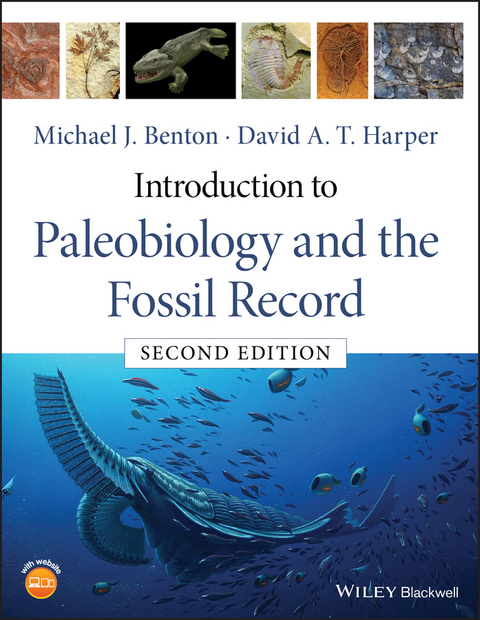
Introduction to Paleobiology and the Fossil Record (eBook)
John Wiley & Sons (Verlag)
978-1-119-27286-1 (ISBN)
This book presents a comprehensive overview of the science of the history of life. Paleobiologists bring many analytical tools to bear in interpreting the fossil record and the book introduces the latest techniques, from multivariate investigations of biogeography and biostratigraphy to engineering analysis of dinosaur skulls, and from homeobox genes to cladistics.
All the well-known fossil groups are included, including microfossils and invertebrates, but an important feature is the thorough coverage of plants, vertebrates and trace fossils together with discussion of the origins of both life and the metazoans. All key related subjects are introduced, such as systematics, ecology, evolution and development, stratigraphy and their roles in understanding where life came from and how it evolved and diversified.
Unique features of the book are the numerous case studies from current research that lead students to the primary literature, analytical and mathematical explanations and tools, together with associated problem sets and practical schedules for instructors and students.
New to this edition
- The text and figures have been updated throughout to reflect current opinion on all aspects
- New case studies illustrate the chapters, drawn from a broad distribution internationally
- Chapters on Macroevolution, Form and Function, Mass extinctions, Origin of Life, and Origin of Metazoans have been entirely rewritten to reflect substantial advances in these topics
- There is a new focus on careers in paleobiology
Michael J. Benton is Professor of Vertebrate Palaeontology at the University of Bristol. He is interested particularly in early reptiles, Triassic dinosaurs and macroevolution, and has published 50 books and over 400 scientific articles. He founded the Masters in Paleobiology degree at Bristol, which has now graduated over 400 students.
David A.T. Harper is a leading expert on fossil brachiopods, numerical methods in paleontology and Phanerozoic stratigraphy. He is Professor of Paleontology, and Principal of Van Mildert College in Durham University. He has published over 15 books and monographs, including a couple of influential textbooks, as well as over 300 scientific articles and, together with Øyvind Hammer, the widely-used software package PAST.
This book presents a comprehensive overview of the science of the history of life. Paleobiologists bring many analytical tools to bear in interpreting the fossil record and the book introduces the latest techniques, from multivariate investigations of biogeography and biostratigraphy to engineering analysis of dinosaur skulls, and from homeobox genes to cladistics. All the well-known fossil groups are included, including microfossils and invertebrates, but an important feature is the thorough coverage of plants, vertebrates and trace fossils together with discussion of the origins of both life and the metazoans. All key related subjects are introduced, such as systematics, ecology, evolution and development, stratigraphy and their roles in understanding where life came from and how it evolved and diversified. Unique features of the book are the numerous case studies from current research that lead students to the primary literature, analytical and mathematical explanations and tools, together with associated problem sets and practical schedules for instructors and students. New to this edition The text and figures have been updated throughout to reflect current opinion on all aspects New case studies illustrate the chapters, drawn from a broad distribution internationally Chapters on Macroevolution, Form and Function, Mass extinctions, Origin of Life, and Origin of Metazoans have been entirely rewritten to reflect substantial advances in these topics There is a new focus on careers in paleobiology
Michael J. Benton is Professor of Vertebrate Palaeontology at the University of Bristol. He is interested particularly in early reptiles, Triassic dinosaurs and macroevolution, and has published 50 books and over 400 scientific articles. He founded the Masters in Paleobiology degree at Bristol, which has now graduated over 400 students. David A.T. Harper is a leading expert on fossil brachiopods, numerical methods in paleontology and Phanerozoic stratigraphy. He is Professor of Paleontology, and Principal of Van Mildert College in Durham University. He has published over 15 books and monographs, including a couple of influential textbooks, as well as over 300 scientific articles and, together with Øyvind Hammer, the widely-used software package PAST.
Cover Page 1
Title Page 5
Copyright Page 6
Contents 7
Full contents 8
Preface 12
Acknowledgments 14
About the Companion website 15
Chapter 1 Paleontology as a science 17
Introduction 18
Paleontology in the modern world 18
Paleontology as a science 19
What is science? 19
Speculation, hypotheses, and testing 24
Fact and fantasy – where to draw the line? 25
Paleontology and the history of images 27
Steps to understanding 28
Earliest fossil finds 28
Fossils as magical stones 30
Fossils as fossils 30
The idea of extinction 31
The vastness of geological time 31
Fossils and evolution 32
Progressionism and evolution 32
Darwinian evolution 32
Paleontology today 33
Dinosaurs and fossil humans 33
Evidence of earliest life 34
Macroevolution 34
Paleontological research 35
Review Questions 39
Further reading 39
References 40
Chapter 2 Stratigraphy 41
Introduction 42
How stratigraphy works 42
Leonardo’s legacy 42
On the ground: lithostratigraphy 42
Use of fossils: discovery of biostratigraphy 44
Biostratigraphy: the means of correlation 44
Dividing up geological time: chronostratigraphy 49
Sequence stratigraphy: using transgressions and regressions 52
New techniques, new tools 56
Astrochronology and cyclostratigraphy: looking up to find the rhythm 56
Isotope stratigraphy: mixing the chemicals 60
Magnetostratigraphy: a useful attraction 60
Geological time scale: a common language 62
Geological time scales 62
Extraterrestrial stratigraphy 63
Fly me to the moon 63
Planets: remote but on the radar 63
Review Questions 64
Further Reading 64
References 65
Chapter 3 Paleogeography and paleoclimates 66
Paleobiogeography 66
How do we position plates? 67
Faunal and floral barriers 69
Island biogeography: alone and isolated? 71
Dispersal versus vicariance 71
The history of an ancient ocean 74
Biodiversity and geography 77
Provinces through time 77
Fossils in mountain belts 80
A Caledonian conundrum 81
Taking the strain and the heat 84
Paleoclimates 85
Climatic fluctuations through time 87
Biological feedbacks 91
The Anthropocene 92
Review Questions 93
Further Reading 93
References 93
Chapter 4 Paleoecology 96
Introduction 97
Taphonomic constraints: sifting through the debris 99
Populations: can groups of individuals make a difference? 101
Habitats and niches 102
Definitions 102
Trophic structures: bottom or top of the food chain? 104
Megaguilds 109
Controlling factors 109
Paleocommunities 111
Introduction 111
Describing fossil communities 112
Paleocommunity development through time 114
Ecological interactions 116
Evolutionary paleoecology 116
Communities and habitats through time 117
Jurassic park and deep-sea worlds 120
Ecological patterns and trends through time 120
Ecological ranking of mass extinctions 126
Review questions 128
Further reading 128
References 128
Chapter 5 Taphonomy and the quality of the fossil record 131
Introduction 132
Fossil preservation 132
Fossilization 132
Hard parts and soft parts 132
Decay and scavenging 133
Preservation of biomolecules 135
Exceptional preservation 135
Breakage and transport 136
Burial and modification 141
Plant preservation 142
Impact of taphonomy on understanding 145
Quality of the fossil record 146
Incompleteness of the record 146
Bias and adequacy 147
Preservation bias or common cause? 148
Sampling and reality 152
Review questions 153
Further reading 154
References 154
Chapter 6 Fossil form and function 156
Introduction 157
Growth and form 157
Variations in form within species 157
Allometry 159
Shape variation between species 162
Evolution and development 163
Ontogeny and phylogeny 163
Heterochrony: are human adults juvenile apes? 165
Developmental genes 166
Interpreting the function of fossils 168
Functional morphology 168
Comparison with modern analogs 171
Biomechanical modeling 172
Circumstantial evidence 176
Review questions 179
Further reading 180
References 180
Chapter 7 Macroevolution and the tree of life 181
Introduction 182
Evolution by natural selection 183
Evolution and the fossil record 186
What is a species? 186
Speciation 187
Speciation and evolution in the fossil record 189
Trends and radiations 195
Trends and progress 195
The Red Queen 195
Body size evolution 196
Adaptive radiation 197
Biotic replacements 198
The tree of life 200
Tree thinking 200
Cladistics: reconstructing life’s hierarchy 200
The molecular revolution 203
The tree of life 206
Review questions 207
Further reading 207
References 207
Chapter 8 Biodiversity, extinction, and mass extinction 209
Introduction 210
The diversification of life 211
Onward and upward 211
Interpreting global diversification patterns 214
Equilibrium or expansion? 215
Mass extinctions 218
Definition 218
Pattern and timing of mass extinctions 220
Selectivity and mass extinctions 222
The “big five” mass extinction events 223
The “big five” mass extinctions 223
The Permian-Triassic event 223
The Cretaceous-Paleogene event 228
Extinction then and now 231
Extinction events 231
Recovery after mass extinctions 232
Extinction today 233
Review questions 236
Further reading 236
References 237
Chapter 9 The origin of life 239
Introduction 240
The origin of life 240
Scientific models 240
Testing the biochemical model 242
RNA world 243
Evidence for the origin of life 244
The Early Precambrian world 244
The oldest life on Earth 245
The two-step rise in oxygen levels 249
The universal tree of life 251
Biomarkers 252
Life diversifies: eukaryotes 252
Eukaryote characters 252
Basal eukaryotes 256
Multicellularity and sex 256
The late Neoproterozoic 260
Review questions 261
Further reading 262
References 262
Chapter 10 Protists 264
Introduction 265
Microfossils 265
Protist history 266
Protozoa 268
Foraminifera 268
Radiolaria 270
Mystery protists of the proterozoic and paleozoic 276
Acritarchs 276
Chitinozoans 280
Phytoplankton 282
Dinoflagellates 283
Ciliophora 285
Coccolithophores 287
Diatoms 291
Review Questions 293
Further reading 293
References 293
Chapter 11 Origin and expansion of the metazoans 295
Origins and classification 296
Body fossil evidence 297
Trace fossil evidence 298
Embryo fossil evidence 298
Molecular evidence 298
Biomarker evidence 300
Invertebrate body and skeletal plans 300
Classification and relationships 303
Five key faunas 305
Ediacara biota 305
Small shelly fauna 310
Cambrian Explosion 314
Great Ordovician Biodiversification Event 315
The Nekton revolution: lift-off from the seabed 316
Review Questions 320
Further reading 320
References 320
Chapter 12 The basal metazoans: sponges and corals 322
Introduction 323
Porifera 323
Morphology: dissecting a typical sponge 323
Autecology: life as a sponge 325
Synecology: sponges and sponge reefs through time 329
Stromatoporoidea 330
Archaeocyatha 332
Cnidaria 338
Morphology: the basic cnidarian 339
Classification: design and relationships of the main groups 339
Corals 341
Synecology: corals and reefs 351
Corals through time 354
Modern coral reefs under threat 357
Review Questions 357
Further Reading 358
References 358
Chapter 13 Lophophorates 1: brachiopods and bryozoans 360
Introduction 361
Brachiopoda 361
Introduction 361
Morphology: brachiopod animal 362
Ultramorphology: brachiopod shell 367
Distribution in time: extinctions and radiations 368
Ecology: life on the seabed 370
Brachiopods, functional morphology, and paradigms 372
Distribution in space: biogeography 372
Bryozoa 376
Introduction 376
Morphology: Amathia 378
Ecology: feeding and colonial morphology 379
Evolution: main fossil bryozoan groups 379
Ecology and life modes 382
Competition and replacement 383
Review questions 385
Further reading 386
References 386
Chapter 14 Lophotrochozoans 2: mollusks and annelids 388
Mollusks 388
Introduction 389
Early mollusks 391
Class Bivalvia 396
Basic morphology 396
Main bivalve groups 397
Lifestyles and morphology 399
Bivalve evolution 399
Class Gastropoda 400
Main gastropod groups and their ecology 403
Gastropod evolution 405
Class Cephalopoda 406
Nautiloidea 407
Ammonoidea 408
Coleoidea 416
Class Scaphopoda 419
Class Rostroconcha 419
Evolutionary trends within the Mollusca 420
Annelids 422
Review questions 426
Further reading 426
References 426
Chapter 15 Ecdysozoa: arthropods 428
Introduction 429
Early arthropod faunas 429
Subphylum Trilobitomorpha (artiopoda) 432
Trilobite morphology 432
Trilobite diversity and lifestyles 437
Trilobite paleogeography and evolution 440
Trilobite abnormalities and injuries 443
Subphylum Chelicerata 444
Subphylum Myriapoda 446
Subphylum Hexapoda 446
Subphylum Crustacea 449
Barnacles, shrimps, and crabs 449
Ostracodes 452
Exceptional arthropod faunas through time 454
Review questions 458
Further reading 458
References 459
Chapter 16 Deuterostomes: echinoderms and hemichordates 461
Introduction 462
Echinoderms 462
Crinoidea 466
Blastozoans 470
Echinoidea 473
Asteroidea and Ophiuroidea 479
Carpoidea 483
Hemichordates 484
Modern hemichordates 485
Graptolites 486
Review questions 500
Further reading 500
References 500
Chapter 17 Fishes and basal tetrapods 502
Introduction 503
Origin of the vertebrates 503
The skeleton 503
Jawless fishes: slurping rather than biting 504
Conodonts: animals of mystery 504
Jaws and fish evolution 508
The first jaws 508
Bony fishes: ray fins and lobefins 510
The evolution of sharks: an arms race with their prey? 513
Tetrapods 514
The origin of tetrapods: fins to limbs 514
The amphibians: halfway land animals 514
Reign of the reptiles 519
Making the break: the origin of the reptiles 519
A world of synapsids 523
Dinosaurs and mammals 525
Review questions 526
Further reading 526
References 527
Chapter 18 Dinosaurs and mammals 528
Introduction 529
Dinosaurs and their kin 529
The diapsids take over 529
The age of dinosaurs 531
Being a monster 534
Dragons of the deep 536
Bird evolution 537
Rise of the mammals 538
Primitive forms, and then success 538
Marsupials: the pouched mammals 541
Paleogeography and diversification of the placentals 541
Placentals in southern continents 543
The “northern” placentals 543
The monkey-rabbits 546
The line to humans 546
Early primates 546
Human evolution 547
Modern peoples 548
Review questions 552
Further reading 552
References 553
Chapter 19 Fossil plants and fungi 554
Introduction 555
Terrestrialization of plants 555
Fungi 555
The greening of the land: mosses, liverworts, and hornworts 556
Relationships of green plants 557
Adapting to life on land 561
Plant reproductive cycles 562
Vascular plants in the Silurian and Devonian 563
The great coal forests 563
Lycopsids, small, and large 563
The horsetails 567
Ferns – fronds or leaves? 567
Seed-bearing plants 568
The origin of seeds 568
Seed ferns 573
Plant ecology of the Coal Measures 574
Conifers 576
Diverse gymnosperm groups 576
Flowering plants 578
Flowers and angiosperm success 578
The first angiosperms 579
Radiation of the angiosperms 580
Angiosperms and climate 583
Review questions 584
Further reading 584
References 584
Chapter 20 Trace fossils 586
Introduction 587
Understanding trace fossils 587
Types of trace fossils 587
Naming trace fossils: shapes not biological species 587
Preservation of trace fossils 590
Interpreting ancient behavior 592
Trace fossils in sediments 594
Trace fossils as environmental indicators 594
Organisms in sediments 598
Trace fossils and time 604
Trace fossils and the oil industry 606
Review questions 608
Further reading 608
References 608
Finale 610
Glossary 614
Appendix 1: Stratigraphic chart 633
Appendix 2: Paleogeographic maps 635
Index 636
EULA 659
| Erscheint lt. Verlag | 14.4.2020 |
|---|---|
| Sprache | englisch |
| Themenwelt | Geisteswissenschaften ► Archäologie |
| Geschichte ► Allgemeine Geschichte ► Vor- und Frühgeschichte | |
| Naturwissenschaften ► Geowissenschaften ► Geologie | |
| Naturwissenschaften ► Geowissenschaften ► Mineralogie / Paläontologie | |
| Technik | |
| Schlagworte | basal metazoans • Biowissenschaften • earth sciences • Evolution • evolutionary biology • Evolutionsbiologie • Expansion • extinction • Geowissenschaften • Life Sciences • origin • Paläontologie, Paläobiologie u. Geobiologie • Paleontology, Paleobiology & Geobiology • quality • Sponges • Tree |
| ISBN-10 | 1-119-27286-6 / 1119272866 |
| ISBN-13 | 978-1-119-27286-1 / 9781119272861 |
| Informationen gemäß Produktsicherheitsverordnung (GPSR) | |
| Haben Sie eine Frage zum Produkt? |
 PDF (Adobe DRM)
Kopierschutz: Adobe-DRM
Adobe-DRM ist ein Kopierschutz, der das eBook vor Mißbrauch schützen soll. Dabei wird das eBook bereits beim Download auf Ihre persönliche Adobe-ID autorisiert. Lesen können Sie das eBook dann nur auf den Geräten, welche ebenfalls auf Ihre Adobe-ID registriert sind.
Details zum Adobe-DRM
Dateiformat: PDF (Portable Document Format)
Mit einem festen Seitenlayout eignet sich die PDF besonders für Fachbücher mit Spalten, Tabellen und Abbildungen. Eine PDF kann auf fast allen Geräten angezeigt werden, ist aber für kleine Displays (Smartphone, eReader) nur eingeschränkt geeignet.
Systemvoraussetzungen:
PC/Mac: Mit einem PC oder Mac können Sie dieses eBook lesen. Sie benötigen eine
eReader: Dieses eBook kann mit (fast) allen eBook-Readern gelesen werden. Mit dem amazon-Kindle ist es aber nicht kompatibel.
Smartphone/Tablet: Egal ob Apple oder Android, dieses eBook können Sie lesen. Sie benötigen eine
Geräteliste und zusätzliche Hinweise
Buying eBooks from abroad
For tax law reasons we can sell eBooks just within Germany and Switzerland. Regrettably we cannot fulfill eBook-orders from other countries.
aus dem Bereich