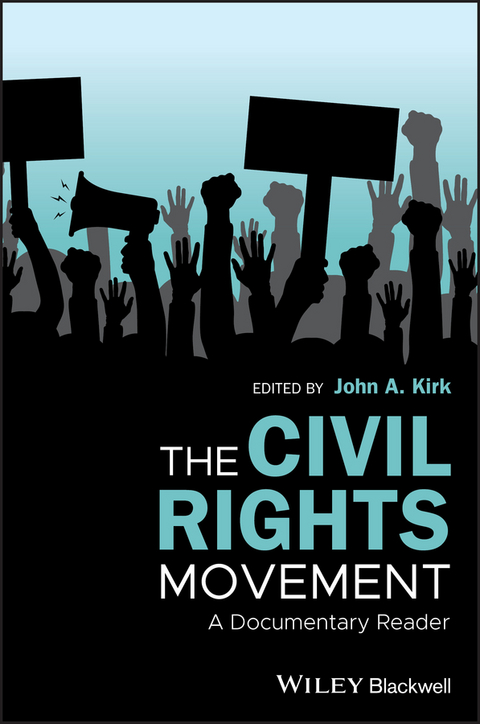
The Civil Rights Movement (eBook)
John Wiley & Sons (Verlag)
978-1-119-58362-2 (ISBN)
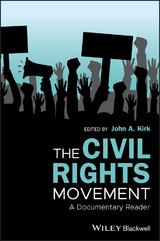
A new civil rights reader that integrates the primary source approach with the latest historiographical trends
Designed for use in a wide range of curricula, The Civil Rights Movement: A Documentary Reader presents an in-depth exploration of the multiple facets and layers of the movement, providing a wide range of primary sources, commentary, and perspectives. Focusing on documents, this volume offers students concise yet comprehensive analysis of the civil rights movement by covering both well-known and relatively unfamiliar texts. Through these, students will develop a sophisticated, nuanced understanding of the origins of the movement, its pivotal years during the 1950s and 1960s, and its legacy that extends to the present day.
Part of the Uncovering the Past series on American history, this documentary reader enables students to critically engage with primary sources that highlight the important themes, issues, and figures of the movement. The text offers a unique dual approach to the subject, addressing the opinions and actions of the federal government and national civil rights organizations, as well as the views and struggles of civil rights activists at the local level. An engaging and thought-provoking introduction to the subject, this volume:
- Explores the civil rights movement and the African American experience within their wider political, economic, legal, social, and cultural contexts
- Renews and expands the primary source approach to the civil rights movement
- Incorporates the latest historiographical trends including the 'long' civil rights movement and intersectional issues
- Offers authoritative commentary which places the material in appropriate context
- Presents clear, accessible writing and a coherent chronological framework
Written by one of the leading experts in the field, The Civil Rights Movement: A Documentary Reader is an ideal resource for courses on the subject, as well as classes on race and ethnicity, the 1960s, African American history, the Black Power and economic justice movements, and many other related areas of study.
Dr. John A. Kirk is the George W. Donaghey Distinguished Professor of History and Director of the Joel E. Anderson Institute on Race and Ethnicity at the University of Arkansas at Little Rock, USA. He was previously a Professor of US History at Royal Holloway, University of London, UK, and is author and editor of several books including the award-winning Redefining the Color Line: Black Activism in Little Rock, Arkansas, 1940-1970.
Dr. John A. Kirk is the George W. Donaghey Distinguished Professor of History and Director of the Joel E. Anderson Institute on Race and Ethnicity at the University of Arkansas at Little Rock, USA. He was previously a Professor of US History at Royal Holloway, University of London, UK, and is author and editor of several books including the award-winning Redefining the Color Line: Black Activism in Little Rock, Arkansas, 1940-1970.
Introduction
What is the civil rights movement? To those historians who first asked that question, the answer was relatively straightforward: Martin Luther King, Jr was the civil rights movement and the civil rights movement was Martin Luther King, Jr. Early histories of the civil rights movement were therefore biographies of its talismanic figurehead that focused on his activism during the 1950s and 1960s. Starting in the year of his death in 1968, for two decades King cast a long shadow over the civil rights movement’s history. This King‐centered period of attention crested in the mid‐1980s. In 1983, President Ronald Reagan signed into law a Martin Luther King, Jr national holiday, celebrated on the third Monday in January each year. The first observance of the holiday was in 1986. King was the first black American to be honored in this way and the recognition, which followed a concerted grassroots campaign to exert political pressure to achieve it, cemented his position in American historical folklore. Around the same time, the publication of three landmark books provided an exhaustive chronicling of King’s life and the organization he led, the Southern Christian Leadership Conference (SCLC): David J. Garrow, Bearing the Cross: Martin Luther King, Jr and the Southern Christian Leadership Conference (William Morrow, 1986), Adam Fairclough, To Redeem the Soul of America: The Southern Christian Leadership Conference and Martin Luther King, Jr (University of Georgia Press, 1987), and Taylor Branch, Parting the Waters: Martin Luther King and the Civil Rights Movement, 1954–63 (Simon and Schuster, 1988). Branch subsequently wrote another two hefty volumes: Pillar of Fire: America in the King Years, 1963–65 (Simon and Schuster, 1998) and At Canaan’s Edge: America in the King Years, 1965–1968 (Simon and Schuster, 2006). The books written by Garrow, Fairclough, and Branch remain among the defining works written about King and his movement leadership. Garrow’s book and Branch’s first book both won Pulitzer Prizes. The television series Eyes on the Prize: America’s Civil Rights Years 1954–1965, created and executive produced by Henry Hampton at the film company Blackside, Inc., first aired in 1987. The series is still considered one of the best multipart documentaries about the civil rights movement. Although not quite as intently focused on King’s leadership, and incorporating a wider array of movement voices, nevertheless the chronology of the series identified the years in which King was prominent as being the movement’s halcyon days.
The initial King‐centered focus in telling the story of the civil rights movement established narrative conventions that still profoundly shape popular conceptions of civil rights history today. The concentration on one individual leader has created the impression of a “top‐down” movement in which a few, namely King and other national civil rights leaders, influenced and led the many rank and file participants. King’s interaction with presidents and other prominent national political leaders reinforced the notion that the civil rights movement’s focus was exclusively about winning national legislation and changing laws. In this rendition, King’s life and death frame the chronology of the movement. King rose to prominence through his local leadership in the Montgomery, Alabama bus boycott from 1955 to 1956 and died from an assassin’s bullet in Memphis, Tennessee in 1968. Indeed, many early accounts created an even shorter “Montgomery to Selma” movement narrative, beginning with King’s bus boycott leadership and ending with the passage of the Civil Rights Act of 1964 and the Voting Rights Act of 1965, the latter in part a result of King’s and the SCLC’s campaign for the vote in Selma, Alabama. It was this timeframe that the first series of Eyes on the Prize adopted. The books by Garrow, Fairclough, and Branch did extend the “Montgomery to Selma” narrative to a “Montgomery to Memphis” narrative covering the entire length of King’s life. In doing so, they began to draw attention to the more complex challenges in addressing structural and institutional racism that King and the movement faced after 1965, which did not fit quite as comfortably with the more triumphalist “Montgomery to Selma” narrative that ended with the successful passage of civil rights legislation.
Beginning in earnest in the 1980s, a second wave of civil rights studies emerged that challenged many of the basic assumptions found in King‐centered studies. These new studies were rooted in community‐based approaches to the civil rights movement from a “bottom‐up” perspective that viewed events mainly through the lens of local and state level activists. Initially, many of these studies focused on communities that were national flashpoints in the “Montgomery to Memphis” narrative and relocated those nationally known events within the context of local and state struggles. As the number of community studies proliferated, they gradually moved beyond the familiar locales of civil rights activism and explored an extensive and expansive story of black struggles for freedom and equality nationwide. Collectively, these community studies have reshaped our understanding of the civil rights movement, and the locus of civil rights studies has increasingly moved away from national legislation, and national figures and organizations, to local concerns, local leadership, and community organizations and institutions. Community studies revealed that although sometimes there were overlapping agendas between national and local activists, at other times they were quite different from one another, and sometimes even directly at odds with each other. The move to examine communities beyond those that King and the SCLC engaged with in the 1950s and 1960s signaled the vibrancy and extent of local civil rights organizing that stretched well beyond King, the SCLC, and their immediate orbit of influence. They chimed with the claim of movement activist Ella Baker that “The movement made Martin rather than Martin making the movement.” Community studies also suggested that civil rights activism had a much longer history than an exclusive focus on the national picture in the 1950s and 1960s revealed. Viewed from the “bottom‐up,” civil rights struggles appeared to both predate and outlast the established King‐centered movement chronology by decades.
The questions about when the civil rights movement began and when it ended have been a major source of debate. In the mid‐1980s, at the height of King‐centered studies, historian Clayborne Carson insisted that the civil rights movement should be reimagined as part of a longer and continuing “black freedom struggle” driven by activists at a local level. Almost 20 years later, Jacquelyn Dowd Hall argued that the black freedom struggle was part of a “long” civil rights movement, with its roots in the “liberal and radical milieu of the late 1930s.” At the same time, Hall rejected the well‐worn “declension narrative” about the movement’s demise in the late 1960s and early 1970s, instead claiming that the movement’s legacies continue down to the present day, as do those of the successive white “backlash” resistance movements that opposed it. In a provocative rejoinder, on the face of it Peniel Joseph essentially agreed with many of the points that Hall made: he too called for a longer movement chronology, an engagement with the uses and abuses of black freedom struggle history, and a more involved and nuanced discussion about movement legacies. However, Joseph, at the forefront of the emergent field of “Black Power Studies,” more fundamentally maintained that these issues should be explored not within the framework of a “long” civil rights movement, but rather within the framework of a “long” black power movement, giving primacy to the black power movement rather than to the civil rights movement as the most authentic expression of a longer black freedom struggle. Very much in line with these developments, in 1990 Henry Hampton and Blackside, Inc. produced Eyes on the Prize II: America at the Racial Crossroads 1965–1985 that extended the narrative arc of the first series.
Meanwhile, despite the ascendency of the longue durée approach in civil rights studies, there have been plenty of observers sounding notes of caution about dispensing quite so quickly with what movement activist Bayard Rustin called the “classical” phase of the civil rights movement in the 1950s and 1960s (for this usage, see Rustin’s essay “From Protest to Politics” in Chapter 10). Civil rights activist Hugh Murray has been among the bluntest of these voices complaining, “The people who were involved in the movement in the 1950s and 1960s called it the civil rights movement. Historians in pipe‐smoked rooms ought not to try to rename it.” A number of historians have articulated their own particular reservations. Richard H. King, whose work has explored the distinct meanings of freedom that emerged during the classical civil rights movement, warns that, “the freshness, even inexplicability, of the movement should not be underplayed for the sake of historical pedigree.” Adam Fairclough, whose work embodies the shifts that have taken place in civil rights studies, with his first major study one...
| Erscheint lt. Verlag | 3.4.2020 |
|---|---|
| Reihe/Serie | Uncovering the Past: Documentary Readers in American History |
| Uncovering the Past: Documentary Readers in American History | Uncovering the Past: Documentary Readers in American History |
| Sprache | englisch |
| Themenwelt | Geisteswissenschaften ► Geschichte ► Allgemeine Geschichte |
| Geisteswissenschaften ► Geschichte ► Regional- / Ländergeschichte | |
| Schlagworte | 20th Century America • African American history</p> • Amerika im 20. Jahrhundert • civil rights movement documents • civil rights movement historiography • civil rights movement history • civil rights movement reader • civil rights movement textbook • Ethnic & Immigration History • Ethnische Geschichte u. Einwanderungsgeschichte der USA • Geschichte • History • <p>civil rights movement • Regional American History • Regionalgeschichte Amerikas • US civil rights history |
| ISBN-10 | 1-119-58362-4 / 1119583624 |
| ISBN-13 | 978-1-119-58362-2 / 9781119583622 |
| Informationen gemäß Produktsicherheitsverordnung (GPSR) | |
| Haben Sie eine Frage zum Produkt? |
 EPUB (Adobe DRM)
Kopierschutz: Adobe-DRM
Adobe-DRM ist ein Kopierschutz, der das eBook vor Mißbrauch schützen soll. Dabei wird das eBook bereits beim Download auf Ihre persönliche Adobe-ID autorisiert. Lesen können Sie das eBook dann nur auf den Geräten, welche ebenfalls auf Ihre Adobe-ID registriert sind.
Details zum Adobe-DRM
Dateiformat: EPUB (Electronic Publication)
EPUB ist ein offener Standard für eBooks und eignet sich besonders zur Darstellung von Belletristik und Sachbüchern. Der Fließtext wird dynamisch an die Display- und Schriftgröße angepasst. Auch für mobile Lesegeräte ist EPUB daher gut geeignet.
Systemvoraussetzungen:
PC/Mac: Mit einem PC oder Mac können Sie dieses eBook lesen. Sie benötigen eine
eReader: Dieses eBook kann mit (fast) allen eBook-Readern gelesen werden. Mit dem amazon-Kindle ist es aber nicht kompatibel.
Smartphone/Tablet: Egal ob Apple oder Android, dieses eBook können Sie lesen. Sie benötigen eine
Geräteliste und zusätzliche Hinweise
Buying eBooks from abroad
For tax law reasons we can sell eBooks just within Germany and Switzerland. Regrettably we cannot fulfill eBook-orders from other countries.
aus dem Bereich