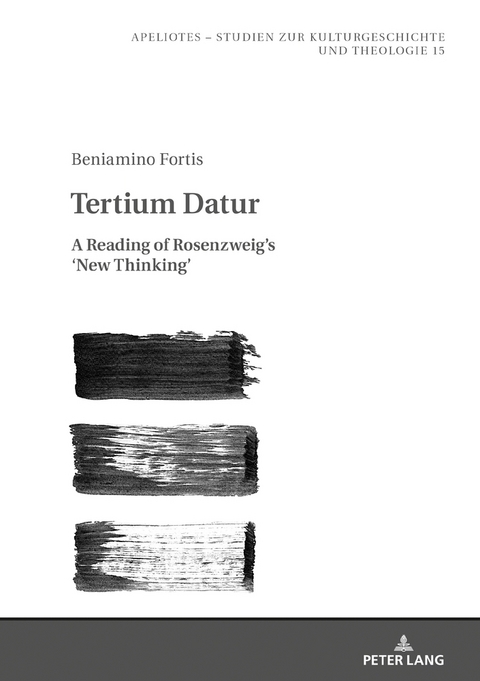
Tertium Datur
Peter Lang Gmbh, Internationaler Verlag Der Wissenschaften
978-3-631-80874-0 (ISBN)
The Homeric metaphor of Scylla and Charybdis provides the general guidelines Rosenzweig seems to stick to in developing his 'new thinking.' Not only does it avoid the dangers of idealism and irrationalism charting a third way between them, but it also takes shape as a combination of philosophy and Jewish thought - a combination irreducible to each of its terms, and thus representing a tertium datur beyond them.
Beniamino Fortis holds a PhD in Philosophy. He studied in Venice, Florence, and Berlin. His research interests are in picture theory, aesthetics, and contemporary Jewish thought. As a postdoctoral fellow he is currently leading a research group on the topic " Bilderverbot and art theory".
lt;p>Introduction ......................................................................................................... 11
Three Spheres. Three Epochs. Three Ways .............................................. 17
Antiquity ............................................................................................................... 18
Middle Ages ......................................................................................................... 19
Modernity ............................................................................................................. 20
Reduction ............................................................................................................. 22
Three Ways ........................................................................................................... 25
The First Way: Hegel ......................................................................................... 29
Two Attitudes of Thought .................................................................................. 30
Hegel's Attitude of Thought ................................................................................ 33
The Three Spheres in Hegel's Philosophy ......................................................... 35
The Divine ....................................................................................................... 36
The Natural-Worldly ...................................................................................... 38
The Human ...................................................................................................... 39
Hegel and Rosenzweig ........................................................................................ 41
The Second Way: Nietzsche ........................................................................... 47
Nietzsche's Irrationalism for Rosenzweig ......................................................... 49
Against Values and Hierarchies ......................................................................... 50
Nietzsche and Hegel ............................................................................................ 54
The Three Spheres in Nietzsche's Philosophy .................................................. 57
The Divine ....................................................................................................... 58
The Natural-Worldly ...................................................................................... 60
The Human ...................................................................................................... 61
Nietzsche and Rosenzweig ................................................................................. 62
The Third Way: Rosenzweig .......................................................................... 69
Rosenzweig Versus Idealism I: Elements ......................................................... 70
Beyond the Human ........................................................................................ 71
Beyond the Natural-Worldly ......................................................................... 74
Beyond the Divine .......................................................................................... 75
Rosenzweig Versus Idealism II: Nothingness and Irrationality .................... 77
Nothingness ..................................................................................................... 78
Irrationality ...................................................................................................... 81
Rosenzweig Versus Irrationalism ...................................................................... 83
Trendelenburg ................................................................................................. 84
Kierkegaard ..................................................................................................... 87
Nietzsche .......................................................................................................... 90
Truth as Relation ................................................................................................. 92
Ex Negativo ..................................................................................................... 93
Ex Positivo ....................................................................................................... 95
Theory and Praxis .............................................................................................. 100
The Three Spheres in Rosenzweig's 'New Thinking' ......................... 103
The Divine .......................................................................................................... 104
The Natural-Worldly ......................................................................................... 110
The Human ......................................................................................................... 117
Between and Beyond Hegel and Nietzsche .................................................... 135
The Three Paths in Rosenzweig's 'New Thinking' .............................. 139
Explicit References and Implicit Analogies ................................................... 141
'Quod sit' and 'Quid sit' in Der Stern der Erlosung ....................................... 149
Between God and World: The Path of Creation ............................................ 154
The Creator: Divine Power .......................................................................... 155
The Creature: Worldly Existence ................................................................ 158
Rosenzweig Versus Hegel: Creation Versus Production ......................... 161
Rosenzweig Versus Nietzsche: Creation Versus Eternal Return ............ 165
A Keyword for Creation: 'Relational Otherness' ...................................... 168
Between God and Human Being: The Path of Revelation ........................... 170
The Revealer: Divine Love ........................................................................... 171
The Recipient of Revelation: Human Humility ........................................ 174
Revelation as Cornerstone of Reality ......................................................... 177
Rosenzweig Versus Hegel: Revelation Versus Dialectical Logic ............. 178
Rosenzweig Versus Nietzsche: Revelation Versus Disconnection ......... 182
A Keyword for Revelation: 'Event' .............................................................. 184
Between Human Being and World: The Path of Redemption ..................... 186
The Agent of Redemption: Human Neighbor-Love ................................. 188
The Context of Redemption: Worldly Life ................................................ 191
Redemption: Communality and Eternity .................................................. 194
Rosenzweig Versus Hegel: Redemptive Praxis Versus
Self-Reflection and Theory ................................................................ 196
Rosenzweig Versus Nietzsche: Redemptive Praxis Versus
Gift-Giving Virtue .............................................................................. 201
A Keyword for Redemption: 'Oriented Praxis' ......................................... 203
Beyond Philosophy: The 'New Thinking' as Jewish .......................... 207
Creation: Relational Otherness - Bereshit 1 .................................................. 212
Revelation: Event - Shir ha-Shirim ................................................................. 215
Redemption: Oriented Praxis - Psalm 115 and Tiqqun ............................... 217
Final Remarks .................................................................................................... 221
A Third Way between Idealism and Irrationalism ........................................ 221
A Third Way between Philosophy and Jewish Thought ............................... 227
'Otherness' in Philosophy and in Jewish Thought .................................... 228
'Event' in Philosophy and in Jewish Thought ........................................... 230
Praxis' in Philosophy and in Jewish Thought ........................................... 232
Conclusion ......................................................................................................... 236
Bibliography ....................................................................................................... 239
| Erscheinungsdatum | 23.03.2020 |
|---|---|
| Reihe/Serie | Apeliotes. Studien zur Kulturgeschichte und Theologie ; 15 |
| Verlagsort | Berlin |
| Sprache | englisch |
| Maße | 148 x 210 mm |
| Gewicht | 404 g |
| Themenwelt | Geisteswissenschaften ► Philosophie ► Philosophie des Mittelalters |
| Geisteswissenschaften ► Religion / Theologie ► Judentum | |
| Schlagworte | Beniamino • datur • fortis • Hegel (Hegelianism) • idealism • Irrationalism • Jewish philosophy • Jewish thought • Kampling • 'New • ‘New • Nietzsche (Nietzscheanism) • Philosophy • Rainer • Reading • Rosenzweig's • Rosenzweig’s • Tertium • thinking’ • Thinking' |
| ISBN-10 | 3-631-80874-7 / 3631808747 |
| ISBN-13 | 978-3-631-80874-0 / 9783631808740 |
| Zustand | Neuware |
| Informationen gemäß Produktsicherheitsverordnung (GPSR) | |
| Haben Sie eine Frage zum Produkt? |
aus dem Bereich