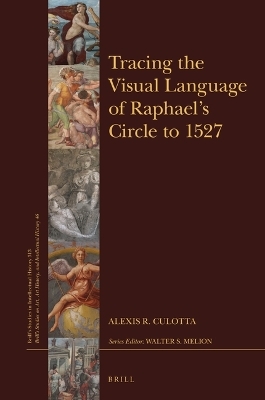
Tracing the Visual Language of Raphael’s Circle to 1527
Brill (Verlag)
978-90-04-43014-3 (ISBN)
In Tracing the Visual Language of Raphael’s Circle to 1527, Alexis Culotta examines how the Renaissance master’s style – one infused with borrowed visual quotations from other artists both past and present – proved influential in his relationship with associate Baldassare Peruzzi and in the development of the artists within his thriving workshop.
Shedding new light on the important, yet often-overshadowed, figures within this network, this book calls upon key case studies to convincingly illustrate how this visual language and its recombination evolved during Raphael’s Roman career and subsequently served as a springboard for artistic innovation for these close associates as they collaborated in the years following Raphael’s death.
Alexis R. Culotta, Ph.D. (2014), University of Washington, is a lecturer at the School of the Art Institute of Chicago. Other publications on Raphael’s circle include her recent chapter in Breaking with Convention in Italian Visual Culture (Cambridge Scholars Publishing, 2017).
Acknowledgments
List of Illustrations
Introduction
1 Reclaiming Raphael’s Workshop
2 Mechanics of a Visual Language: Imitation/Emulation/Repetition/Recombination
3 Recombination in Light of Competition and Collaboration
4 Revisiting Recombination within the Workshop
5 Continuing the Conversation
1 Origins of a Visual Language
1 The Prevalent Language of the Classical
2 The Visual Language of the Papacy
3 The Visual Language of Raphael
4 The Language of Recombination in the Stanza della Segnatura
2 Visual Language through the Lens of Competition at the Villa Farnesina
1 Commissions from Agostino Chigi
2 Raphael, Sebastiano, and Competition
3 Collaborative Practice and Emerging Workshop Mentalities
1 Partnering with Peruzzi
2 Raphael’s Workshop Takes Form
3 The Capstone of Chigi’s Villa
4 Revisiting the “Raphael Rooms”
5 The Stanza dell’Incendio
6 The Vatican Loggie
7 Sala di Costantino
8 Beyond the Vatican
4 Giovanni da Udine, Perino del Vaga, and Polidoro da Caravaggio, at the Palazzo Baldassini
1 Melchiorre Baldassini (1470–1522)
2 Sangallo’s Designs
3 Giovanni da Udine and the Quotation of Antiquity
4 Perino del Vaga, Polidoro da Caravaggio, and the Piano Nobile
5 Giulio Romano, Gianfrancesco Penni, and Polidoro da Caravaggio at the Villa Lante al Gianicolo
1 Baldassarre Turini (1486–1543)
2 A Challenge of Attribution and Dating
3 Giulio’s Designs
4 The Lateral Sale
5 The Grand Salone
6 Polidoro da Caravaggio and Maturino da Firenze from the Frescoed Facade to the Fetti Chapel
1 Fra Mariano Fetti (d. 1531)
2 A Complicated History
3 Peruzzi, Polidoro, and Painted Illusion
4 Illusions of Landscape in the Fetti Chapel
7 Santa Maria Della Pace and a Pastiche by Peruzzi
1 Filippo Sergardi (1466–1541)
2 A Pastiche of Figures
3 A Pastiche of Architecture
Epilogue
Bibliography
Index
| Erscheinungsdatum | 06.07.2020 |
|---|---|
| Reihe/Serie | Brill's Studies on Art, Art History, and Intellectual History ; 313/46 |
| Verlagsort | Leiden |
| Sprache | englisch |
| Maße | 155 x 235 mm |
| Gewicht | 567 g |
| Themenwelt | Kunst / Musik / Theater ► Kunstgeschichte / Kunststile |
| Geisteswissenschaften ► Sprach- / Literaturwissenschaft ► Anglistik / Amerikanistik | |
| Geisteswissenschaften ► Sprach- / Literaturwissenschaft ► Literaturwissenschaft | |
| Technik ► Architektur | |
| ISBN-10 | 90-04-43014-8 / 9004430148 |
| ISBN-13 | 978-90-04-43014-3 / 9789004430143 |
| Zustand | Neuware |
| Informationen gemäß Produktsicherheitsverordnung (GPSR) | |
| Haben Sie eine Frage zum Produkt? |
aus dem Bereich