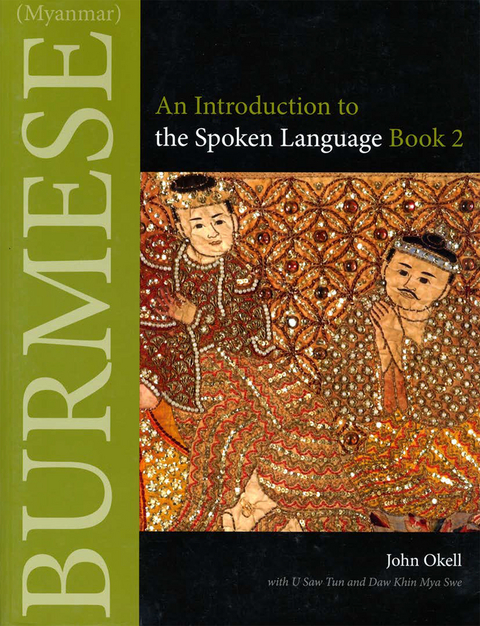
Burmese (Myanmar) (eBook)
302 Seiten
Northern Illinois University Press (Verlag)
978-1-60909-219-1 (ISBN)
Burmese has two styles of speaking and writing: the colloquial style, which is used for talking to friends and for writing letters, and the literary style, which is used in more formal contexts, such as academic articles, newspaper reports, and narrative passages in fiction. This volume, the final book in a four-part Burmese language course, introduces learners to the literary style. It assumes a prior knowledge of Burmese script and a grounding in the colloquial style. Okell starts with simple sentences, and, over a series of short lessons, gradually increases the range of vocabulary and the level of complexity. The texts Okell uses for study are excerpts from Burmese children's schoolbooks highlighting themes of home- and school-life and Burmese nationalism and independence. Each passage is accompanied by a full translation and is followed by a set of exercises designed to familiarize the reader with the new vocabulary and sentence structures. Accompanying audio files allow students to hear the texts read aloud. Language professors and their students, or those learning Burmese on their own, will appreciate the accessible approach and the manageable size of the lessons of the very practical textbooks in this series.
The first volume in a four-part language course, this textbook enables students to start speaking and understanding the spoken language. In the early sections the focus is on familiarizing the learner with the unfamiliar sounds of the language and the structures of Burmese sentences. After this foundation the emphasis changes to acquiring the words and phrases needed for early encounters with Burmese speakers in Burma and elsewhere in the world. Numerous speaking exercises and practice dialogues feature travel topics such as asking for directions, taking taxis, and ordering food and drink, and common conversational topics such as introductions, family, and work. Because Burmese script can be challenging, Okell offers Roman transcription alongside the Burmese script for Burmese material throughout the text. Like the other titles in this series, Book 1 is accompanied by audio files and can be used either under the instruction of a teacher or for self-study. The series was developed over a period of several years and was tested, modified, and expanded after use in the classroom. Language professors and their students, or those learning Burmese on their own, will appreciate the accessible approach and the manageable size of the lessons of the very practical textbooks in this series.
The second volume in a four-part language course, this textbook builds on the spoken language lessons from Book 1 and contains more advanced speaking exercises and practice dialogues, as well as activities to reinforce the material presented in Book 1. The material of Book 2 is arranged in five levels, each of which covers the same set of topics, but each succeeding level both consolidates and extends the learner's proficiency in the topic. The lessons are followed by appendices on etiquette and social behavior in Burma and an outline of Burmese grammar. Okell also presents more extensive vocabulary lists, both Burmese-English and English-Burmese, which are arranged by topic and include such categories as names of clothes, foods, and talking with Buddhist monks. Like the other titles in this series, Book 2 is accompanied by audio files and can be used either under the instruction of a teacher or for self-study. The series was developed over a period of several years and was tested, modified, and expanded after use in the classroom. Language professors and their students, or those learning Burmese on their own, will appreciate the accessible approach and the manageable size of the lessons of the very practical textbooks in this series.
The third volume in a four-part language course, this textbook enables students to become competent in reading and writing Burmese script. Most students find it helpful to begin learning the script at the same time they start on the spoken language, but this volume can be used independently if preferred. In addition to lists of words for reading and writing practice, presented in a series of short graduated lessons, Okell includes sample texts from Burmese materials such as product labels, newspaper headlines, and maps. Appendices on handwriting and cursive forms, display fonts, the Burmese names of the characters, Burmese alphabetical order, and common abbreviations round out the book. One of the challenges of learning a non-Roman script language from traditional course books is that the use of the Rroman alphabet to describe sounds is not as effective as hearing the sounds. The extensive audio files that accompany this volume allow the learner to hear and produce the sounds corresponding to the symbols. Language professors and their students, or those learning Burmese on their own, will appreciate the accessible approach and the manageable size of the lessons of the very practical textbooks in this series.
John Okell, now retired, was for many years Lecturer in Burmese at the School of Oriental and African Studies (SOAS), University of London. He is the author of First Steps in Burmese and A Reference Grammar of Colloquial Burmese and coauthor of Burmese/Myanmar. He continues to teach short courses in Thailand, in Burma, in Spain, in the USA, and at SOAS.
| Erscheint lt. Verlag | 10.5.2016 |
|---|---|
| Co-Autor | U Saw Tun, Daw Khin Mya Swe |
| Verlagsort | Ithaca |
| Sprache | englisch |
| Maße | 220 x 220 mm |
| Themenwelt | Schulbuch / Wörterbuch ► Lektüren / Interpretationen |
| Schulbuch / Wörterbuch ► Wörterbuch / Fremdsprachen | |
| Geisteswissenschaften ► Sprach- / Literaturwissenschaft ► Sprachwissenschaft | |
| Schlagworte | Burmese spoken language, structures of Burmese sentences, Burmese language acquisition, Burmese script, Burmese grammar, colloquial Burmese |
| ISBN-10 | 1-60909-219-8 / 1609092198 |
| ISBN-13 | 978-1-60909-219-1 / 9781609092191 |
| Informationen gemäß Produktsicherheitsverordnung (GPSR) | |
| Haben Sie eine Frage zum Produkt? |
 PDF (Adobe DRM)
Kopierschutz: Adobe-DRM
Adobe-DRM ist ein Kopierschutz, der das eBook vor Mißbrauch schützen soll. Dabei wird das eBook bereits beim Download auf Ihre persönliche Adobe-ID autorisiert. Lesen können Sie das eBook dann nur auf den Geräten, welche ebenfalls auf Ihre Adobe-ID registriert sind.
Details zum Adobe-DRM
Dateiformat: PDF (Portable Document Format)
Mit einem festen Seitenlayout eignet sich die PDF besonders für Fachbücher mit Spalten, Tabellen und Abbildungen. Eine PDF kann auf fast allen Geräten angezeigt werden, ist aber für kleine Displays (Smartphone, eReader) nur eingeschränkt geeignet.
Systemvoraussetzungen:
PC/Mac: Mit einem PC oder Mac können Sie dieses eBook lesen. Sie benötigen eine
eReader: Dieses eBook kann mit (fast) allen eBook-Readern gelesen werden. Mit dem amazon-Kindle ist es aber nicht kompatibel.
Smartphone/Tablet: Egal ob Apple oder Android, dieses eBook können Sie lesen. Sie benötigen eine
Geräteliste und zusätzliche Hinweise
Buying eBooks from abroad
For tax law reasons we can sell eBooks just within Germany and Switzerland. Regrettably we cannot fulfill eBook-orders from other countries.
aus dem Bereich