


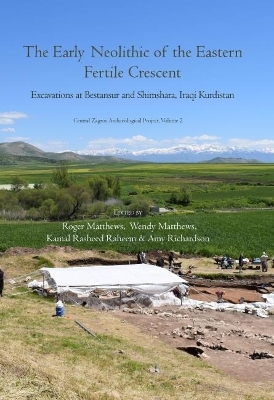
The Early Neolithic of the Eastern Fertile Crescent
Oxbow Books (Verlag)
978-1-78925-526-3 (ISBN)
The Eastern Fertile Crescent region of western Iran and eastern Iraq hosted major developments in the transition from hunter-forager to farmer-herder lifestyles through the Early Neolithic period, 10,000-7000 BC. Within the scope of the Central Zagros Archaeological Project, excavations have been conducted since 2012 at two Early Neolithic sites in the Kurdistan region of Iraq: Bestansur and Shimshara. Bestansur represents an early stage in the transition to sedentary, farming life, where the inhabitants pursued a mixed strategy of hunting, foraging, herding and cultivating, maximising the new opportunities afforded by the warmer, wetter climate of the Early Holocene. They also constructed substantial buildings of mudbrick, including a major building with a minimum of 65 human individuals, mainly infants, buried under its floor in association with hundreds of beads. These human remains provide new insights into mortuary practices, demography, diet and disease during the early stages of sedentarisation. The material culture of Bestansur and Shimshara is rich in imported items such as obsidian, carnelian and sea-shells, indicating the extent to which Early Neolithic communities were networked across the Eastern Fertile Crescent and beyond. This volume includes final reports by a large-scale interdisciplinary team on all aspects of the results from excavations at Bestansur and Shimshara, through application of state-of-the-art scientific techniques, methods and analyses. The net result is to re-emphasise the enormous significance of the Eastern Fertile Crescent in one of the most important episodes in human history: the Neolithic transition.
Roger Matthews is Professor of Near Eastern Archaeology at the University of Reading and Co-Director of the Central Zagros Archaeological Project (CZAP). He is President of RASHID International, an organisation concerned to protect and promote the cultural heritage of Iraq. He has directed excavations and surveys in Iraq, Iran, Syria and Turkey, and has published many books and articles on the archaeology of the Middle East with a focus on the Neolithic and the Bronze Age Wendy Matthews is Associate Professor in Archaeology at the University of Reading. She completed her PhD and was a Research Associate and Fellow at the University of Cambridge 1992-2000. She is Co-Director of the Central Zagros Archaeological Project. Her interdisciplinary research interests are in the built environment and sustainability from the origins of agriculture to today. Kamal Rasheed Raheem is Director of Sulaimaniyah Antiquities Directorate in the Kurdistan Regional Government of Iraq. He studied Archaeology at the University of Baghdad and under his supervision Sulaimaniyah Antiquities Directorate supports a broad spectrum of international, collaborative archaeological and heritage projects across Sulaimaniyah province Amy Richardson is a Senior Researcher at the University of Reading, where she completed her PhD in 2010. Between 2011 and 2014, Amy was CZAP Project Manager, before spending three years as the Wainwright Fellow at the University of Oxford. Her research examines prehistoric material networks through the analysis of clay and stone artefacts, with a focus on knowledge exchange and social organisation.
Contributors
Preface and acknowledgements
1. The Neolithic transition in the Eastern Fertile Crescent: project themes, aims and objectives
Roger Matthews, Wendy Matthews, Amy Richardson and Kamal Rasheed Raheem
2. Excavation, recording, and sampling methodologies
Amy Richardson, Roger Matthews and Wendy Matthews
3. Palaeoclimate and environment of the Iraqi Central Zagros
Matt Bosomworth, Dominik Fleitmann and Maria Rabbani
4. Intensive field survey in the Zarzi Region
Roger Matthews, Wendy Matthews, Amy Richardson and Kamal Raeuf Aziz
5. Fluxgate gradiometry survey at Bestansur
David Thornley
6. Geoarchaeological borehole, sediment and microfossil analyses at Bestansur
Chris Green, Rob Batchelor, Maria Rabbani, Alessandro Guaggenti and Wendy Matthews
7. Ethnoarchaeological research in Bestansur: insights into vegetation, land-use, animals and animal dung
Sarah Elliott, Robin Bendrey, Jade Whitlam and Kamal Raeuf Aziz
8. Conservation
Jessica S. Johnson
9. Excavations and contextual analyses: Bestansur
Amy Richardson, Roger Matthews, Wendy Matthews, Sam Walsh, Kamal Raeuf Aziz and Adam Stone
10. Excavations and contextual analyses: Shimshara
Wendy Matthews, Roger Matthews, Kamal Raeuf Aziz and Amy Richardson
11. Radiocarbon dating of Bestansur and shimshara
Pascal Flohr, Roger Matthews, Wendy Matthews, Amy Richardson and Dominik Fleitmann
12. Sustainability of early sedentary agricultural communities: new insights from high-resolution microstratigraphic and micromorphological analyses
Wendy Matthews
13.integrated micro-analysis of the built environment and resource use: high-resolution microscopy and geochemical, mineralogical and biomolecular approaches
Wendy Matthews, Aroa Garcia-Suarez, Marta Portillo, Chris Speed, Georgia Allistone, Ian Bull, Jessica Godleman and Matthew Almond
14. Microarchaeology: the small traces of neolithic activities
Ingrid Iversen
15. Animal remains and human-animal-environment relationships at Early Neolithic Bestansur and Shimshara
Robin Bendrey, Wim Van Neer, Salvador Bailon, Juan Rofes, Jeremy Herman, Mel Morlin and Tom Moore
16. Early Neolithic animal management and ecology: integrated analysis of faecal material
Sarah Elliott with contributions from Wendy Matthews and Ian Bull
17. Bestansur molluscs: regional context and local activities
Ingrid Iversen
18. The charred plant remains from Early Neolithic levels at Bestansur and Shimshara
Jade Whitlam, Charlotte Diffey, Amy Bogaard and Mike Charles
19. Human remains from Bestansur: demography, diet and health
Sam Walsh
20. Early Neolithic chipped stone worlds of Bestansur and Shimshara
Roger Matthews, Amy Richardson and Osamu Maeda
21. Material culture and networks of Bestansur and Shimshara
Amy Richardson
22. Ground stone tools and technologies
David Mudd
23. Public archaeology at Bestansur
Rhi Smith, Othman Fattah, Hero Salih, Hawar Hawas, Mathew Britten and Wendy Matthews
24. The Neolithic transition in the eastern Fertile Crescent: thematic synthesis and discussion
Wendy Matthews, Roger Matthews, Amy Richardson and Kamal Rasheed Raheem
Bibliography
| Erscheinungsdatum | 24.08.2020 |
|---|---|
| Reihe/Serie | Central Zagros Archaeological Project ; 2 |
| Zusatzinfo | b/w and colour |
| Verlagsort | Oxford |
| Sprache | englisch |
| Maße | 210 x 297 mm |
| Themenwelt | Geisteswissenschaften ► Archäologie |
| ISBN-10 | 1-78925-526-0 / 1789255260 |
| ISBN-13 | 978-1-78925-526-3 / 9781789255263 |
| Zustand | Neuware |
| Informationen gemäß Produktsicherheitsverordnung (GPSR) | |
| Haben Sie eine Frage zum Produkt? |
aus dem Bereich


