


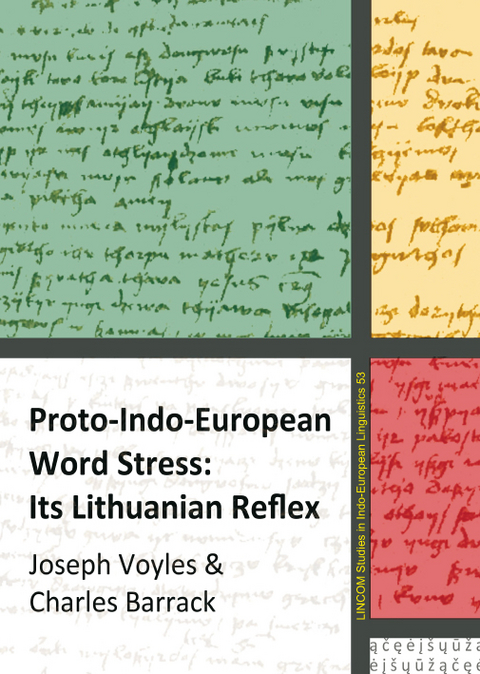
Proto-Indo-European Word Stress: Its Lithuanian Reflex
Seiten
2020
LINCOM GmbH (Verlag)
978-3-86290-066-4 (ISBN)
LINCOM GmbH (Verlag)
978-3-86290-066-4 (ISBN)
- Keine Verlagsinformationen verfügbar
- Artikel merken
The development of Lithuanian word stress has long lent itself to misinterpretation. Many have considered it as somehow directly reflective of that of Proto-Indo-European (PIE).
The present study represents a dissent from this view. The reconstruction of PIE word stress is based on the evidence of Classical Sanskrit and Ancient Greek. An early morphologically conditioned rule is therefore posited which is then completely replaced (as in Sanskrit) or partially replaced (as in Greek) by some sort of phonologically conditioned rule.
This model is then applied to the Lithuanian data: in Lithuanian there is a partial retention of the original PIE morphologically conditioned rule with the addition of a phonologically conditioned rule which moves the stress to the left. But the Lithuanian rule moves the stress only one mora to the left (where 1 mora = a short vowel and 2 morae = a long vowel or diphthong). This change in its interaction with the other explicitly formulated changes from PIE into Lithuanian suffices to account for the Lithuanian stress patterns--namely the grave accent over a short stressed vowel, the acute accent over a long vowel or diphthong stressed on its first mora and finally the tilde (or circumflex) accent over a long vowel or diphthong stressed on its second mora.
Thus it has been demonstrated that the Lithuanian word-stress rule can be derived from that of PIE by reasonable and attested types of change. It should also be emphasized that the Lithuanian rule has undergone massive change from that of PIE and is therefore only faintly reflective of it.
ISBN 9783862900664 (Hardcover). LINCOM Studies in Indo-European Linguistics 53. 246pp. 2020.
The present study represents a dissent from this view. The reconstruction of PIE word stress is based on the evidence of Classical Sanskrit and Ancient Greek. An early morphologically conditioned rule is therefore posited which is then completely replaced (as in Sanskrit) or partially replaced (as in Greek) by some sort of phonologically conditioned rule.
This model is then applied to the Lithuanian data: in Lithuanian there is a partial retention of the original PIE morphologically conditioned rule with the addition of a phonologically conditioned rule which moves the stress to the left. But the Lithuanian rule moves the stress only one mora to the left (where 1 mora = a short vowel and 2 morae = a long vowel or diphthong). This change in its interaction with the other explicitly formulated changes from PIE into Lithuanian suffices to account for the Lithuanian stress patterns--namely the grave accent over a short stressed vowel, the acute accent over a long vowel or diphthong stressed on its first mora and finally the tilde (or circumflex) accent over a long vowel or diphthong stressed on its second mora.
Thus it has been demonstrated that the Lithuanian word-stress rule can be derived from that of PIE by reasonable and attested types of change. It should also be emphasized that the Lithuanian rule has undergone massive change from that of PIE and is therefore only faintly reflective of it.
ISBN 9783862900664 (Hardcover). LINCOM Studies in Indo-European Linguistics 53. 246pp. 2020.
| Erscheinungsdatum | 25.03.2020 |
|---|---|
| Sprache | englisch |
| Maße | 170 x 240 mm |
| Gewicht | 680 g |
| Themenwelt | Geisteswissenschaften ► Sprach- / Literaturwissenschaft ► Latein / Altgriechisch |
| Geisteswissenschaften ► Sprach- / Literaturwissenschaft ► Sprachwissenschaft | |
| Schlagworte | Baltistik • Indogermanistik • Sprachwissenschaft |
| ISBN-10 | 3-86290-066-5 / 3862900665 |
| ISBN-13 | 978-3-86290-066-4 / 9783862900664 |
| Zustand | Neuware |
| Informationen gemäß Produktsicherheitsverordnung (GPSR) | |
| Haben Sie eine Frage zum Produkt? |
Mehr entdecken
aus dem Bereich
aus dem Bereich
kleines Lexikon deutscher Wörter lateinischer Herkunft
Buch | Softcover (2023)
C.H.Beck (Verlag)
CHF 20,95


