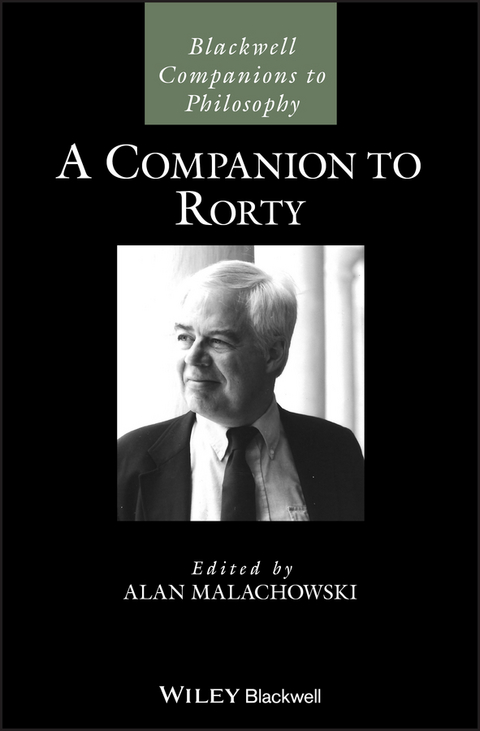
A Companion to Rorty (eBook)
John Wiley & Sons (Verlag)
978-1-118-97218-2 (ISBN)
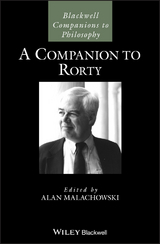
A groundbreaking reference work on the revolutionary philosophy and intellectual legacy of Richard Rorty
A provocative and often controversial thinker, Richard Rorty and his ideas have been the subject of renewed interest to philosophers working in epistemology, metaphysics, analytic philosophy, and the history of philosophy. Having called for philosophers to abandon representationalist accounts of knowledge and language, Rorty introduced radical and challenging concepts to modern philosophy, generating divisive debate through the new form of American pragmatism which he advocated and the renunciation of traditional epistemology which he espoused.
However, while Rorty has been one of the most widely-discussed figures in modern philosophy, few volumes have dealt directly with the expansive reach of his thought or its implications for the fields of philosophy in which he worked. The Blackwell Companion to Rorty is a collection of essays by prominent scholars which provide close, and long-overdue, examination of Rorty's groundbreaking work. Divided into five parts, this volumecovers the major intellectual movements of Rorty's career from his early work on consciousness and transcendental arguments, to the lasting impacts of his major writings, to his approach to pragmatism and his controversial appropriations from other philosophers, and finally to his later work in culture, politics, and ethics.
- Offers a comprehensive, balanced, and insightful account of Rorty's approach to philosophy
- Provides an assessment of Rorty's more controversial thoughts and his standing as an 'anti-philosopher's philosopher'
- Contains new and original exploration of Rorty's thinking from leading scholars and philosophers
- Includes new perspectives on topics such as Rorty's influence in Central Europe
Despite the relevance of Rorty's work for the wider community of philosophers and for those working in fields such as international relations, legal and political theory, sociology, and feminist studies, the secondary literature surrounding Rorty's work and legacy is limited. A Companion to Rorty address this absence, providinga comprehensive resource for philosophers and general readers.
Alan Malachowski is Research Fellow at the Centre for Applied Ethics, Stellenbosch University, South Africa. He has published extensively on both Richard Rorty and Pragmatism and has authored and edited many volumes, including Reading Rorty (Blackwell, 1990).
A groundbreaking reference work on the revolutionary philosophy and intellectual legacy of Richard Rorty A provocative and often controversial thinker, Richard Rorty and his ideas have been the subject of renewed interest to philosophers working in epistemology, metaphysics, analytic philosophy, and the history of philosophy. Having called for philosophers to abandon representationalist accounts of knowledge and language, Rorty introduced radical and challenging concepts to modern philosophy, generating divisive debate through the new form of American pragmatism which he advocated and the renunciation of traditional epistemology which he espoused. However, while Rorty has been one of the most widely-discussed figures in modern philosophy, few volumes have dealt directly with the expansive reach of his thought or its implications for the fields of philosophy in which he worked. The Blackwell Companion to Rorty is a collection of essays by prominent scholars which provide close, and long-overdue, examination of Rorty s groundbreaking work. Divided into five parts, this volumecovers the major intellectual movements of Rorty s career from his early work on consciousness and transcendental arguments, to the lasting impacts of his major writings, to his approach to pragmatism and his controversial appropriations from other philosophers, and finally to his later work in culture, politics, and ethics. Offers a comprehensive, balanced, and insightful account of Rorty's approach to philosophy Provides an assessment of Rorty s more controversial thoughts and his standing as an anti-philosopher s philosopher Contains new and original exploration of Rorty s thinking from leading scholars and philosophers Includes new perspectives on topics such as Rorty's influence in Central Europe Despite the relevance of Rorty s work for the wider community of philosophers and for those working in fields such as international relations, legal and political theory, sociology, and feminist studies, the secondary literature surrounding Rorty s work and legacy is limited. A Companion to Rorty address this absence, providinga comprehensive resource for philosophers and general readers.
Alan Malachowski is Research Fellow at the Centre for Applied Ethics, Stellenbosch University, South Africa. He has published extensively on both Richard Rorty and Pragmatism and has authored and edited many volumes, including Reading Rorty (Blackwell, 1990).
Preface and Acknowledgments viii
Contributors ix
Introduction: Rorty's Approach to Philosophy: Time for Reassessment 1
Alan Malachowski
Prologue 9
1 Reading Rorty: A Sketch of a Plan 11
Danielle Macbeth
Part I Early Developments 25
2 Was Rorty an Eliminative Materialist? 27
William Ramsey
3 Rorty's Philosophy of Consciousness 43
James Tartaglia
4 Rorty and Transcendental Arguments 59
Neil Gascoigne
Part II Texts 79
5 Philosophy and the Mirror of Nature 81
James Tartaglia
6 The Uses of Philosophy after the Collapse of Metaphysics: Ironism and Liberalism in Rorty's Contingency, Irony, and Solidarity 100
Colin Koopman
7 Rhetoric Between Philosophy and Poetry: Rorty as Essayist 119
William M. Curtis
8 Rorty's Inspirational Liberalism 135
Richard J. Bernstein
Part III Themes 147
9 Are Pragmatists About Truth True Democrats? 149
Pascal Engel
10 Richard Rorty and (the End of) Metaphysics (?) 163
David Macarthur
11 Rorty, Pragmatism, and Ethics: The Value of Hope 178
Marjorie C. Miller
12 The Center and Circumference of Knowledge: Rorty on Pragmatism and Romanticism 194
Isaac Nevo
13 Rorty and Analytic Philosophy 211
Gary Gutting
14 Speculative Pragmatism: Richard Rorty and the Hyperboles of Philosophy 229
Paul Trembath
Part IV Appropriations 251
15 Rorty on Hegel on the Mind in History 253
Paul Redding
16 Rorty and the Mirror of Nietzsche 268
Steven Michels
17 The Truth of Being and the History of Philosophy 281
Mark Okrent
18 Rorty's Romantic Polytheism: The Influence of William James 297
Carol Nicholson
19 Inconvenient Conversational Partners: Rorty and Freud 312
Alan Malachowski
20 Rorty and Dewey 335
David L. Hildebrand
21 Common Understanding Without Uncommon Certainty: Rorty's Wittgenstein Revisited 357
Alan Malachowski
22 Rorty, Davidson, and Representation 370
Steven Levine
23 The Rorty-Habermas Debate: A Critical Appraisal 395
Anton A. van Niekerk
Part V Culture, Politics, and Religion 411
24 Rorty and Literature 413
Serge Grigoriev
25 The Contested Marriage of Rorty and Feminism 427
Elizabeth Sperry
26 Rorty and Religion: Beyond the Culture Wars? 444
Molly B. Farneth
27 Rorty's Philosophy of Religion 456
Emil Visn^ovsky
28 Rorty and the Intellectual Culture of Central Europe 467
Emil Visn^ovsky, Alexander Krémer, and Krzysztof Piotr Skowronski
29 Rorty and Nihilism 482
Tracy Llanera
30 Rorty's Ethics of Responsibility 490
Christopher J. Voparil
Part VI Coda 505
31 Poetry as (a Kind of) Philosophy: For Richard Rorty 507
Christopher Norris
Internet Resources 528
Index 529
Contributors
Richard J. Bernstein is Vera List professor of philosophy at the New School for Social Research. He is one of Richard Rorty’s most insightful commentators. His books include Philosophical Profiles, The New Constellation, and The Pragmatic Turn. He is the coeditor of The Rorty Reader.
William M. Curtis is professor of political science at the University of Portland. His research interests include theories of liberalism, classical liberalism and the free market, religion and politics, politics and literature, US Constitutional law, and American pragmatism. He is the author of Defending Rorty: Pragmatism and Liberal Virtue.
Pascal Engel is professor of contemporary philosophy at the University of Geneva. He is co‐author (with Richard Rorty) of What is the Use of Truth? His other books include The Norm of Truth and Truth.
Molly B. Farneth is assistant professor in the Religion Department at Haverford College. She works in the areas of American and European religious and philosophical thought (nineteenth century to the present), with particular attention to religion and politics, ethics, ritual studies, and feminist and gender studies in religion. She is the author of Hegel’s Social Ethics: Religion, Conflict, and Rituals of Reconciliation.
Neil Gascoigne is reader in philosophy at Royal Holloway University of London. He is the author of Richard Rorty and Rorty, Liberal Democracy, and Religious Belief.
Serge Grigoriev is associate professor of philosophy at Ithaca College, New York. His recent publications include “A Pragmatist Critique of Dogmatic Philosophy of History” and “Hypotheses, Generalizations, and Convergene: Some Peircean Themes in the Study of History.”
Gary Gutting is a former professor of philosophy at the University of Notre Dame and holder of the endowed chair. Gary was the author of numerous books including French Philosophy in the Twentieth Century, What Philosophy Can Do, and Thinking the Impossible.
David L. Hildebrand is associate professor of philosophy at the University of Colorado. His publications include Beyond Realism and Antirealism: John Dewey and the Neopragmatists and Dewey: A Beginner’s Guide.
Colin Koopman is associate professor of philosophy at the University of Oregon. He is the author of How We Became Our Data: A Genealogy of the Informational Person, Genealogy as Critique, and Pragmatism as Transition: Historicity and Hope in James, Dewey, and Rorty.
Alexander Krémer is professor of philosophy at the University of Szeged. His field of interest includes hermeneutics, ethics, aesthetics, and pragmatism, especially neopragmatism. He is the author of four books including Why Did Heidegger Become Heidegger? and Philosophy of the Late Richard Rorty. He is the editor in chief of Pragmatism Today.
Steven Levine is associate professor of philosophy at the University of Massachusetts, Boston. He has published articles on classical and contemporary pragmatism as well as more contemporary figures including Sellars, Brandom, McDowell, and Davidson. He is the author of Pragmatism, Objectivity, and Experience.
Tracy Llanera is an assistant research professor in the Department of Philosophy at the University of Connecticut and a faculty affiliate at the UConn Asian and Asian American Studies Institute. She works in philosophy of religion, social and political philosophy, and American pragmatism, specializing on the topics of nihilism, conversion, and the politics of language. Her writings have been published in a variety of journals, including Philosophy and Social Criticism, Contemporary Pragmatism, Hypatia, Analyse & Kritik, and Pragmatism Today. She is currently working on two books: Outgrowing Modern Nihilism and A Philosophical Defence of Nihilism, coauthored with James Tartaglia.
David Macarthur is an associate professor of philosophy at the University of Sydney. His main interests include skepticism, pragmatism, philosophy of psychology, history of modern philosophy, Wittgenstein, and aesthetics. He coedited Naturalism in Question.
Danielle Macbeth is T. Wistar Brown professor of philosophy at Haverford College in Pennsylvania and the author of Frege’s Logic and Realizing Reason: A Narrative of Truth and Knowing. Her work focuses mainly on philosophy of mathematics, metaphysics, language, and logic. She has also published various essays in the history and philosophy of mathematics, philosophy of language, philosophy of mind, and pragmatism, among other topics.
Alan Malachowski is a research fellow in the Centre for Applied Ethics at Stellenbosch University. He is author of Richard Rorty, and The New Pragmatism. His edited works include Reading Rorty and The Cambridge Companion to Pragmatism.
Steven Michels is professor of political science at Sacred Heart University, Fairfield. His scholarship covers work in theory (Nietzsche, Tocqueville, Sinclair Lewis), higher education, and popular culture. His publications include Sinclair Lewis and American Democracy, and “Neitzsche on Truth and The Will.”
Marjorie C. Miller is professor emirata of philosophy at Purchase College, State University of New York. She has held Fulbright awards in both China and Korea. Her publications include “Rortian Extremes and the Confucian Zhongyong” and “Feminism and Pragmatism”
Isaac Nevo is associate professor of philosophy at the Ben‐Gurion University. His publications include “Richard Rorty’s Romantic Pragmatism” and “In Defence of Dogma: Davidson, languages, and conceptual schemes.”
Carol Nicholson is professor of philosophy at Rider University. Her publications include “Rorty’s Pragmatic Patriotism” and “Education and the Pragmatic Temperament.”
Christopher Norris is distinguished research professor in philosophy at Cardiff University. He is author of numerous books including The Contest of Faculties, Derrida, and Truth and Meaning.
Mark Okrent is professor of philosophy at Bates College. He is the author of Heidegger's Pragmatism as well as numerous articles on intentionality, teleology, and Heidegger.
William Ramsey is professor of philosophy at the University of Nevada, Las Vegas. He works primarily in the philosophy of mind and cognitive science, and is the author of Representation Reconsidered, “Intuitions as Evidence Facilitators,” and “Must Cognition be Representational?” as well as the coeditor (with Keith Frankish) of the Cambridge Handbook of Cognitive Science and the Cambridge Handbook of Artificial Intelligence.
Paul Redding is professor emeritus of philosophy at the University of Sydney. He is a leading authority on Kantian and Hegelian Idealism. He is author of Analytic Philosophy and the Return of Hegelian Thought and Thoughts, Deeds, Words and World: Hegel’s Idealist Response to the Linguistic “Metacritical Invasion.”
Krzysztof Piotr Skowroński is associate professor of philosophy at Opole University. He is the author of Values, Valuations and Axiological Norms in Richard Rorty’s Neopragmatism and Beyond Aesthetic and Politics.
Elizabeth Sperry is professor of philosophy at William Jewell College. Her publications include “Dupes of Patriarchy: Feminist Strong Substantive Autonomy’s Epistemological Weaknesses” and “Medina on the Social Construction of Agency.”
James Tartaglia is professor of metaphysical philosophy at the University of Keele. He is the author of Rorty and the Mirror of Nature and Philosophy in a Meaningless Life: A System of Nihilism, Consciousness and Reality; editor of Richard Rorty: Critical Assessments of Leading Philosophers; and coeditor (with Stephen Leach) of Mind, Language, and Metaphilosophy: Early Philosophical Papers and Consciousness and the Great Philosophers: What Would They Have Said About Our Mind‐Body Problem?
Paul Trembath is associate professor in the Department of English at Colorado State University. He teaches critical studies and its philosophical backgrounds, twentieth‐century literatures, and interdisciplinary humanities. He has published widely in critical journals and book editions and is finishing a book that examines the relationship of nonreading to capital process, how ordinary language practices produce unnecessary antagonisms between scientific and discursive materialisms as well as policy‐regulated incompatibility of human behavior and eco‐sustainability.
Anton A. van Niekerk is distinguished professor of philosophy at the University of Stellenbosch. has published widely in philosophy. He is editor and coauthor of The Status of Prenatal Life and Aids in Context: A South African Perspective. His published articles include “Pragmatism and religion.”
Emil Višňovský is professor of philosophy at Comenius University, Bratislava. His publications include “Peirce and Rorty: An Attempt at a Reconciliation of Two Versions of Pragmatism” and...
| Erscheint lt. Verlag | 14.2.2020 |
|---|---|
| Reihe/Serie | Blackwell Companions to Philosophy |
| Blackwell Companions to Philosophy | Blackwell Companions to Philosophy |
| Sprache | englisch |
| Themenwelt | Geisteswissenschaften ► Philosophie ► Allgemeines / Lexika |
| Schlagworte | A Companion to Rorty • Alan Malachowski • eliminative materialism • Geschichte der Philosophie • History of Philosophy • Philosophie • Philosophy • Philosophy of Language • Richard Rorty • Rorty anthology • Rorty approaches • Rorty appropriations • Rorty articles • Rorty Asia • Rorty commentary • Rorty compendium • Rorty Essays • Rorty ethics • Rorty Europe • Rorty feminism • Rorty history • Rorty irony • Rorty Latin America • Rorty law • Rorty literature • Rorty neopragmatism • Rorty philosophy • Rorty philosophy commentary • Rorty philosophy compendium • Rorty philosophy concepts • Rorty philosophy criticism • Rorty philosophy critiques • Rorty philosophy essays • Rorty philosophy history • Rorty philosophy ideas • Rorty philosophy of consciousness • Rorty philosophy pragmatism • Rorty philosophy readings • Rorty philosophy textbook • Rorty politics • Rorty pragmatists • Rorty reader • Rorty reception • Rorty religion • Rorty, Richard • Rorty solidarity • Rorty transcendentalism • Rorty vocabulary • Sprachphilosophie |
| ISBN-10 | 1-118-97218-X / 111897218X |
| ISBN-13 | 978-1-118-97218-2 / 9781118972182 |
| Informationen gemäß Produktsicherheitsverordnung (GPSR) | |
| Haben Sie eine Frage zum Produkt? |
 EPUB (Adobe DRM)
Kopierschutz: Adobe-DRM
Adobe-DRM ist ein Kopierschutz, der das eBook vor Mißbrauch schützen soll. Dabei wird das eBook bereits beim Download auf Ihre persönliche Adobe-ID autorisiert. Lesen können Sie das eBook dann nur auf den Geräten, welche ebenfalls auf Ihre Adobe-ID registriert sind.
Details zum Adobe-DRM
Dateiformat: EPUB (Electronic Publication)
EPUB ist ein offener Standard für eBooks und eignet sich besonders zur Darstellung von Belletristik und Sachbüchern. Der Fließtext wird dynamisch an die Display- und Schriftgröße angepasst. Auch für mobile Lesegeräte ist EPUB daher gut geeignet.
Systemvoraussetzungen:
PC/Mac: Mit einem PC oder Mac können Sie dieses eBook lesen. Sie benötigen eine
eReader: Dieses eBook kann mit (fast) allen eBook-Readern gelesen werden. Mit dem amazon-Kindle ist es aber nicht kompatibel.
Smartphone/Tablet: Egal ob Apple oder Android, dieses eBook können Sie lesen. Sie benötigen eine
Geräteliste und zusätzliche Hinweise
Buying eBooks from abroad
For tax law reasons we can sell eBooks just within Germany and Switzerland. Regrettably we cannot fulfill eBook-orders from other countries.
aus dem Bereich