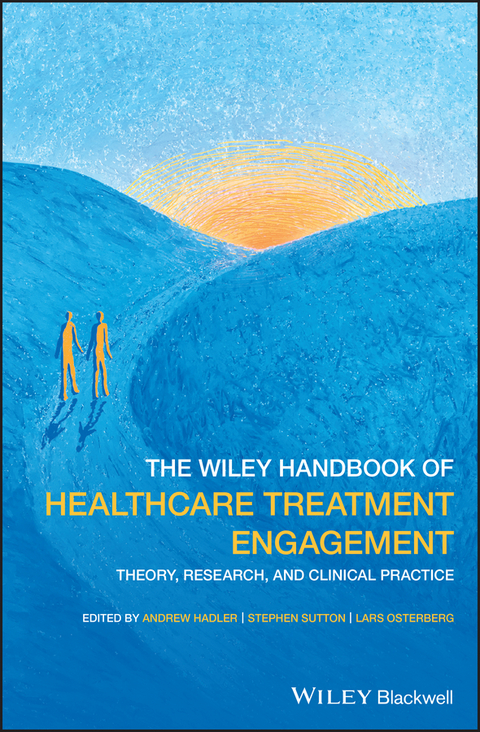
The Wiley Handbook of Healthcare Treatment Engagement (eBook)
John Wiley & Sons (Verlag)
978-1-119-12951-6 (ISBN)
Against a global backdrop of problematic adherence to medical treatment, this volume addresses and provides practical solutions to the simple question: 'Why don't patients take treatments that could save their lives?'
The Wiley handbook of Healthcare Treatment Engagement offers a guide to the theory, research and clinical practice of promoting patient engagement in healthcare treatment at individual, organizational and systems levels. The concept of treatment engagement, as explained within the text, promotes a broader view than the related concept of treatment adherence. Treatment engagement encompasses more readily the lifestyle factors which may impact healthcare outcomes as much as medication-taking, as well as practical, economic and cultural factors which may determine access to treatment. Over a span of 32 chapters, an international panel of expert authors address this far-reaching and fascinating field, describing a broad range of evidence-based approaches which stand to improve clinical services and treatment outcomes, as well as the experience of users of healthcare service and practitioners alike.
This comprehensive volume adopts an interdisciplinary approach to offer an understanding of the factors governing our healthcare systems and the motivations and behaviors of patients, clinicians and organizations. Presented in a user-friendly format for quick reference, the text first supports the reader's understanding by exploring background topics such as the considerable impact of sub-optimal treatment adherence on healthcare outcomes, before describing practical clinical approaches to promote engagement in treatment, including chapters referring to specific patient populations. The text recognizes the support which may be required throughout the depth of each healthcare organization to promote patient engagement, and in the final section of the book, describes approaches to inform the development of healthcare services with which patients will be more likely to seek to engage.
This important book:
- Provides a comprehensive summary of practical approaches developed across a wide range of clinical settings, integrating research findings and clinical literature from a variety of disciplines
- Introduces and compliments existing approaches to improve communication in healthcare settings and promote patient choice in planning treatment
- Presents a range of proven clinical solutions that will appeal to those seeking to improve outcomes on a budget
Written for health professionals from all disciplines of clinical practice, as well as service planners and policy makers, The Wiley Handbook of Healthcare Treatment Engagement is a comprehensive guide for individual practitioners and organizations alike.
Andrew Hadler is a Consultant Forensic Psychiatrist with Sussex Partnership NHS Foundation Trust, UK and Honorary Lecturer at Brighton and Sussex Medical School.
Stephen Sutton is Professor of Behavioural Science and Head of the Behavioural Science Group at the Institute of Public Health, University of Cambridge, UK.
Lars Osterberg is Associate Professor (Teaching) at Stanford University School of Medicine, USA, and a Staff Physician at the Veterans Administration Palo Alto Health Care System.
Winner of the 2021 PROSE Award for CLINICAL PSYCHOLOGY and PSYCHIATRY Against a global backdrop of problematic adherence to medical treatment, this volume addresses and provides practical solutions to the simple question: "e;Why don't patients take treatments that could save their lives?"e; The Wiley handbook of Healthcare Treatment Engagement offers a guide to the theory, research and clinical practice of promoting patient engagement in healthcare treatment at individual, organizational and systems levels. The concept of treatment engagement, as explained within the text, promotes a broader view than the related concept of treatment adherence. Treatment engagement encompasses more readily the lifestyle factors which may impact healthcare outcomes as much as medication-taking, as well as practical, economic and cultural factors which may determine access to treatment. Over a span of 32 chapters, an international panel of expert authors address this far-reaching and fascinating field, describing a broad range of evidence-based approaches which stand to improve clinical services and treatment outcomes, as well as the experience of users of healthcare service and practitioners alike. This comprehensive volume adopts an interdisciplinary approach to offer an understanding of the factors governing our healthcare systems and the motivations and behaviors of patients, clinicians and organizations. Presented in a user-friendly format for quick reference, the text first supports the reader s understanding by exploring background topics such as the considerable impact of sub-optimal treatment adherence on healthcare outcomes, before describing practical clinical approaches to promote engagement in treatment, including chapters referring to specific patient populations. The text recognizes the support which may be required throughout the depth of each healthcare organization to promote patient engagement, and in the final section of the book, describes approaches to inform the development of healthcare services with which patients will be more likely to seek to engage. This important book: Provides a comprehensive summary of practical approaches developed across a wide range of clinical settings, integrating research findings and clinical literature from a variety of disciplines Introduces and compliments existing approaches to improve communication in healthcare settings and promote patient choice in planning treatment Presents a range of proven clinical solutions that will appeal to those seeking to improve outcomes on a budget Written for health professionals from all disciplines of clinical practice, as well as service planners and policy makers, The Wiley Handbook of Healthcare Treatment Engagement is a comprehensive guide for individual practitioners and organizations alike. 2021 PROSE Biological and Life Sciences Category for Clinical Psychology & Psychiatry
Andrew Hadler is a Consultant Forensic Psychiatrist with Sussex Partnership NHS Foundation Trust, UK and Honorary Lecturer at Brighton and Sussex Medical School. Stephen Sutton is Professor of Behavioural Science and Head of the Behavioural Science Group at the Institute of Public Health, University of Cambridge, UK. Lars Osterberg is Associate Professor (Teaching) at Stanford University School of Medicine, USA, and a Staff Physician at the Veterans Administration Palo Alto Health Care System.
Notes on Contributors
Jessica L. Alpert is a case writer and researcher at the Harvard Medical School Center for Primary Care, Boston, Massachusetts.
Vivian Auyeung is Senior Lecturer in Medicines Use at the Institute of Pharmaceutical Science, King's College London. Her research aims to integrate the disciplines of health psychology with pharmacy; specifically, tackling the problem of medicines non‐adherence by designing and testing scalable and sustainable pharmacy‐led solutions based on psychological theories.
Thomas R.E. Barnes is Emeritus Professor of Clinical Psychiatry at Imperial College, London, and joint head of the Prescribing Observatory for Mental Health at the Royal College of Psychiatrists. His research in schizophrenia and its treatment has generated over 300 publications. He is a co‐editor of The Maudsley Prescribing Guidelines in Psychiatry and has been a member of schizophrenia treatment guideline development groups for both the National Institute for Health and Care Excellence and the British Association for Psychopharmacology.
Paul Barr is a member of Faculty at the Dartmouth Institute for Health Policy & Clinical Practice, Hanover, New Hampshire, where he leads the “Open Recordings” research group. He is a health‐services researcher, promoting greater transparency in healthcare and working at the intersections of technology, patient‐ and family‐centered communication and shared decision‐making. He is the recipient of the Gordon and Betty Moore Patient and Family Engagement Award. Paul received his PhD (Public Health) and BSc (Psychology) from Queen's University, Belfast, Ireland, and received an MSc in Public Health (Health Services Research stream) from the London School of Hygiene and Tropical Medicine, London UK.
Katherine Berry is a senior lecturer and clinical psychologist who is based at the University of Manchester. Her main area of expertise is attachment theory and therapeutic relationships in people with a diagnosis of psychosis. She currently works on the Manchester Clinical Psychology Training Programme and as a clinical psychologist in mental health rehabilitation.
Joseph R. Betancourt MD MPH is the founder and director of the Disparities Solutions Center, Senior Scientist at the Mongan Institute for Health Policy at Massachusetts General Hospital, and an Associate Professor of Medicine at Harvard Medical School. Dr. Betancourt has authored peer‐reviewed articles on topics including racial/ethnic disparities in health and healthcare; public health; cross‐cultural care and education; clinical decision‐making; ethics; workforce diversity; and the impact of language barriers on healthcare.
Danielle Blanch‐Hartigan PhD MPH is Assistant Professor of Health Studies in the Department of Natural and Applied Sciences and Director of the Health Thought Leadership Network at Bentley University in Waltham, Massachusetts. Danielle holds a PhD in Psychology from Northeastern University, a Masters in Public Health from Harvard School of Public Health and completed postdoctoral training as a Cancer Prevention Fellow in the Behavioral Research Program and Office of Cancer Survivorship at the National Cancer Institute. Her interdisciplinary research in psychology and public health aims to understand patient perceptions and improve the patient‐care experience. Dr. Blanch‐Hartigan has published over 45 articles in peer‐reviewed journals across psychology, health communication, and medicine.
Jed Boardman is a psychiatrist and Senior Lecturer in Social Psychiatry at the Institute of Psychiatry, Psychology, and Neuroscience. He is Senior Policy Adviser at the Centre for Mental Health and lead for Social Inclusion at the Royal College of Psychiatrists where he advises on employment and welfare benefit matters. He chaired the Royal College of Psychiatrists Social Inclusion Scoping Group.
Hayden Barry Bosworth is the Associate Director of the Center for Health Services Research in Primary Care at the Durham Veterans Affairs Healthcare System. He is also a Professor of Medicine, Psychiatry, Population Health Science, and Nursing at Duke University Medical Center. His research provides knowledge for improving patients' treatment adherence and self‐management in chronic care. Dr. Bosworth has authored over 280 peer‐reviewed publications, over 70 of which address treatment adherence.
Wendy Bryant, is Senior Lecturer and Subject Lead for Occupational Therapy at the University of Essex. Wendy has practiced as an occupational therapist since 1984 in a wide range of UK settings including social care. Her research has been focused on collaborating with service users and providers, using participatory and creative methods.
Deborah L. Cabaniss MD is Professor of Clinical Psychiatry and Associate Director of Residency Training in the Columbia University Department of Psychiatry. In that role she teaches psychodynamic psychotherapy to residents and coordinates teaching and supervising of psychotherapy in the residency. She is the winner of numerous teaching awards and is a Training and Supervising Analyst at the Columbia University Center for Psychoanalytic Training and Research. Her books, Psychodynamic Psychotherapy: A Clinical Manual and Psychodynamic Formulation, are widely used and translated.
Ali Calkins‐Smith received her PhD in Clinical Psychology with a Major Area of Study in Clinical Health Psychology from the University of Kansas in 2018. She completed her Pre‐doctoral Clinical Internship and Post‐doctoral Fellowship at Children’s Mercy Hospital in Kansas City, Missouri. Her research and clinical interests are both broadly in the area of pediatric psychology with specific interests in adherence and pediatric chronic pain. Her dissertation was titled, “Adherence Behaviors in Youth Following the Completion of an Intensive Pain Rehabilitation Program.” Dr. Calkins‐Smith became licensed in 2019 and started her first position as the sole psychologist in a well‐established primary care pediatric office in Kansas.
Chia‐Hsin Emily Cheng is Lecturer of Psychology and Health Science at California State University, Fullerton. She has served as co‐principal investigator of a CDC funded interdisciplinary obesity research project and as evaluation analyst on several health promotion programs in minority communities. She is on the editorial board of the Californian Journal of Health Promotion and is a doctoral candidate at the University of California, Los Angeles.
Alan J. Christensen PhD is Professor and Collegiate Fellow in the Department of Psychology and Professor in the Department of Internal Medicine at the University of Iowa. He currently serves as Editor‐in‐Chief of the Journal of Behavioral Medicine and is a Past President of the Society of Behavioral Medicine. He has studied issues involving patient treatment adherence and self‐management in chronic illness for over three decades.
Anne Cohen is a current Masters Student in the Nutrition and Exercise Physiology program at Teachers College, Columbia University and has a BA in Behavioral Biology from Johns Hopkins University. She previously worked as a Research Assistant at the Center for Behavioral Intervention Technologies at Northwestern University.
Jason P. Connor is a clinical psychologist, Director of the Centre for Youth Substance Abuse Research, and Professor of Clinical and Health Psychology at the University of Queensland.
Michael Copenhaver is a Professor of Health Promotion in the Department of Allied Health Sciences and a principal investigator at the Institute for Collaboration on Health, Intervention, and Policy (InCHIP) at the University of Connecticut, and a licensed clinical psychologist in Connecticut. He conducts primarily NIH/NIDA‐funded research aimed at developing and adapting evidence‐based behavioral HIV prevention interventions for optimal use in real world clinical settings (drug treatment, prison) where high‐risk drug users may be more efficiently reached. Dr. Copenhaver has been at the University of Connecticut since 2002.
Paul Crawshaw is Professor of Sociology and Dean of the School of Social Sciences, Humanities and Law at Teesside University, UK. A medical sociologist by training, he has published extensively on health improvement interventions, behavioural change, and sociologies of risk in a range of international journals, including Social Science and Medicine and Critical Social Policy. A former editor of Critical Public Health, he continues to contribute substantially to debates on health, wellbeing, and social policy, with particular interest in complex interventions.
Adam Danquah is a Lecturer in Clinical Psychology at the University of Manchester. He has particular interests in attachment theory and psychoanalysis. Clinically he works in secondary care adult mental health for Pennine Care NHS Foundation Trust. As well as being a Clinical Psychologist, Adam is a Psychodynamic Psychotherapist.
Chris Desmond is the Director of the Centre for Liberation Studies in Durban, South Africa.
Seeta Durvasula is a Senior Lecturer in the Faculty of Medicine and Health, University of Sydney. She is also the Clinical Director of two specialized multidisciplinary health clinics for people with intellectual disability and complex health conditions. Seeta has over 30 years of...
| Erscheint lt. Verlag | 30.1.2020 |
|---|---|
| Sprache | englisch |
| Themenwelt | Geisteswissenschaften ► Psychologie |
| Studium ► Querschnittsbereiche ► Prävention / Gesundheitsförderung | |
| Schlagworte | Allg. Public Health • clinical practice of healthcare treatment • Gesundheits- u. Sozialwesen • Health & Behavioral Clinical Psychology • Health & Social Care • healthcare engagement • Klinische Psychologie / Verhalten • Patient compliance • Patient engagement • patient informed consent • Patient satisfaction • Psychologie • Psychology • Public Health General • research of healthcare treatment • Sociology • Sociology of Health & Illness • Soziologie • Soziologie d. Gesundheit u. Krankheit • Theory of healthcare treatment • values-based healthcare practice |
| ISBN-10 | 1-119-12951-6 / 1119129516 |
| ISBN-13 | 978-1-119-12951-6 / 9781119129516 |
| Informationen gemäß Produktsicherheitsverordnung (GPSR) | |
| Haben Sie eine Frage zum Produkt? |
 EPUB (Adobe DRM)
Kopierschutz: Adobe-DRM
Adobe-DRM ist ein Kopierschutz, der das eBook vor Mißbrauch schützen soll. Dabei wird das eBook bereits beim Download auf Ihre persönliche Adobe-ID autorisiert. Lesen können Sie das eBook dann nur auf den Geräten, welche ebenfalls auf Ihre Adobe-ID registriert sind.
Details zum Adobe-DRM
Dateiformat: EPUB (Electronic Publication)
EPUB ist ein offener Standard für eBooks und eignet sich besonders zur Darstellung von Belletristik und Sachbüchern. Der Fließtext wird dynamisch an die Display- und Schriftgröße angepasst. Auch für mobile Lesegeräte ist EPUB daher gut geeignet.
Systemvoraussetzungen:
PC/Mac: Mit einem PC oder Mac können Sie dieses eBook lesen. Sie benötigen eine
eReader: Dieses eBook kann mit (fast) allen eBook-Readern gelesen werden. Mit dem amazon-Kindle ist es aber nicht kompatibel.
Smartphone/Tablet: Egal ob Apple oder Android, dieses eBook können Sie lesen. Sie benötigen eine
Geräteliste und zusätzliche Hinweise
Buying eBooks from abroad
For tax law reasons we can sell eBooks just within Germany and Switzerland. Regrettably we cannot fulfill eBook-orders from other countries.
aus dem Bereich