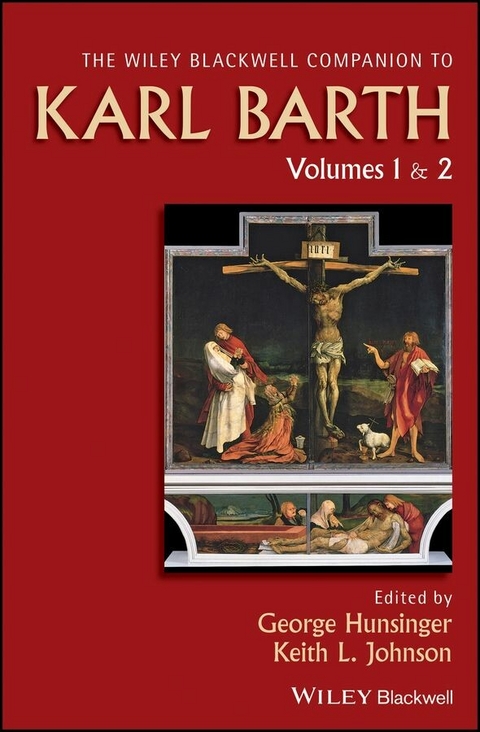
The most comprehensive scholarly survey of Karl Barth's theology ever published
Karl Barth, arguably the most influential theologian of the 20th century, is widely considered one of the greatest thinkers within the history of the Christian tradition, Readers of Karl Barth often find his work both familiar and strange: the questions he considers are the same as those Christian theologians have debated for centuries, but he often addresses these questions in new and surprising ways, The Wiley Blackwell Companion to Karl Barth helps readers understand Barth's theology and his place in the Christian tradition through a new lens,
Covering nearly every topic related to Barth's life and thought, this work spans two volumes, comprising 66 in-depth chapters written by leading experts in the field, Volume One explores Barth's dogmatic theology in relation to traditional Christian theology, provides historical timelines of Barth's life and works, and discusses his significance and influence, Volume Two examines Barth's relationship to various figures, movements, traditions, religions, and events, while placing his thought in its theological, ecumenical, and historical context, This groundbreaking work:
- Places Barth into context with major figures in the history of Christian thought, presenting a critical dialogue between them
- Features contributions from a diverse team of scholars, each of whom are experts in the subject
- Provides new readers of Barth with an introduction to the most important questions, themes, and ideas in Barth's work
- Offers experienced readers fresh insights and interpretations that enrich their scholarship
- Edited by established scholars with expertise on Barth's life, his theology, and his significance in Christian tradition
An important contribution to the field of Barth scholarship, the Wiley Blackwell Companion to Karl Barth is an indispensable resource for scholars and students interested in the work of Karl Barth, modern theology, or systematic theology,
THE MOST COMPREHENSIVE SCHOLARLY SURVEY OF KARL BARTH S THEOLOGY EVER PUBLISHED Karl Barth, perhaps the most influential theologian of the 20th century, is widely considered one of the greatest thinkers within the history of the Christian tradition. Readers of Karl Barth often find his work both familiar and strange: the questions he considers are the same as those Christian theologians have debated for centuries, but he often addresses these questions in new and surprising ways. The Wiley Blackwell Companion to Karl Barth helps readers understand Barth s theology and his place in the Christian tradition through a new lens. Covering nearly every topic related to Barth s life and thought, this work spans two volumes, comprising 66 in-depth chapters written by leading experts in the field. Volume One explores Barth s dogmatic theology in relation to traditional Christian theology, provides historical timelines of Barth s life and works, and discusses his significance and influence. Volume Two examines Barth s relationship to various figures, movements, traditions, religions, and events, while placing his thought in its theological, ecumenical, and historical context. This groundbreaking work: Places Barth into context alongside major figures in the history of Christian thought, presenting a critical dialogue between them Features contributions from a diverse team of scholars, each of whom are experts in the subject Provides new readers of Barth with an introduction to the most important questions, themes, and ideas in Barth s work Offers experienced readers fresh insights and interpretations that enrich their scholarship An important contribution to the field of Barth scholarship, The Wiley Blackwell Companion to Karl Barth is an indispensable resource for scholars and students interested in the work of Karl Barth, modern theology, or systematic theology.
CHAPTER 1
Karl Barth's Historical and Theological Significance
Christiane Tietz
Karl Barth allowed himself to be moved by the realities that surrounded him. It was the harsh and perplexing reality of the world that led him to ask about God in a new way. It was the poverty he confronted as a young curate in Geneva, not to mention the class divisions he encountered as pastor in Safenwil, that made him search for a hope against hope on the basis of faith (cf. Barth 1971, p. 306; GA 22, p. 730). It was the reality of World War I and the capitulation of many of his theological teachers to German zeal for the war that made him doubt their theological presuppositions and develop his disruptively “dialectical” counterproposals. It was the reality of his teaching post as a professor that made him move away from a merely dialectical critique to developing a full‐scale dogmatics. And it was the reality of the Third Reich that made him lift up the relevance not only of the First Commandment as a theological criterion but also of Jesus Christ as the self‐revelation of God. Although Barth argued that God and the Christian faith were not merely cultural or historical phenomena, his thinking arose in response to immediate historical circumstances that betrayed, he felt, a certain crisis of modernity (cf. Gestrich 1977, p. 6f).
Barth and the other dialectical theologians were not the only ones who discerned a crisis in modernity. Many intellectuals at that time like Ernst Bloch or Paul Tillich felt similarly. But the distinctive feature of Barth and the other dialectical theologians was their return to the theology of the Reformation (cf. Ebeling 1962, p. 1). For them that meant returning to faith in a God “whose existence radically questioned the world and oneself. Only God himself and his existence were no longer uncertain” (Gogarten 1937, p. 13 rev.).
Some of their contemporaries regarded their approach as a departure from “modernity.” They suspected that here “‘modern man’ after the First World War had become weary of Enlightenment ideals and was now clinging to an idea of God that erupted from dark, medieval depths” (Gestrich 1977, p. 1).1 Yet Barth and his friends did not understand their approach as a withdrawal from modernity and its rationality. They claimed that their concept of God as the Wholly Other was “the theme of the Bible and the sum of philosophy in one” (Barth 2010, p. 17; cf. Gestrich 1977, p. 2f.).
Return to the Bible, Focus on “die Sache”
At the center of Barth's new views lay his return to the biblical text. Of course, the biblical text was always – and also in Barth's time – a subject of theological study. Yet because Barth regarded the historic‐critical approach to the Bible as insufficient, he tried something different in his two commentaries on Paul's Letter to the Romans. The philosopher Hans‐Georg Gadamer considered Barth's first commentary to be a milestone in modern hermeneutics, because it made clear that understanding a text means understanding “die Sache” or “subject matter” of the text. Here Barth undertook “a ‘critique’ of liberal theology which not so much meant critical history as such but the theological modesty which acknowledged that its results were already an understanding of Holy Scripture. Therefore, despite its refusal of methodological reflection, Barth's Letter to the Romans was some kind of hermeneutical manifesto” (Gadamer 1972, 481 rev.)
In his preface to the second edition of The Letter to the Romans, it not only became clearer what Barth meant by “die Sache” of a text but also what he regarded as the shortcomings of the historical‐critical method. Barth replied to the reproach that he was an “enemy of historical criticism” and little more than a biblicist (Barth 2010, p. 11). First he acknowledged the full “right and necessity” of historical criticism. Then he went on to register his dissatisfaction that historical criticism ended with an “interpretation of the text which I cannot call an interpretation, but only the first primitive attempt at an interpretation” (Barth 2010, p. 11). His own aim was first to bring out “what stands in the text,” yet then to think about it until “the barrier” between Paul's time and ours becomes “transparent” so that “Paul talks there and we … listen here, until the conversation between document and reader is focused totally on ‘die Sache’ (which cannot be different here and there)” (Barth 2010, p. 13 rev.). In focusing on one and the same “Sache,” text and reader become present to each other. This is the critique that was finally necessary when reading a biblical text: relating and comparing all its statements with “die Sache” of which it is talking. In this regard Barth penned his famous line: “In my view, the historical critics need to be more critical!” (Barth 2010, p. 14)
Barth's perspective on the historical‐critical method was a response to the dominance of historism in Protestant theology at that time (cf. Gestrich 1977, p. 2). In standing against it, Barth, Brunner, Bultmann, Gogarten, and Thurneysen were on the same page as Paul Tillich and Emanuel Hirsch (cf. Gestrich 1977, p. 16). All of them judged that historism had made the revelation of God into an inner‐worldly phenomenon. The extra nos of the divine Word had been abolished and preaching had thereby become impossible (cf. Gestrich 1977, p. 16f.). Ernst Troeltsch's historical method and its norms of critique, analogy, and correlation (cf. Troeltsch 1913) had dwindled God's reality into a part of history. God’s absolute otherness could no longer be encountered (cf. Gestrich 1977, p. 21f.).
With his critique of historicism and his concept of the transhistorical simultaneity of Sache and reader (through the text), Barth had rejected a simple linear conception of time. He was convinced that the whole existence of the church depended on its simultaneity with the living Christ. In his mature view, this simultaneity was the essence of Christian celebrations like Christmas and Easter. When celebrating these holidays, Christians presupposed “that prior to our remembrance, the One whom we remember is himself in action to‐day, here and now.” They presupposed that as such events once took place definitively there and then, they also in some form (secondary and dependent) “take place to‐day, and will take place again tomorrow” (CD IV/2, p. 112 rev.). This “realism” was grounded in Jesus Christ, the living Savior present then and present now. “He overcomes the barrier of his own time and therefore of historical distance …. He is present and future in his once‐for‐all act there and then …. He is among us to‐day, and will be among us to‐morrow, in his once‐for‐all act as it took place there and then” (CD IV/2, p. 112 rev.). Through his focus on “die Sache” – on the incarnate and present Christ who lived, died, and rose again – Barth was able to develop an understanding of the biblical text which expected that God would speak through it – not in the naïve sense of a fundamentalist biblicism but in reckoning with God's active, in‐breaking presence when reading and studying the Bible.
Barth's methodological approach to the biblical text was rejected by distinguished theologians of his time. For example, in 1923 his former teacher Adolf von Harnack accused him of destroying the academic character of theology through his somehow naïve and devotional return to the meaning of the biblical text. In his eyes, Barth had turned the professor's lectern into a pastor's pulpit (cf. GA 35, pp. 55–88).
Barth's rediscovery of the Bible in fact led to a revival of biblical theology and of biblical preaching among his contemporaries. And it led to a new interest in the church, as the Bible has its decisive meaning only in and for the church. The church was the community that lived from reading the Bible and from preaching its texts. Whereas cultural Protestantism emphasized the individual and his or her subjectivity, Barth's theology brought the church back into the picture.
God as the Wholly Other
In contrast to the liberal theological approach of his time that started with the human being, and in particular with religious self‐consciousness, Barth emphasized that theology had to begin with God. This emphasis was prompted by the shock of World War I, which showed Barth that all human ethical concepts such as socialism or pacifism or even “Christianity” were part of the world and were not able to overcome the world as it is. In World War I, in Barth's view, all ethics had “gone into the trenches” (GA 48, p. 186). No ethical concept was able to overcome this human catastrophe, be it the concept of the state or of patriotism, not to mention socialism or even pacifism. Not unlike the sixteenth‐century Swiss reformer Huldrych Zwingli, for Barth everything human was “flesh” in its nullity and transitory nature (cf. Gestrich 1977, p. 47)....
| Erscheint lt. Verlag | 10.1.2020 |
|---|---|
| Reihe/Serie | Blackwell Companions to Religion |
| Blackwell Companions to Religion | Wiley Blackwell Companions to Religion |
| Sprache | englisch |
| Themenwelt | Religion / Theologie ► Christentum ► Kirchengeschichte |
| Schlagworte | Barth contexts • Barth conversation • Barth doctrine • Barth dogmatics • Barth essays • Barth, Karl • Barth reader</p> • Barth scholarship • Barth significance • Barth survey • Barth themes • barth theology • Barth thought • Barth timeline • Barth topics • Barth writings • contemporary theology • <p>Karl Barth • Moderne Theologie • Moraltheologie • Moraltheologie, christliche Ethik • Moral Theology / Christian Ethics • Religion & Theology • Religion u. Theologie • Systematic Theology • Systematische Theologie • Theologie |
| ISBN-13 | 9781119156598 / 9781119156598 |
| Informationen gemäß Produktsicherheitsverordnung (GPSR) | |
| Haben Sie eine Frage zum Produkt? |
 EPUB (Adobe DRM)
Kopierschutz: Adobe-DRM
Adobe-DRM ist ein Kopierschutz, der das eBook vor Mißbrauch schützen soll. Dabei wird das eBook bereits beim Download auf Ihre persönliche Adobe-ID autorisiert. Lesen können Sie das eBook dann nur auf den Geräten, welche ebenfalls auf Ihre Adobe-ID registriert sind.
Details zum Adobe-DRM
Dateiformat: EPUB (Electronic Publication)
EPUB ist ein offener Standard für eBooks und eignet sich besonders zur Darstellung von Belletristik und Sachbüchern. Der Fließtext wird dynamisch an die Display- und Schriftgröße angepasst. Auch für mobile Lesegeräte ist EPUB daher gut geeignet.
Systemvoraussetzungen:
PC/Mac: Mit einem PC oder Mac können Sie dieses eBook lesen. Sie benötigen eine
eReader: Dieses eBook kann mit (fast) allen eBook-Readern gelesen werden. Mit dem amazon-Kindle ist es aber nicht kompatibel.
Smartphone/Tablet: Egal ob Apple oder Android, dieses eBook können Sie lesen. Sie benötigen eine
Geräteliste und zusätzliche Hinweise
Buying eBooks from abroad
For tax law reasons we can sell eBooks just within Germany and Switzerland. Regrettably we cannot fulfill eBook-orders from other countries.
aus dem Bereich