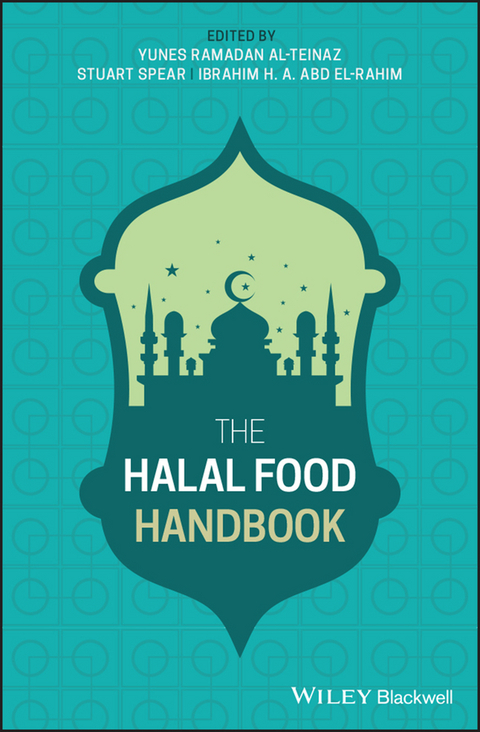
The Halal Food Handbook (eBook)
John Wiley & Sons (Verlag)
978-1-118-82310-1 (ISBN)
A unique handbook providing a set of good practice standards for both producers and consumers of Halal food
This accessible, authoritative book covers all aspects of Halal from its origins through to how we expect Halal to develop in the coming years. It explains what Halal is, where it came from, how it is practiced, and by whom. In addition to putting Halal in a religious and cultural context, the book provides practical standards for those working in the Halal trade. It explains why there are so many different interpretations of Halal and why this needs to be resolved if international trade is to be developed.
Each chapter in The Halal Food Handbook is written by leading experts in their particular field of study. The first one discusses how regulatory bodies have failed to stem the miss selling and adulteration of Halal foods. The next chapters cover the slaughter process and issues around good practice. The book then looks at regulators-covering Sharia law, UK national laws, and the EU-and outlines the legal framework for enforcing the law. It also compares and contrasts different types of religious slaughter for faith foods; examines attempts to set an international standard for trade; and discusses pork adulteration in Halal foods. The final chapter covers other aspects of Halal, including cosmetics, tourism, lifestyle, and banking, and finishes with a look at what the future holds for Halal.
- Written and edited by leading international experts in Halal who are backed by the Muslim Council of Britain
- Presents a set of good practice standards for both producers and consumers of Halal food
- Covers the complexity of the political, legal, and practical dimensions of Halal food production
The Halal Food Handbook will appeal to a wide audience, including abattoirs, manufacturers, retailers, regulators, academics, public bodies catering for Muslims, and the broader Muslim community.
YUNES RAMADAN AL-TEINAZ, manages his own environmental health consultancy practice in London, UK.
STUART SPEAR, is a freelance journalist specializing in environmental health, health and safety, public health, food safety, and housing.
IBRAHIM H. A. ABD EL-RAHIM, is an academic professor in the field of veterinary medicine specializing in infectious diseases of domestic animals.
A unique handbook providing a set of good practice standards for both producers and consumers of Halal food This accessible, authoritative book covers all aspects of Halal from its origins through to how we expect Halal to develop in the coming years. It explains what Halal is, where it came from, how it is practiced, and by whom. In addition to putting Halal in a religious and cultural context, the book provides practical standards for those working in the Halal trade. It explains why there are so many different interpretations of Halal and why this needs to be resolved if international trade is to be developed. Each chapter in The Halal Food Handbook is written by leading experts in their particular field of study. The first one discusses how regulatory bodies have failed to stem the miss selling and adulteration of Halal foods. The next chapters cover the slaughter process and issues around good practice. The book then looks at regulators covering Sharia law, UK national laws, and the EU and outlines the legal framework for enforcing the law. It also compares and contrasts different types of religious slaughter for faith foods; examines attempts to set an international standard for trade; and discusses pork adulteration in Halal foods. The final chapter covers other aspects of Halal, including cosmetics, tourism, lifestyle, and banking, and finishes with a look at what the future holds for Halal. Written and edited by leading international experts in Halal who are backed by the Muslim Council of Britain Presents a set of good practice standards for both producers and consumers of Halal food Covers the complexity of the political, legal, and practical dimensions of Halal food production The Halal Food Handbook will appeal to a wide audience, including abattoirs, manufacturers, retailers, regulators, academics, public bodies catering for Muslims, and the broader Muslim community.
YUNES RAMADAN AL-TEINAZ, manages his own environmental health consultancy practice in London, UK. STUART SPEAR, is a freelance journalist specializing in environmental health, health and safety, public health, food safety, and housing. IBRAHIM H. A. ABD EL-RAHIM, is an academic professor in the field of veterinary medicine specializing in infectious diseases of domestic animals.
Notes on Contributors
Dr Majed Alhariri
Dr Majed Alhariri is a food scientist who holds a PhD in Food Science and Technology from Cairo University. He carries out research on natural antioxidants and anticancer agents, focusing on halal auditing, halal program training, and halal assurance systems. Dr Majed has developed a program of halal assurance system training to increase understanding of this area. He is currently working in GIMDES as R&D Coordinator and Lead Auditor. He has many published scientific articles and has given scientific presentations on halal topics worldwide at international conferences.
Dr Hani Mansour M. Al‐Mazeedi
Dr Hani Mansour M. Al‐Mazeedi is a Kuwaiti scientist who specializes in halal requirements for food and non‐food products and food safety management systems (HACCP/pre‐requisite programs and ISO22000). Dr Mazeedi obtained his BSc from USA and his PhD from UK and is the author of a number of books, such as Concepts on Food Hygiene (1998), Practical Guide to Food Safety (2002), and a six‐book series, My Food, to be published in 2019. He also published a four‐part book series entitled Index of Official Papers Related to Food and Slaughter According to Islamic Rites over the period of 1979–2017. Since 2011, through the Kuwait government (Ministry of Awqaf and Islamic Affairs and Kuwait Institute for Scientific Research) and the Gulf Standard Organization of the GCC Cooperation Council for the Arab States of the Gulf, he has organized several Gulf conferences on the halal industry and its services in Kuwait. Being an international speaker, Dr Mazeedi has over 35 years of experience of delivering presentations on the halal industry and its services and food safety systems in countries including South Africa, Thailand, Malaysia, India, Russia, Denmark, France, Turkey, Syria, Yemen, the United Arab Emirates, Saudi Arabia, the USA, and Brazil. Since 1981 he has represented Kuwait when visiting halal certification bodies in major meat exporting countries, such as New Zealand, Australia, Malaysia, Russia, France, Denmark, Belgium, Turkey, the USA, and Brazil. Dr Mazeedi won the Halal Journal Award (Malaysia) in 2009.
Dr Mehmet Haluk Anil
Mehmet is a former Senior Research Fellow of the Veterinary School, University of Bristol, UK, and Professor of Medical Physiology at the Higher Education Council, Turkey. He has been a consultant/expert scientist for several organizations, including Cardiff University, Agriculture Development Board (AHDB), European Food Standards Agency (EFSA), Royal Society for the Prevention of Cruelty to Animals (RSPCA), UK. He has been a research leader for projects funded by the UK Department for the Environment, Food and Rural Affairs, the Food Standards Agency and the European Commission. His research interests include farm animal physiology, animal welfare with particular reference to stunning and slaughter, and food safety. He is currently an assessor for food control and safety, an assessor for halal production and certification for the Dubai Municipality, a tutor for DG‐SANTE courses and an lRSPCA/FAO consultant.
Professor Dr Faqir Muhammad Anjum
Professor Dr Faqir Muhammad Anjum is a renowned and well‐respected expert in food science and technology not only in Pakistan but also worldwide. He holds two PhD degrees, one in Grain Science from Kansas State University, USA and other in Food Technology from the University of Agriculture, Faisalabad, Pakistan. He has a solid scientific/academic food research background, particularly in the field of halal science. He possess 38 years of teaching and research experience. He is presently working as Vice Chancellor (President) of the University of the Gambia, The Gambia. He is food scientist with international publications and research projects.
Dr Muhammad Sajid Arshad
Dr Muhammad Sajid Arshad is currently working as Assistant Professor at the Institute of Home and Food Sciences, Government College University, Faisalabad, Pakistan. He served as visiting research scholar at the University of Illinois, Urbana Champaign, USA for a period of six months. He received his doctoral degree from the University of Agriculture, Faisalabad, Pakistan in 2013. From 2016 to 2017 he worked as a post‐doctoral researcher at Kyungpook National University, South Korea. He is the author of about 35 publications and has five book chapters to his credit. His area of research is food science, particularly meat science and halal foods.
Dr Rossella Bottoni
Rossella Bottoni specializes in law and religion. She wrote her PhD dissertation on the origins of secularism in Turkey (1839–1938), and it received the 2007 Arturo Carlo Jemolo Award for the best PhD dissertation in law and religion‐related disciplines. She is currently Researcher and Adjunct Professor of Religious Factor and New Constitutions: Europe and Africa in the Faculty of Political and Social Sciences at the Catholic University of Milan, and Adjunct Professor of Law and Religion in the Department of Political and Legal Sciences and International Studies at the University of Padua, Italy. Her research interests include the legal regulation of religious slaughter in the EU and EU member states, the accommodation of religious and ethical dietary rules in secular legal systems, secularism, Islam and religious minorities in Turkey, the legal condition of Islam in European countries, and legal pluralism.
Mary Critchley
After obtaining a first degree at London University, Mary Critchley worked as a teacher in British state schools. A concern for all aspects of animal health led her, at the beginning of the 2001 UK foot and mouth disaster, to set up the public information website warmwell.com. Updated daily from 2001 to her retirement in 2016, the website provided a platform for experts in veterinary science, diagnostics, virology, and public health, as well as for concerned and informed members of the public, to contribute to the debate on governmental livestock disease policies.
Magfirah Dahlan
Magfirah Dahlan receives her PhD from Virginia Tech. She specializes in the ethics and politics of religious food practices. She is a faculty in Philosophy, Religous Studies and Political Science at Craven Community College. Her research interests include religious ethics, food ethics, food politics, animal ethics, posthumanism, and postliberalism. Her current project is a monograph on the religious, ethical, and political aspects of modern meat.
Dr Adrian Evans
Adrian is a Senior Research Fellow at the Centre for Agro ecology Water and Resilience (CAWR) at Coventry University. His current research seeks to understand food and drink consumption practices, especially in relation to exploring the ethics, sustainability, and resilience of different types of food consumption. He has a particular interest in understanding the embodied nature of food consumption practices. He also researches the cultural and political embeddedness of different markets for food and drink, and explores the interconnections between food consumption and systems of provision, distribution, and ownership.
Professor Dr M. Diaa El‐Din H. Farag
Professor Farag is Chairman of the Industrial Irradiation Division, Atomic Energy Authority, Nasr City, Egypt. He was Head of the Food Irradiation Research Department, Former National Center for Radiation Research and Technology (NCRRT).
Professor Dr Beniamino Cenci Goga
Beniamino is currently Head of the Food Bacteriology Laboratory at the Faculty of Veterinary Medicine, University of Perugia. He has a background in private practice, research, and academia, and consults for slaughterhouses and private companies. His research interests lie in veterinary public health, community‐oriented veterinary extension, livestock and animal welfare, and veterinary regulation. He is the Italian primary investigator of the EU‐funded project DIALREL (FP6–2005‐FOOD‐4‐C) on animal welfare and religious slaughter. He is an expert for the European Commission (Research Directorate‐General) and for the European Food Safety Authority, as well as Deputy for the ERASMUS scheme of the School of Veterinary Medicine, Perugia, Italy and Lead Auditor for Quality Management Systems (ISO 19011).
Professor Dr Temple Grandin
Professor Grandin is a Professor of Animal Science at Colorado State University and the owner of Grandin Livestock Handling Systems, Inc. Her entire career has been dedicated to animal welfare, including major contributions to the improvement of animal welfare during the religious slaughter of animals. She also works to help those with autism. Dr Grandin is generally considered the foremost animal welfare expert in the world. She was listed as one of the 100 most influential people by Time Magazine in 2010 and a movie about her early life won the Emmy in 2010 as the best documentary movie along with six other Emmy awards.
Dr Shahzad Hussain
Dr Shahzad Hussain is currently working as Associate Professor in the Food Science and Nutrition Department, College of Food and Agricultural Sciences, King Saud University Riyadh, Saudi Arabia. He also served as a Trained Sensory Panellist at the Department of Food Science and Nutrition, University of Minnesota, USA for a period of six months in 2008. He received a University Merit Scholarship for the duration of his academic carrier. He has published a number of research and review articles in journals of high repute. His particular area of research is...
| Erscheint lt. Verlag | 8.1.2020 |
|---|---|
| Sprache | englisch |
| Themenwelt | Geisteswissenschaften ► Religion / Theologie ► Islam |
| Naturwissenschaften ► Biologie | |
| Technik ► Lebensmitteltechnologie | |
| Weitere Fachgebiete ► Land- / Forstwirtschaft / Fischerei | |
| Schlagworte | abbatoir • animal welfare</p> • Department of Health • Fleisch, Fisch, Geflügel • Food Legislation • Food regulation • Food Safety • food science • Food Science & Technology • Food Standards • Food Types • Halal Food • Halal Standards • International Trade • Islam • Lebensmittel • Lebensmittelforschung u. -technologie • Lebensmittel-Gesetzgebung • <p>Halal • Meat, Fish & Poultry • Muslim law • religious slaughter • Slaughterhouse |
| ISBN-10 | 1-118-82310-9 / 1118823109 |
| ISBN-13 | 978-1-118-82310-1 / 9781118823101 |
| Informationen gemäß Produktsicherheitsverordnung (GPSR) | |
| Haben Sie eine Frage zum Produkt? |
 EPUB (Adobe DRM)
Kopierschutz: Adobe-DRM
Adobe-DRM ist ein Kopierschutz, der das eBook vor Mißbrauch schützen soll. Dabei wird das eBook bereits beim Download auf Ihre persönliche Adobe-ID autorisiert. Lesen können Sie das eBook dann nur auf den Geräten, welche ebenfalls auf Ihre Adobe-ID registriert sind.
Details zum Adobe-DRM
Dateiformat: EPUB (Electronic Publication)
EPUB ist ein offener Standard für eBooks und eignet sich besonders zur Darstellung von Belletristik und Sachbüchern. Der Fließtext wird dynamisch an die Display- und Schriftgröße angepasst. Auch für mobile Lesegeräte ist EPUB daher gut geeignet.
Systemvoraussetzungen:
PC/Mac: Mit einem PC oder Mac können Sie dieses eBook lesen. Sie benötigen eine
eReader: Dieses eBook kann mit (fast) allen eBook-Readern gelesen werden. Mit dem amazon-Kindle ist es aber nicht kompatibel.
Smartphone/Tablet: Egal ob Apple oder Android, dieses eBook können Sie lesen. Sie benötigen eine
Geräteliste und zusätzliche Hinweise
Buying eBooks from abroad
For tax law reasons we can sell eBooks just within Germany and Switzerland. Regrettably we cannot fulfill eBook-orders from other countries.
aus dem Bereich