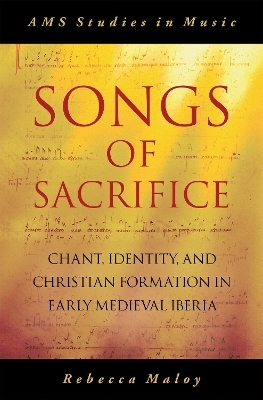
Songs of Sacrifice
Oxford University Press Inc (Verlag)
978-0-19-007153-0 (ISBN)
Between the seventh and eleventh centuries, Christian worship on the Iberian Peninsula was structured by rituals of great theological and musical richness, known as the Old Hispanic (or Mozarabic) rite. Much of this liturgy was produced during a seventh-century cultural and educational program aimed at creating a society unified in the Nicene faith, built on twin pillars of church and kingdom. Led by Isidore of Seville and subsequent generations of bishops, this cultural renewal effort began with a project of clerical education, facilitated through a distinctive culture of textual production.
Rebecca Maloy's Songs of Sacrifice argues that liturgical music--both texts and melodies--played a central role in the cultural renewal of early Medieval Iberia, with a chant repertory that was carefully designed to promote the goals of this cultural renewal. Through extensive reworking of the Old Testament, the creators of the chant texts fashioned scripture in ways designed to teach biblical exegesis, linking both to patristic traditions--distilled through the works of Isidore of Seville and other Iberian bishops--and to Visigothic anti-Jewish discourse. Through musical rhetoric, the melodies shaped the delivery of the texts to underline these messages. In these ways, the chants worked toward the formation of individual Christian souls and a communal Nicene identity. Examining the crucial influence of these chants, Songs of Sacrifice addresses a plethora of long-debated issues in musicology, history, and liturgical studies, and reveals the potential for Old Hispanic chant to shed light on fundamental questions about how early chant repertories were formed, why their creators selected particular passages of scripture, and why they set them to certain kinds of music.
Rebecca Maloy is Professor of Music and the University of Colorado Boulder, specializing in plainsong, liturgy and ritual, and the theory and analysis of early music. She is the author of Inside the Offertory: Aspects of Chronology and Transmission (2010), the co-author, with Emma Hornby, of Music and Meaning in Old Hispanic Lenten Chants (2013), and the co-editor, with Daniel J. DiCenso, of Chant, Liturgy, and the Inheritance of Rome (2017). Her current and recent work has been supported by funding from the European Research Council, the Arts and Humanities Research Council in the UK, the American Council of Learned Societies, and the Institute for Advanced Study in Princeton.
INTRODUCTION
Old Hispanic Chant and the Visigothic Context
CHAPTER 1
The Sacrificium
CHAPTER 2
Liturgy, Patristic Learning, and Christian Formation
CHAPTER 3
From Scripture to Chant: Biblical Exegesis and Communal Identity in the Sacrificia
CHAPTER 4
The Melodic Language
CHAPTER 5
Sounding Prophecy: Words and Music in the Sacrificia
CHAPTER 6
The Broader Old Hispanic Tradition: Aspects of Melodic Transmission
CHAPTER 7
Connections beyond Hispania
CONCLUSION
APPENDIX
Manuscripts with Sacrificia and Their Sigla
BIBLIOGRAPHY
INDEX OF CHANTS
GENERAL INDEX
| Erscheinungsdatum | 29.06.2020 |
|---|---|
| Reihe/Serie | AMS Studies in Music |
| Zusatzinfo | 135 musical examples, 250 inline images, 48 tables with 83 images |
| Verlagsort | New York |
| Sprache | englisch |
| Maße | 236 x 160 mm |
| Gewicht | 703 g |
| Themenwelt | Religion / Theologie ► Christentum ► Kirchengeschichte |
| ISBN-10 | 0-19-007153-2 / 0190071532 |
| ISBN-13 | 978-0-19-007153-0 / 9780190071530 |
| Zustand | Neuware |
| Informationen gemäß Produktsicherheitsverordnung (GPSR) | |
| Haben Sie eine Frage zum Produkt? |
aus dem Bereich