


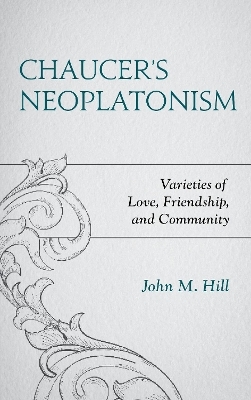
Chaucer's Neoplatonism
Varieties of Love, Friendship, and Community
Seiten
2020
Lexington Books (Verlag)
978-1-4985-6195-2 (ISBN)
Lexington Books (Verlag)
978-1-4985-6195-2 (ISBN)
Chaucer’s Neoplatonism covers his major works and the ways in which he has absorbed a Boethian, essentially rational Neoplatonism. By means of that philosophy he poetically engages issues of truth, falsehood, love, friendship, joy, and community. His widely recognized, capacious humanism arises from that engagement.
Although centrally focused on varieties of friendship and love in Troilus and Criseyde, the discussion in Chaucer’s Neoplatonism includes the dream visions as well as aspects of The Canterbury Tales. It lays out Chaucer’s Boethian-inspired, cognitive approach, drawn mainly from Book V of the Consolatio, to whatever subject he treats. Far from courting skepticism, Chaucer gathers many variants of such matters as love, friendship, and community within a meditative mode that assess better and worse instances. He does so to illuminate a fuller sense of the forms that respectively underlie particular manifestations of love, joy, friendship or community. That process is both cognitive and aesthetic in that beauty and truth appear more fully as one assess both better and worse instances of an idea or of an experience. Chapters on the dream visions establish Chaucer’s reasonable belief in the truth-value of fictions, however grounded on exaggerated and mixed tidings of truth and falsehood. Chapters on Troilus and Criseyde examine relationships between the main characters given the place of noble friendship within an initially promising but then tragic love story. The drama of those relationships become Chaucer’s major claim to fame before the tales of Canterbury, where, for meditative purposes, he gathers various gestures toward community among the dramatically interacting pilgrims, while also exploring the dynamics of reconciliation.
Although centrally focused on varieties of friendship and love in Troilus and Criseyde, the discussion in Chaucer’s Neoplatonism includes the dream visions as well as aspects of The Canterbury Tales. It lays out Chaucer’s Boethian-inspired, cognitive approach, drawn mainly from Book V of the Consolatio, to whatever subject he treats. Far from courting skepticism, Chaucer gathers many variants of such matters as love, friendship, and community within a meditative mode that assess better and worse instances. He does so to illuminate a fuller sense of the forms that respectively underlie particular manifestations of love, joy, friendship or community. That process is both cognitive and aesthetic in that beauty and truth appear more fully as one assess both better and worse instances of an idea or of an experience. Chapters on the dream visions establish Chaucer’s reasonable belief in the truth-value of fictions, however grounded on exaggerated and mixed tidings of truth and falsehood. Chapters on Troilus and Criseyde examine relationships between the main characters given the place of noble friendship within an initially promising but then tragic love story. The drama of those relationships become Chaucer’s major claim to fame before the tales of Canterbury, where, for meditative purposes, he gathers various gestures toward community among the dramatically interacting pilgrims, while also exploring the dynamics of reconciliation.
John M. Hill is professor emeritus of English language and literature at the U.S. Naval Academy.
Chapter One - Chaucer’s Neoplatonism: Varieties of Love, Friendship and Community
Chapter Two - Varieties of Supposition and the Truth Value of Story
Chapter Three - Varieties of Friendship: Pandarus, Troilus and Noble Friendship
Chapter Four - Avuncular Form and Pandarus’s Several Embassies
Chapter Five - Varieties of Joy in Troilus and Criseyde
Chapter Six - Varieties of Invited “Compaignye” in the Pilgrimage to Canterbury
Conclusion - Chaucer’s Neoplatonic Art
| Erscheinungsdatum | 17.02.2020 |
|---|---|
| Reihe/Serie | Studies in Medieval Literature |
| Sprache | englisch |
| Maße | 155 x 222 mm |
| Gewicht | 322 g |
| Themenwelt | Geisteswissenschaften ► Sprach- / Literaturwissenschaft ► Anglistik / Amerikanistik |
| Geisteswissenschaften ► Sprach- / Literaturwissenschaft ► Literaturwissenschaft | |
| ISBN-10 | 1-4985-6195-0 / 1498561950 |
| ISBN-13 | 978-1-4985-6195-2 / 9781498561952 |
| Zustand | Neuware |
| Informationen gemäß Produktsicherheitsverordnung (GPSR) | |
| Haben Sie eine Frage zum Produkt? |
Mehr entdecken
aus dem Bereich

aus dem Bereich
Poetik eines sozialen Urteils
Buch | Hardcover (2023)
De Gruyter (Verlag)
CHF 83,90


