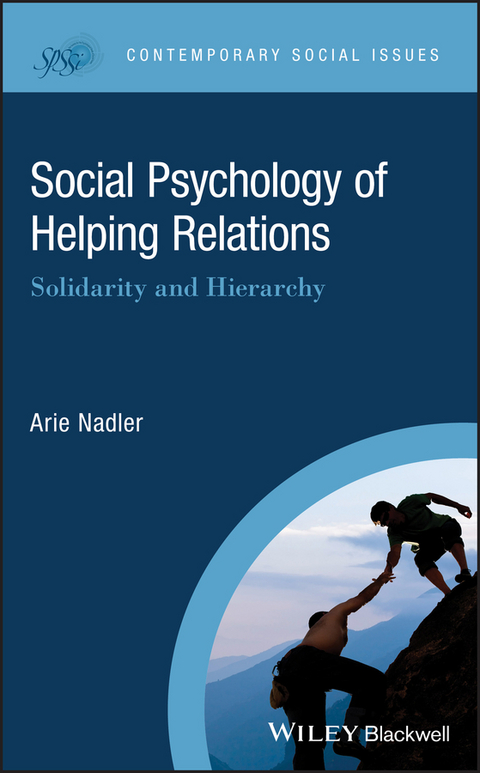
Social Psychology of Helping Relations (eBook)
248 Seiten
John Wiley & Sons (Verlag)
9781118521403 (ISBN)
This unique book extends the traditional emphasis on interpersonal help-giving in order to consider a wider spectrum of interpersonal and intergroup helping relations. Help giving is viewed as reflecting people's care for others, while at the same time dependency on help and giving help imply lower and higher places on the social hierarchy, respectively. It studies the psychology of what goes into helping someone and integrates experimental work conducted in the social psychological laboratory with applied research from volunteer organizations, schools, and work and family environments. In addition to research on the giving of help, the book considers the recipient of help and reviews research and theory on people's readiness to seek and receive help. Unlike much of past research in this context that has been interested in the "generosity question" (i.e., whether or not people help others) the book considers how different kinds of assistance (i.e., autonomy and dependency-oriented help) shape helping interactions. It then goes beyond the analyses of the immediate helping interaction to consider the long-term consequences of giving and receiving help. Finally, the book addresses theory and research on intergroup helping relations.
Social Psychology of Helping Relations: Solidarity and Hierarchy begins with a general introduction to the topic. It then offers a series of broad perspectives, covering the philosophical and psychological theory, evolution, and overview of social psychological research. Next, the book looks at the social psychology of helping relations, examining the parties involvedt, and the "why" behind their actions. The positives and negatives of giving and receiving assistance, and the links between status and interpersonal and intergroup helping relations are also covered. It considers how giving, seeking and receiving help maintains or challenges status relations between individuals and groups. The book finishes with a conclusion that wraps up the many lessons learned.
* Looks at solidarity and inequality in social interactions
* Examines why people are ready to give and receive help
* Studies the consequences of giving and receiving help
* Highlights important implications to different kinds of help beyond the dichotomy between giving/receiving help or not
* Addresses research and theory on interpersonal and intergroup helping relations
* The implications of helping relations for personal and social change
Social Psychology of Helping Relations: Solidarity and Hierarchy is an ideal book for advanced students, researchers and individuals interested in social psychology, counselling, social work, Sociology, and Political Science.
ARIE NADLER, PHD is Professor Emeritus of Psychology at Tel Aviv University. He has authored more than 100 scholarly papers and chapters and edited 6 scholarly books in Social Psychology. He was the incumbent of the Argentina Chair for Research in Social Psychology, the Head of the Department of Psychology, and the Dean of the Faculty of Social Sciences at Tel Aviv University. He was also the academic director of the Tami Steinmetz Center for Peace Research, and the head of the Institute of Diplomacy and Regional Cooperation at Tel Aviv University.
| Erscheint lt. Verlag | 9.12.2019 |
|---|---|
| Reihe/Serie | Contemporary Social Issues | Contemporary Social Issues |
| Sprache | englisch |
| Themenwelt | Geisteswissenschaften ► Psychologie ► Sozialpsychologie |
| Schlagworte | Psychologie • Psychology • Social Psychology • Sozialpsychologie |
| ISBN-13 | 9781118521403 / 9781118521403 |
| Informationen gemäß Produktsicherheitsverordnung (GPSR) | |
| Haben Sie eine Frage zum Produkt? |
 PDF (Adobe DRM)
Kopierschutz: Adobe-DRM
Adobe-DRM ist ein Kopierschutz, der das eBook vor Mißbrauch schützen soll. Dabei wird das eBook bereits beim Download auf Ihre persönliche Adobe-ID autorisiert. Lesen können Sie das eBook dann nur auf den Geräten, welche ebenfalls auf Ihre Adobe-ID registriert sind.
Details zum Adobe-DRM
Dateiformat: PDF (Portable Document Format)
Mit einem festen Seitenlayout eignet sich die PDF besonders für Fachbücher mit Spalten, Tabellen und Abbildungen. Eine PDF kann auf fast allen Geräten angezeigt werden, ist aber für kleine Displays (Smartphone, eReader) nur eingeschränkt geeignet.
Systemvoraussetzungen:
PC/Mac: Mit einem PC oder Mac können Sie dieses eBook lesen. Sie benötigen eine
eReader: Dieses eBook kann mit (fast) allen eBook-Readern gelesen werden. Mit dem amazon-Kindle ist es aber nicht kompatibel.
Smartphone/Tablet: Egal ob Apple oder Android, dieses eBook können Sie lesen. Sie benötigen eine
Geräteliste und zusätzliche Hinweise
Buying eBooks from abroad
For tax law reasons we can sell eBooks just within Germany and Switzerland. Regrettably we cannot fulfill eBook-orders from other countries.
aus dem Bereich