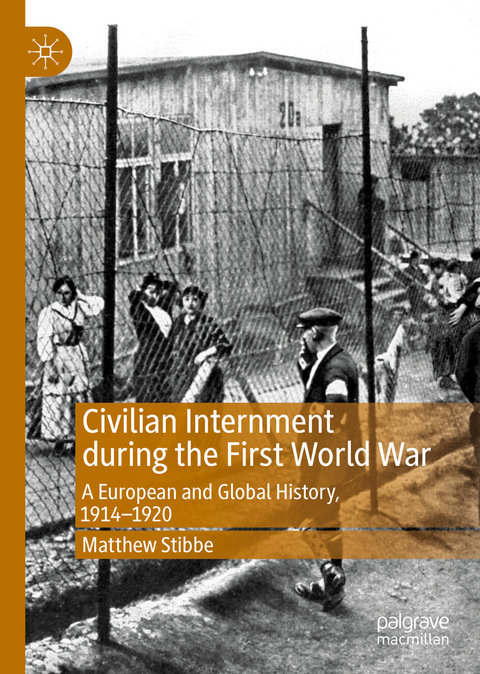
Civilian Internment during the First World War (eBook)
XI, 335 Seiten
Palgrave Macmillan UK (Verlag)
978-1-137-57191-5 (ISBN)
Matthew Stibbe is Professor of Modern European History at Sheffield Hallam University. UK. A twentieth-century specialist working across and beyond the borders of Europe, he has co-edited two essay collections on First World War captivity, and is author of the British Civilian Internees in Germany: The Ruhleben Camp, 1914-18 (2008).
This book is the first major study of civilian internment during the First World War as both a European and global phenomenon. Based on research spanning twenty-eight archives in seven countries, this study explores the connections and continuities, as well as ruptures, between different internment systems at the local, national, regional and imperial levels. Arguing that the years 1914-20 mark the essential turning point in the transnational and international history of the detention camp, this book demonstrates that wartime civilian captivity was inextricably bound up with questions of power, world order and inequalities based on class, race and gender. It also contends that engagement with internees led to new forms of international activism and generated new types of transnational knowledge in the spheres of medicine, law, citizenship and neutrality. Finally, an epilogue explains how and why First World War internment is crucial to understanding the world we live in today.
Acknowledgements 5
Contents 6
Abbreviations 7
Glossary of Terms 9
Chapter 1: Introduction 10
The Historical Specificity of First World War Internment 15
Sources and the Question of Differentiation Between Civilian and Military Captivity 22
The Structure of This Book 25
Chapter 2: First World War Internment Across the Globe 40
Germans and Austro-Hungarians 44
The German and Habsburg Empires’ Response 55
Ottoman Turkey, Bulgaria and the Balkans 65
Chapter 3: Internment and War Governance in the First World War 86
France 90
Britain 98
Germany 107
Austria-Hungary 111
War Governance, Camps and the Turkish Genocide Against the Ottoman Armenians, 1915–16 121
Chapter 4: Imagining Internment: International Law, Social Order and National Community 138
International Law and Perceptions of the ‘Other’: The View of Officials 143
Reprisals and Punishments 154
Internment and Social Control 161
Internment and Ideas About ‘National Community’ 172
Chapter 5: Internment and International Activism: The Search for More Humane Alternatives 192
Pre-war Precedents: Emily Hobhouse and the South African Camps 195
The Auskunfts- und Hilfsstelle für Deutsche im Ausland und Ausländer in Deutschland 198
The Auskunfts- und Hilfsstelle and the ICRC 204
Neutral Internment in Switzerland and the Netherlands 213
Barbed-Wire Disease and the ‘Medicalisation’ of Internment 220
Chapter 6: (Not) Ending Internment: The Years 1918–20 247
Wartime Civilian Captivity in Russia from Tsar Nicholas II to Lenin 251
Germany and Austria-Hungary 259
Imperial Britain and Its Allies in Africa, Asia and the Atlantic Ocean 268
France, Italy and the ‘Little Entente’ (Romania, Czechoslovakia, Yugoslavia) 276
The ‘Red Scare’: The Americas 281
Chapter 7: Conclusion and Epilogue 298
Bibliography 322
Archival Sources 322
Austria 322
Germany 322
Italy 323
Portugal 323
Switzerland 323
United Kingdom/British Isles 323
United States 323
Contemporary Government Publications 323
Red Cross, Quaker and Medical Publications 325
Eye-Witness and Documentary Accounts, Diaries, Memoirs and Other Printed Primary Sources 326
Select List of Secondary Sources 327
Unpublished Dissertations 336
Novels 337
Index 338
| Erscheint lt. Verlag | 14.11.2019 |
|---|---|
| Zusatzinfo | XI, 335 p. |
| Sprache | englisch |
| Themenwelt | Geisteswissenschaften ► Geschichte ► Allgemeine Geschichte |
| Geisteswissenschaften ► Geschichte ► Regional- / Ländergeschichte | |
| Geschichte ► Teilgebiete der Geschichte ► Kulturgeschichte | |
| Geschichte ► Teilgebiete der Geschichte ► Militärgeschichte | |
| Schlagworte | barbed wire disease • Civilian Internment • European History • First World War • History of Military |
| ISBN-10 | 1-137-57191-8 / 1137571918 |
| ISBN-13 | 978-1-137-57191-5 / 9781137571915 |
| Informationen gemäß Produktsicherheitsverordnung (GPSR) | |
| Haben Sie eine Frage zum Produkt? |
 PDF (Wasserzeichen)
DRM: Digitales Wasserzeichen
Dieses eBook enthält ein digitales Wasserzeichen und ist damit für Sie personalisiert. Bei einer missbräuchlichen Weitergabe des eBooks an Dritte ist eine Rückverfolgung an die Quelle möglich.
Dateiformat: PDF (Portable Document Format)
Mit einem festen Seitenlayout eignet sich die PDF besonders für Fachbücher mit Spalten, Tabellen und Abbildungen. Eine PDF kann auf fast allen Geräten angezeigt werden, ist aber für kleine Displays (Smartphone, eReader) nur eingeschränkt geeignet.
Systemvoraussetzungen:
PC/Mac: Mit einem PC oder Mac können Sie dieses eBook lesen. Sie benötigen dafür einen PDF-Viewer - z.B. den Adobe Reader oder Adobe Digital Editions.
eReader: Dieses eBook kann mit (fast) allen eBook-Readern gelesen werden. Mit dem amazon-Kindle ist es aber nicht kompatibel.
Smartphone/Tablet: Egal ob Apple oder Android, dieses eBook können Sie lesen. Sie benötigen dafür einen PDF-Viewer - z.B. die kostenlose Adobe Digital Editions-App.
Buying eBooks from abroad
For tax law reasons we can sell eBooks just within Germany and Switzerland. Regrettably we cannot fulfill eBook-orders from other countries.
aus dem Bereich