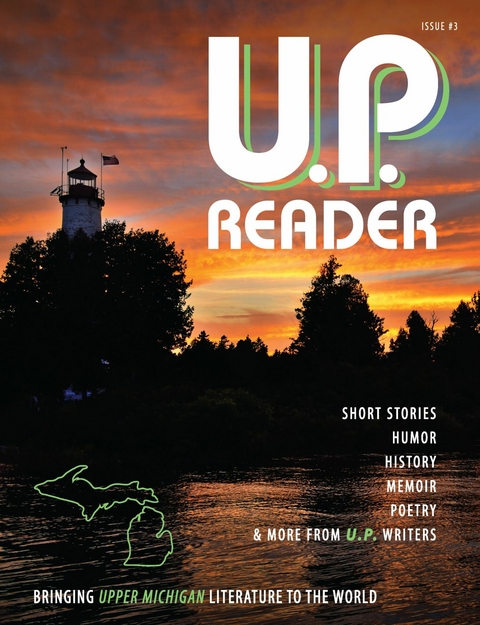
U.P. Reader -- Issue #3 (eBook)
96 Seiten
Modern History Press (Verlag)
978-1-61599-449-6 (ISBN)
Michigan's Upper Peninsula is blessed with a treasure trove of storytellers, poets, and historians, all seeking to capture a sense of Yooper Life from settler's days to the far-flung future. Since 2017, the U.P. Reader offers a rich collection of their voices that embraces the U.P.'s natural beauty and way of life, along with a few surprises.
The twenty-three works in this third annual volume take readers on U.P. road and boat trips from the Keweenaw to the Soo. Every page is rich with descriptions of the characters and culture that make the Upper Peninsula worth living in and writing about. U.P. writers span genres from humor to history and from science fiction to poetry. This issue also includes imaginative fiction from the Dandelion Cottage Short Story Award winners, honoring the amazing young writers enrolled in all of the U.P.'s schools.
Featuring the words of Larry Buege, Mikel B. Classen, Deborah K. Frontiera, Jan Kellis, Amy Klco, David Lehto, Sharon Kennedy, Bobby Mack, Becky Ross Michael, T. Sanders, Donna Searight Simons and Frank Searight, Emma Locknane, Lucy Woods, Kaitlin Ambuehl, T. Kilgore Splake, Aric Sundquist, Ninie G. Syarikin, and Tyler R. Tichelaar.
'U.P. Reader offers a wonderful mix of storytelling, poetry, and Yooper culture. Here's to many future volumes!'
--Sonny Longtine, author of Murder in Michigan's Upper Peninsula
'As readers embark upon this storied landscape, they learn that the people of Michigan's Upper Peninsula offer a unique voice, a tribute to a timeless place too long silent.' --Sue Harrison, international bestselling author of Mother Earth Father Sky 'I was amazed by the variety of voices in this volume. U.P. Reader offers a little of everything, from short stories to nature poetry, fantasy to reality, Yooper lore to humor. I look forward to the next issue.' --Jackie Stark, editor, Marquette Monthly
The U.P. Reader is sponsored by the Upper Peninsula Publishers and Authors Association (UPPAA) a non-profit 501(c)3 corporation. A portion of proceeds from each copy sold will be donated to the UPPAA for its educational programming.
Michigan's Upper Peninsula is blessed with a treasure trove of storytellers, poets, and historians, all seeking to capture a sense of Yooper Life from settler's days to the far-flung future. Since 2017, the U.P. Reader offers a rich collection of their voices that embraces the U.P.'s natural beauty and way of life, along with a few surprises. The twenty-three works in this third annual volume take readers on U.P. road and boat trips from the Keweenaw to the Soo. Every page is rich with descriptions of the characters and culture that make the Upper Peninsula worth living in and writing about. U.P. writers span genres from humor to history and from science fiction to poetry. This issue also includes imaginative fiction from the Dandelion Cottage Short Story Award winners, honoring the amazing young writers enrolled in all of the U.P.'s schools. Featuring the words of Larry Buege, Mikel B. Classen, Deborah K. Frontiera, Jan Kellis, Amy Klco, David Lehto, Sharon Kennedy, Bobby Mack, Becky Ross Michael, T. Sanders, Donna Searight Simons and Frank Searight, Emma Locknane, Lucy Woods, Kaitlin Ambuehl, T. Kilgore Splake, Aric Sundquist, Ninie G. Syarikin, and Tyler R. Tichelaar. "e;U.P. Reader offers a wonderful mix of storytelling, poetry, and Yooper culture. Here's to many future volumes!"e; --Sonny Longtine, author of Murder in Michigan's Upper Peninsula "e;As readers embark upon this storied landscape, they learn that the people of Michigan's Upper Peninsula offer a unique voice, a tribute to a timeless place too long silent."e; --Sue Harrison, international bestselling author of Mother Earth Father Sky "e;I was amazed by the variety of voices in this volume. U.P. Reader offers a little of everything, from short stories to nature poetry, fantasy to reality, Yooper lore to humor. I look forward to the next issue."e; --Jackie Stark, editor, Marquette Monthly The U.P. Reader is sponsored by the Upper Peninsula Publishers and Authors Association (UPPAA) a non-profit 501(c)3 corporation. A portion of proceeds from each copy sold will be donated to the UPPAA for its educational programming.
#2 Pencils
by Deborah K. Frontiera
Whenever I look at a pencil—especially those plain, yellow, six-sided #2 pencils—school, and therefore teachers, come to mind. Pencils and teachers—they are forever intertwined. My personal favorite pencil was the #4 because the harder lead stayed sharp longer. I detest dull pencils. Since the advent of the standardized tests which require a #2, I’m not even sure if they make #4 anymore. Those fill-in-the-bubble tests made their debut while I was in high school, and we had to take the ACT or SAT for college entrance. There were no prep classes and all the nonsense there is today. Our test prep was to get a good night’s sleep and to eat a hearty breakfast on the day of the test, and don’t forget—you have to bring #2 pencils.
Our teachers simply taught their subject matter. Some of them better than others, of course. Some of them more memorable than others—for better and for worse. So begins this mind ramble about pencils and teachers.
•••
Mrs. T came to my name on her sixth grade class roster, “De-BOR-ah Olson.”
Indignant, I responded, “It’s DEB-or-ah, preferably Debbie.” She glared at me over the top of her reading glasses and down her pointed witch’s nose, and called out the next name.
Okay, we both set a bad tone for the first day of the school year, but SHE started it! Or maybe my four older siblings, who had also had Mrs. T for their sixth grade teacher, set up the bad reputation for our family name. That’s a good possibility since another teacher—the high school math teacher whom I would meet in the next year in 7th grade—had this response when he saw my name on the roster, “Another Olson?!”
“Don’t worry; I’m the last one,” was my response that time. Mr. M and I did get along, though, even if I wasn’t his top math student—never had much of a sense of mathematical logic.
That lack of mathematic sense was due in a large part to Mrs. T, who taught strictly by rote memorization of the “rules” of adding, subtracting, multiplying and dividing. Mrs. T. probably taught by rote because that was how she had learned. Looking back, she probably didn’t understand the basic concepts herself, couldn’t explain them, and therefore taught the way she was taught, and God help you if you asked a question she couldn’t answer!
I did that—asked questions—a lot! I was always asking her questions she couldn’t answer. Did I do it on purpose? Yes and no. I was curious. I wanted to know about a lot of things. I’d always been a question-asker, but I don’t remember my previous elementary teachers being so bugged by my questions. Maybe I asked simpler questions at those younger ages and my previous teachers could still answer them. But by 6th grade, I was trying mightily to put some logic to this math stuff—and I have a very strange sense of logic.
When we began to work on multiplying and dividing fractions, my sense of logic completely fell apart. “Mrs. T,” I asked one day, in my best voice, not wanting to be yelled at—again—but genuinely wanting an explanation, “why is it that when you multiply numbers, you get bigger numbers, but when you multiply fractions, you get smaller fractions?” It really made NO sense to me at all. (Much later in college, I would finally understand that multiplying fractions “thing” when I had a class called “Math for Elementary Teachers” that actually explained the concept and also how to teach it.)
It was silent for maybe a minute. Mrs. T. finally spoke, “Well, because that’s the way it is. Multiplying means ‘of’: two groups OF two are four; and ½ OF ¼ is 1/8.”
I was not satisfied. I asked again. Her response was the same, but her tone the second time was clearly irritated. “I still don’t understand. Why is the answer smaller?”
Mrs. T’s third response was that I should be quiet, listen, pay attention, and let her get on with the lesson. Too bad Mrs. T didn’t have all the fancy drawings, charts, pictures and technology available today that would have let me get a clear picture of what she was talking about. But they didn’t teach it that way back then.
That year was very uncomfortable for me. Mrs. T made me sit right in front of her desk, her nose always looking down on me condescendingly, like I was nobody and should just keep my mouth shut. Often, she didn’t even call on me when my hand was up—even to answer a question, because I’d ask a question before I answered hers.
I hated sixth grade. I soaped her windows thoroughly on the night before Halloween! That was the tradition in the village of Lake Linden where I grew up. October 30th was Fawkes Night. I think it came from an English tradition about some man named Guy Fawkes who snatched something valuable from under the eyes of English military guards, and then actually put it back the next night—or so we were told. There were a lot of “Cousin Jack” English in Lake Linden (balancing out the French Canadians) which is probably the reason we had such a “celebration.” Now, the actual history behind it had something to do with planting explosives in the Parliament building in England on Nov. 5, 1605—and there was a lot of Catholic/Protestant stuff behind it—you can look it up on the internet if you are interested. For us, Oct. 30/Fawkes Night, had to do with playing tricks on people like rubbing dry soap bars on windowpanes, overturning trash cans, and other such fairly harmless pranks.
I got my revenge on Mrs. T’s windows and then I did what I had to do for the rest of the school year and endured Mrs. T. She receives an F on my teacher report card.
•••
Much later in life, when I chose teaching for a career, I realized Mrs. T had taught me an excellent lesson: Do not be that kind of teacher!
When I became a kindergarten teacher, I put those “do nots” to use in my own classroom. I embraced my children’s crazy senses of logic and guided them through such things without belittling them.
An example: The nickel should be 10 cents and the dime 5 because the nickel is bigger—therefore worth more in a five-year-old’s sense of logic.
“I know it doesn’t seem to make sense,” I would respond. “Yes, it seems that the bigger coin should be worth more, because the quarter is worth the most, but somebody else decided the dime is 10 cents and you just have to remember it. I’m sorry.” (Fifty-cent pieces had pretty much disappeared by then, or at least were not introduced in kindergarten.)
Or: “Mommy taught me to print my name with all big letters.”
“Yes, and she did a really good job of it, too. You write your name very well. That’s the ‘home’ way you learned and you can keep doing that at home. Now I’m teaching you the ‘kindergarten’ way to write your name, and we use one big letter and the rest little.”
Or the day the two Spanish-speaking children came to me on the playground.
“Se habla Espanol?”
“Mui poco,” (Very little—which was a stretch because I could barely count to ten and say the above phrase properly.)
The two of them had obviously been arguing about something. They both started talking at once. I put my hand up to stop one with a gesture and pointed to the other to speak. Number 2 began to interrupt. I said, “No, wait,” and continued to point to Number 1. When Number 1 finished, I pointed to Number 2, who took her turn, saying her side. When she finished, I pointed back to the first. Their voices changed and pretty soon the two little girls were hugging each other and ran off to play. I have no clue what the argument was about. They just needed a mediator.
I also never put students down for poor grammar. I would simply say a phrase correctly in context several times throughout the day. Sometimes I’d talk about “home talk” and “school talk” without ever making one better or worse, just different.
•••
I never went to visit Mrs. T. once sixth grade was over. But thanks, Mrs. T., your negative teaching style with me had an indirect effect on over 500 children a generation later. Several of them came back over the years to visit me and say thanks and tell me the sweet memories they had of kindergarten. Three years before I “retired,” I met one of them again. I was at a multiple-day workshop to prepare to pass a test—to be taken using #2 pencils, of course—for the ESL (English as Second Language) endorsement on my teaching certificate—the sort of an endorsement that would let me continue what I’d already been doing for twenty years, but formally, and “on paper.” This young woman looked familiar around the eyes. “Do you remember me, Mrs. Frontiera?” she asked.
“I remember your face, but sorry, not your name.”
She had been in my very first kindergarten class in 1985 at Pugh Elementary in Houston Independent School District!
I shall spend less time on a few other...
| Erscheint lt. Verlag | 1.4.2019 |
|---|---|
| Sprache | englisch |
| Themenwelt | Literatur ► Anthologien |
| Literatur ► Lyrik / Dramatik ► Lyrik / Gedichte | |
| Literatur ► Romane / Erzählungen | |
| Geisteswissenschaften ► Geschichte ► Regional- / Ländergeschichte | |
| Geisteswissenschaften ► Sprach- / Literaturwissenschaft | |
| Schlagworte | American • General • History • Ia • IL • In • KS • literary collections • Local • mi • Midwest • MN • Mo • Nd • Ne • Oh • Poetry • SD • State • United States • WI |
| ISBN-10 | 1-61599-449-1 / 1615994491 |
| ISBN-13 | 978-1-61599-449-6 / 9781615994496 |
| Informationen gemäß Produktsicherheitsverordnung (GPSR) | |
| Haben Sie eine Frage zum Produkt? |
 EPUB (Ohne DRM)
Digital Rights Management: ohne DRM
Dieses eBook enthält kein DRM oder Kopierschutz. Eine Weitergabe an Dritte ist jedoch rechtlich nicht zulässig, weil Sie beim Kauf nur die Rechte an der persönlichen Nutzung erwerben.
Dateiformat: EPUB (Electronic Publication)
EPUB ist ein offener Standard für eBooks und eignet sich besonders zur Darstellung von Belletristik und Sachbüchern. Der Fließtext wird dynamisch an die Display- und Schriftgröße angepasst. Auch für mobile Lesegeräte ist EPUB daher gut geeignet.
Systemvoraussetzungen:
PC/Mac: Mit einem PC oder Mac können Sie dieses eBook lesen. Sie benötigen dafür die kostenlose Software Adobe Digital Editions.
eReader: Dieses eBook kann mit (fast) allen eBook-Readern gelesen werden. Mit dem amazon-Kindle ist es aber nicht kompatibel.
Smartphone/Tablet: Egal ob Apple oder Android, dieses eBook können Sie lesen. Sie benötigen dafür eine kostenlose App.
Geräteliste und zusätzliche Hinweise
Buying eBooks from abroad
For tax law reasons we can sell eBooks just within Germany and Switzerland. Regrettably we cannot fulfill eBook-orders from other countries.
aus dem Bereich