


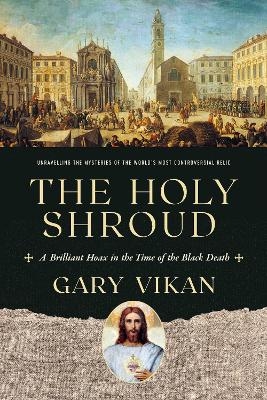
The Holy Shroud
A Brilliant Hoax in the Time of the Black Death
Seiten
2020
Pegasus Books (Verlag)
978-1-64313-432-1 (ISBN)
Pegasus Books (Verlag)
978-1-64313-432-1 (ISBN)
- Keine Verlagsinformationen verfügbar
- Artikel merken
A towering figure in the art world unravels the mystery of the world’s most controversial relic.
The history of the Christian church is strewn with holy relics and artifacts, none more controversial than the Shroud of Turin, the supposed burial cloth of Christ. In The Holy Shroud Gary Vikan shows that the shroud is not the burial cloth of Jesus, but rather a photograph-like body print of a medieval Frenchman created by a brilliant artist serving the royal court in the time of the Black Death.
The Shroud was gifted by King John II to his friend Geoffroi de Charny, the most renowned knight of the Middle Ages, who shortly thereafter died at the disastrous Battle of Poitiers while saving the King’s life. Though intended as nothing more than an innocuous devotional image for Geoffroi’s newly-built church in the French hamlet of Lirey, it was soon misrepresented. Miracles were faked, money was made.
But while other scholars, and even the Catholic Church itself, have never confirmed the authenticity of the Shroud, the question always remained - how did that image get there? Combining copious research and decades of art world experience with an accessible, wry voice, Gary Vikan shows how one of the greatest hoaxes in the history of Christian relics came into being.
The history of the Christian church is strewn with holy relics and artifacts, none more controversial than the Shroud of Turin, the supposed burial cloth of Christ. In The Holy Shroud Gary Vikan shows that the shroud is not the burial cloth of Jesus, but rather a photograph-like body print of a medieval Frenchman created by a brilliant artist serving the royal court in the time of the Black Death.
The Shroud was gifted by King John II to his friend Geoffroi de Charny, the most renowned knight of the Middle Ages, who shortly thereafter died at the disastrous Battle of Poitiers while saving the King’s life. Though intended as nothing more than an innocuous devotional image for Geoffroi’s newly-built church in the French hamlet of Lirey, it was soon misrepresented. Miracles were faked, money was made.
But while other scholars, and even the Catholic Church itself, have never confirmed the authenticity of the Shroud, the question always remained - how did that image get there? Combining copious research and decades of art world experience with an accessible, wry voice, Gary Vikan shows how one of the greatest hoaxes in the history of Christian relics came into being.
Gary Vikan is the former Director of the Walters Art Museum. An internationally known medieval scholar, he holds a PhD in medieval art and has taught at Johns Hopkins University, Carleton College, Goucher College, and the Salzburg Global Seminar. He is the author of Sacred and Stolen and lives in Baltimore, Maryland.
| Erscheinungsdatum | 28.04.2020 |
|---|---|
| Zusatzinfo | 16 pages of color photographs |
| Verlagsort | New York |
| Sprache | englisch |
| Maße | 152 x 229 mm |
| Gewicht | 342 g |
| Themenwelt | Kunst / Musik / Theater ► Kunstgeschichte / Kunststile |
| Geschichte ► Allgemeine Geschichte ► Mittelalter | |
| Geisteswissenschaften ► Geschichte ► Regional- / Ländergeschichte | |
| ISBN-10 | 1-64313-432-9 / 1643134329 |
| ISBN-13 | 978-1-64313-432-1 / 9781643134321 |
| Zustand | Neuware |
| Informationen gemäß Produktsicherheitsverordnung (GPSR) | |
| Haben Sie eine Frage zum Produkt? |
Mehr entdecken
aus dem Bereich


aus dem Bereich
Geschichte einer Augsburger Familie (1367-1650)
Buch | Softcover (2024)
Kohlhammer (Verlag)
CHF 47,60
der epische Kampf um das Heilige Land
Buch | Hardcover (2025)
C.H.Beck (Verlag)
CHF 49,95


