


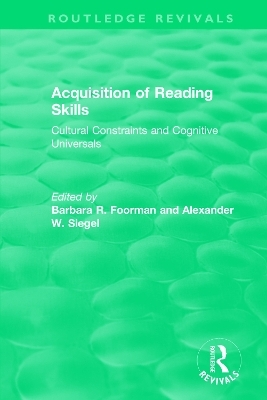
Acquisition of Reading Skills (1986)
Cultural Constraints and Cognitive Universals
Seiten
2019
Routledge (Verlag)
978-1-138-50155-3 (ISBN)
Routledge (Verlag)
978-1-138-50155-3 (ISBN)
Originally published in 1986, this book considers both universal and culturally constrained aspects of the process of learning to read, with the first four chapters exemplifying cognitive universal approaches to reading, and the last four highlighting cultural constraints.
Originally published in 1986.
In literate societies around the world, children begin instruction in reading somewhere between the ages of five and seven years. On one level their tasks are very similar – learn the sound-symbol relationship of their languages and apply their linguistic and cognitive skills to gain meaning from print. On another level their tasks seem to vary – orthographies and sound-symbol relationships differ, and cultures’ attitude towards reading and children’s motivation to achieve range widely.
This book considers both universal and culturally constrained aspects of the process of learning to read, with the first four chapters exemplifying cognitive universal approaches to reading, and the last four highlighting cultural constraints. It will be of use to researchers and students, as well as teachers requiring an insight into how reading skills are acquired.
Originally published in 1986.
In literate societies around the world, children begin instruction in reading somewhere between the ages of five and seven years. On one level their tasks are very similar – learn the sound-symbol relationship of their languages and apply their linguistic and cognitive skills to gain meaning from print. On another level their tasks seem to vary – orthographies and sound-symbol relationships differ, and cultures’ attitude towards reading and children’s motivation to achieve range widely.
This book considers both universal and culturally constrained aspects of the process of learning to read, with the first four chapters exemplifying cognitive universal approaches to reading, and the last four highlighting cultural constraints. It will be of use to researchers and students, as well as teachers requiring an insight into how reading skills are acquired.
Barbara R. Foorman, Alexander W. Siegel
Introduction, Foorman. 1. Cognitive and Linguistic Components of Reading Ability, Perfetti. 2. Some Reflections of Verbal Efficiency Theory, Ghatala. 3. Phonological Skills and Learning to Read and Write, Bryant. 4. Phonological Skills and Learning to Read and Write: Reactions and Implications, Rosner. 5. How do Japanese Children Learn to Read?: Orthographic and Eco-Cultural Variables, Hatano. 6. Non-Alphabetic Codes in Learning to Read: The Case of the Japanese, Foorman. 7. Beginning Reading in Chinese and English, Lee, Stigler, Stevenson. 8. The Reading Achievement Game: Cognitive Universals and Cultural Restraints, Siegel.
| Erscheinungsdatum | 24.10.2019 |
|---|---|
| Reihe/Serie | Routledge Revivals |
| Verlagsort | London |
| Sprache | englisch |
| Maße | 156 x 234 mm |
| Gewicht | 453 g |
| Themenwelt | Geisteswissenschaften ► Psychologie ► Allgemeine Psychologie |
| Geisteswissenschaften ► Psychologie ► Verhaltenstherapie | |
| Sozialwissenschaften ► Pädagogik ► Allgemeines / Lexika | |
| Sozialwissenschaften ► Pädagogik ► Bildungstheorie | |
| ISBN-10 | 1-138-50155-7 / 1138501557 |
| ISBN-13 | 978-1-138-50155-3 / 9781138501553 |
| Zustand | Neuware |
| Informationen gemäß Produktsicherheitsverordnung (GPSR) | |
| Haben Sie eine Frage zum Produkt? |
Mehr entdecken
aus dem Bereich

aus dem Bereich
Paket bestehend aus »Das Patienten-Manual« und »Das Trainer-Manual«
Buch | Softcover (2025)
Schattauer (Verlag)
CHF 125,95


