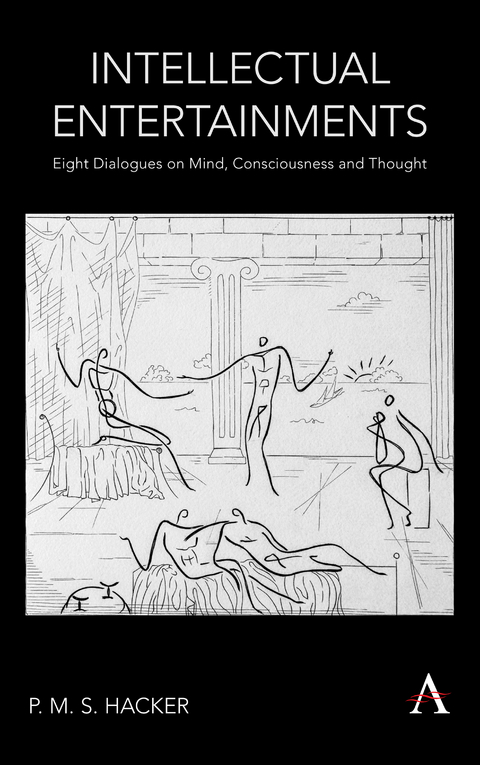
Intellectual Entertainments (eBook)
240 Seiten
Anthem Press (Verlag)
978-1-78527-154-0 (ISBN)

‘Intellectual Entertainments’ consists of eight dialogues on the nature of the mind and consciousness, thought and thinking, perceptual qualities and ownership of pain. Each dialogue has five participants, some living, some dead and some imaginary who represent different points of view. No philosophical knowledge is presupposed.
‘Intellectual Entertainments’ consists of eight philosophical dialogues, each with five participants, some living, some imaginary and some dead. The dialogues take place either in Elysium or in an imaginary Oxford Common Room. Each historical figure speaks in his own idiom with a distinctive turn of phrase. The imaginary figures speak in the accent and idiom of their respective countries (English, Scottish, American, Australian).
The themes of the dialogues are topics of perennial interest to any educated person with an intellectual bent. Two dialogues are concerned with the nature of the mind and the relation between mind and body – whether the mind is separable from the body, whether it is identical with the brain or whether such claims are confused. A second pair of dialogues examines the nature of consciousness and of conscious experience, and whether conscious experience is characterized by its distinctive ‘feel’ and by what it is like to undergo it. It investigates the puzzling question of what consciousness is for and whether there could be ‘zombies’ who behave just as we do, but who lack consciousness. A further pair of dialogues probes the nature of thought, the relationship between the ability to think and mastery of a language, and the question of what we think in – words, images or something else. One dialogue discusses the perennial question of the objectivity or subjectivity of perceptual qualities such as colour and sound, and whether a mindless world would also be colourless. A final dialogue consists of vehement argument on the ‘ownership’ of pain: whether two people can have the same pain or only similar pains.
The dialogues are written in a colloquial style. They presuppose no antecedent philosophical knowledge, but only intellectual curiosity. Each subject is presented from different points of view, presented by a different protagonist, and the various points of view are subjected to criticism. The exchanges are sometimes amusing, sometimes passionate and vehement. The different views advanced are often the views of distinguished living philosophers or great philosophers now deceased, as is made clear by the endnote references to sources. The overall aim of the dialogues is both to amuse and to demystify academic mystery-mongering. Holy cows of current academic philosophy are sacrificed at the altar of reason and sound argument.
lt;p>P. M. S. Hacker is the leading authority on the philosophy of Wittgenstein, on which he has written ten books. He has also written extensively on the philosophy of language. His other area of specialization is philosophy and cognitive neuroscience, on which he has written three books together with the eminent neuroscientist, M. R. Bennett. For Philosophical Foundations of Neuroscience in particular, Hacker was appointed to an honorary UCL professorship in the Department of Neurology at University College London. Hacker has published three volumes of a tetralogy on human nature: The Categorial Framework, The Intellectual Powers and The Passions. The final volume will be The Moral Powers (forthcoming, 2020).
Preface; Acknowledgements; Section 1 Two Dialogues on Mind and Body; Introduction; First Dialogue On the Nature of the Mind; Second Dialogue The Mind and the Body; Section 2 Two Dialogues on Consciousness; Introduction; Third Dialogue The Mystery of Consciousness; Fourth Dialogue Consciousness as Experience – Consciousness as Life Itself; Section 3 A Dialogue on the Objectivity or Subjectivity of Perceptual Qualities; Introduction; Fifth Dialogue On the Objectivity or Subjectivity of Perceptual Qualities; Section 4 Two Dialogues on Thought; Introduction; Sixth Dialogue Thought; Seventh Dialogue Thought and Language; Section 5 A Dialogue on Ownership of Pain; Introduction; Eighth Dialogue Can You Have My Pain? Can Different People Have the Same Pain?
| Erscheint lt. Verlag | 28.10.2019 |
|---|---|
| Reihe/Serie | Anthem Studies in Wittgenstein | Anthem Studies in Wittgenstein |
| Verlagsort | London |
| Sprache | englisch |
| Maße | 150 x 150 mm |
| Gewicht | 454 g |
| Themenwelt | Geisteswissenschaften ► Philosophie |
| ISBN-10 | 1-78527-154-7 / 1785271547 |
| ISBN-13 | 978-1-78527-154-0 / 9781785271540 |
| Informationen gemäß Produktsicherheitsverordnung (GPSR) | |
| Haben Sie eine Frage zum Produkt? |
 EPUB (Adobe DRM)
Kopierschutz: Adobe-DRM
Adobe-DRM ist ein Kopierschutz, der das eBook vor Mißbrauch schützen soll. Dabei wird das eBook bereits beim Download auf Ihre persönliche Adobe-ID autorisiert. Lesen können Sie das eBook dann nur auf den Geräten, welche ebenfalls auf Ihre Adobe-ID registriert sind.
Details zum Adobe-DRM
Dateiformat: EPUB (Electronic Publication)
EPUB ist ein offener Standard für eBooks und eignet sich besonders zur Darstellung von Belletristik und Sachbüchern. Der Fließtext wird dynamisch an die Display- und Schriftgröße angepasst. Auch für mobile Lesegeräte ist EPUB daher gut geeignet.
Systemvoraussetzungen:
PC/Mac: Mit einem PC oder Mac können Sie dieses eBook lesen. Sie benötigen eine
eReader: Dieses eBook kann mit (fast) allen eBook-Readern gelesen werden. Mit dem amazon-Kindle ist es aber nicht kompatibel.
Smartphone/Tablet: Egal ob Apple oder Android, dieses eBook können Sie lesen. Sie benötigen eine
Geräteliste und zusätzliche Hinweise
Buying eBooks from abroad
For tax law reasons we can sell eBooks just within Germany and Switzerland. Regrettably we cannot fulfill eBook-orders from other countries.
aus dem Bereich