


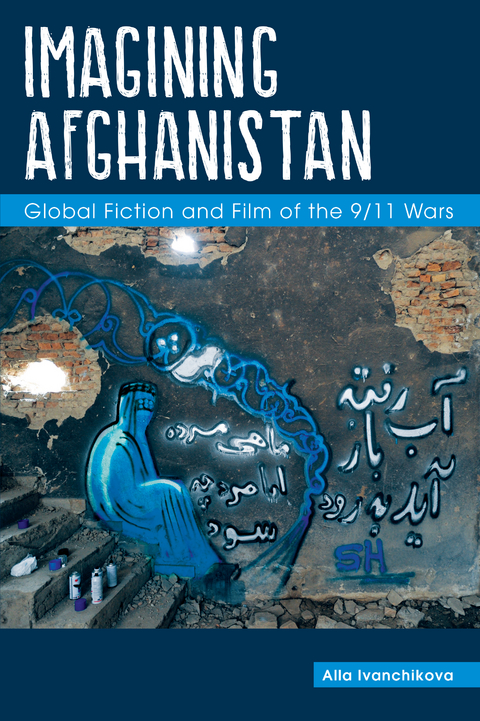
Imagining Afghanistan (eBook)
290 Seiten
Purdue University Press (Verlag)
978-1-61249-580-4 (ISBN)
Imagining Afghanistan examines how Afghanistan
has been imagined in literary and visual texts that were published after the
9/11 attacks and the subsequent U.S.-led invasion—the era that propelled
Afghanistan into the center of global media visibility. Through an analysis of
fiction, graphic novels, memoirs, drama, and film, the book demonstrates that
writing and screening “Afghanistan” has become a conduit for understanding our
shared post-9/11 condition. “Afghanistan” serves as a lens through which
contemporary cultural producers contend with the moral ambiguities of twenty-first-century
humanitarianism, interpret the legacy of the Cold War, debate the role of the
U.S. in the rise of transnational terror, and grapple with the long-term impact
of war on both human and nonhuman ecologies.
Post-9/11 global Afghanistan literary production
remains largely NATO-centric insofar as it is marked by an uncritical
investment in humanitarianism as an approach to Third World suffering and in
anti-communism as an unquestioned premise. The book’s first half exposes how persisting
anti-socialist biases—including anti-statist bias—not only shaped recent literary
and visual texts on Afghanistan, resulting in a distorted portrayal of its
tragic history, but also informed these texts’ reception by critics. In the
book’s second half, the author examines cultural texts that challenge this
limited horizon and forge alternative ways of representing traumatic histories.
Captured by the author through the concepts of deep time, nonhuman witness, and
war as a multispecies ecology, these new aesthetics bring readers a
sophisticated portrait of Afghanistan as a rich multispecies habitat affected
in dramatic ways by decades of war but not annihilated.
Alla Ivanchikova is an associate professor of English and comparative literature at Hobart and William Smith Colleges in Geneva, New York. Her research and teaching focus on the post-9/11 global novel, post-socialist studies, and new media theory. Her recent articles on the global novel and film appeared in Textual Practice, Camera Obscura, and Modern Fiction Studies.
Acknowledgments
Introduction: Global Afghanistan
1. Humanitarian Sublime and the Politics of Pity: Writing and Screening “Afghanistan” Circa 2001
2. Imagining the Soviets: The Faustian Bargain of Khaled Hosseini’s Kabul “Trilogy”
3. Humanitarian Jihad: Unearthing the Contemporary in the Narratives of the Long 1979
4. Witness: Modes of Writing the Disaster
5. The Deep Time of War: Nadeem Aslam and the Aesthetics of the Geologic Turn
6. The Kabubble: The Humanitarian Community Under Scrutiny
Conclusion: The End of an Era
Notes
Works Cited
Index
| Erscheint lt. Verlag | 15.9.2019 |
|---|---|
| Reihe/Serie | Comparative Cultural Studies | Comparative Cultural Studies |
| Verlagsort | West Lafayette |
| Sprache | englisch |
| Themenwelt | Geisteswissenschaften ► Sprach- / Literaturwissenschaft ► Anglistik / Amerikanistik |
| Geisteswissenschaften ► Sprach- / Literaturwissenschaft ► Literaturwissenschaft | |
| Sozialwissenschaften ► Pädagogik | |
| Sozialwissenschaften ► Politik / Verwaltung ► Europäische / Internationale Politik | |
| Sozialwissenschaften ► Politik / Verwaltung ► Politische Systeme | |
| Sozialwissenschaften ► Politik / Verwaltung ► Politische Theorie | |
| Sozialwissenschaften ► Soziologie ► Allgemeines / Lexika | |
| Schlagworte | 1979 • 9/11 fiction • Afghanistan • Afghanistan film • Afghanistan literature • Afghanistan novel • Anthropocene • Deep Time • Didier Lefevre • global novel • humanitarian imaginary • Khaled Hosseini • multispecies • Nadeem Aslam • nonhuman witness • Operation Cyclone • Orientalism • Post-9/11 • Post-Cold War • Saur revolution • Socialism • Soviet invasion • The Kite Runner • World literature • world novel |
| ISBN-10 | 1-61249-580-X / 161249580X |
| ISBN-13 | 978-1-61249-580-4 / 9781612495804 |
| Informationen gemäß Produktsicherheitsverordnung (GPSR) | |
| Haben Sie eine Frage zum Produkt? |
 EPUB (Adobe DRM)
Kopierschutz: Adobe-DRM
Adobe-DRM ist ein Kopierschutz, der das eBook vor Mißbrauch schützen soll. Dabei wird das eBook bereits beim Download auf Ihre persönliche Adobe-ID autorisiert. Lesen können Sie das eBook dann nur auf den Geräten, welche ebenfalls auf Ihre Adobe-ID registriert sind.
Details zum Adobe-DRM
Dateiformat: EPUB (Electronic Publication)
EPUB ist ein offener Standard für eBooks und eignet sich besonders zur Darstellung von Belletristik und Sachbüchern. Der Fließtext wird dynamisch an die Display- und Schriftgröße angepasst. Auch für mobile Lesegeräte ist EPUB daher gut geeignet.
Systemvoraussetzungen:
PC/Mac: Mit einem PC oder Mac können Sie dieses eBook lesen. Sie benötigen eine
eReader: Dieses eBook kann mit (fast) allen eBook-Readern gelesen werden. Mit dem amazon-Kindle ist es aber nicht kompatibel.
Smartphone/Tablet: Egal ob Apple oder Android, dieses eBook können Sie lesen. Sie benötigen eine
Geräteliste und zusätzliche Hinweise
Buying eBooks from abroad
For tax law reasons we can sell eBooks just within Germany and Switzerland. Regrettably we cannot fulfill eBook-orders from other countries.
aus dem Bereich


