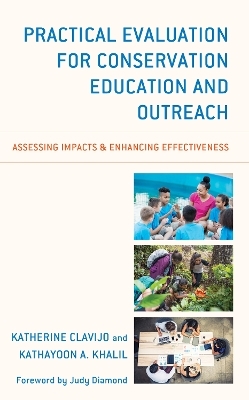
Practical Evaluation for Conservation Education and Outreach
Rowman & Littlefield (Verlag)
9781538109298 (ISBN)
Here are the tools and skills needed to conduct meaningful, comprehensive evaluations
How do we know if a conservation education or outreach program is working?
Practical Evaluation for Conservation Education and Outreach: Assessing Impacts & Enhancing Effectiveness presents a simple approach to using evaluation to design, monitor and assess education and outreach. It is for anyone whose organization or work involves creating educational programs designed to raise conservation awareness and promote pro-conservation behaviors.
Even more than a how-to book, it can help you to build your organization’s capacity to conduct meaningful, comprehensive evaluations. The book’s purpose is to provide specific skills and knowledge that they can immediately put to use in conducting evaluation studies of conservation education programs.
The reader will build an understanding that:
- Evaluation yields useful information
- Evaluation should be a part of a program’s design process
- Evaluation can be a positive experience
- Evaluation contributes to conservation education and outreach program’s success
The reader will build their knowledge of:
- Key evaluation terms and concepts
- The relationship between evaluation and research
- How evaluation processes and finding can contribute to decision making
- The strengths and weaknesses of different evaluation approaches and data collection methods
- The relationship among a program’s goals, objective, activities and expected outcomes
The readers will be able to
- Develop and refine key evaluation questions
- Review and contribute to an evaluation plan
- Construct and improve data-collection instruments
- Collect credible and reliable data
- Interpret results and draw conclusions
This book provides practical advice on conducting evaluation that is specific for conservation professionals. Case studies describe how evaluation has led to program improvements in a range of conservation settings. While there are numerous books that describe how to conduct program evaluation, none provide specific examples and tools relevant to improving environmental outcomes.
Kate Clavijo is a practicing program evaluator with more than 20 years of experience evaluating informal and formal educational programs. She served as the executive director of the Maryland Association for Environmental and Outdoor Education as is the lead author of the publication Evaluation Use in Nonformal Education Settings published by the American Evaluation Association. She has extensive experience in environmental education and a strong interest in evaluation capacity building. Dr. Clavijo earned her doctorate in Educational Program Evaluation and Masters degrees in Environmental Education and Biology at the University of Louisville. Kathayoon Khalil is the Conservation Impact Manager at the Oregon Zoo and the former Principal Evaluator for the Seattle Aquarium. She received her PhD in Learning Sciences and Technology Design from Stanford University, studying the use of social network analysis to understand how innovation in evaluation spreads among the zoo and aquarium community. Kathayoon started her career at as a teen volunteer at the Oregon Zoo and quickly developed a passion for wildlife and conservation. Kathayoon received her Masters of Environmental Science degree from the Yale School of Forestry and her Bachelors in Organismal Biology from Claremont McKenna College. She is an alumna of the Emerging Wildlife Conservation Leaders program as well as an instructor for Project Dragonfly at Miami University of Ohio.
Preface
Acknowledgements
PART I: Planning for Evaluation
Chapter 1. Tailoring the Evaluation
Chapter 2. Finding Focus and Asking Good Questions
Chapter 3. Logic Models: Defining the Big Picture
Chapter 4. Changing Hearts, Minds and Behaviors
PART II: Developing Data Collection Instruments
Chapter 5. Evaluation Methods and Designs
Chapter 6: Surveys
Chapter 7: Interviews, Focus Groups and Observations
Chapter 8: Alternative Approaches to Collecting Data
PART III: Analyzing Data, Presenting Findings and Making Evaluation Useful
Chapter 9 Analyzing Data
Chapter 10 Communicating Evaluation Results
Chapter 11 Developing a Collaborative Culture of Evaluation
Appendix
How to Hire and Work with an Evaluator
Summary of Program Evaluation Standards
Stewardship for Participants’ Information and IRB’s
| Erscheinungsdatum | 10.05.2021 |
|---|---|
| Zusatzinfo | 29 b/w illustrations;1 table; 12 textboxes |
| Sprache | englisch |
| Maße | 156 x 230 mm |
| Gewicht | 318 g |
| Themenwelt | Kunst / Musik / Theater ► Allgemeines / Lexika |
| Geisteswissenschaften ► Geschichte ► Hilfswissenschaften | |
| Naturwissenschaften ► Biologie ► Ökologie / Naturschutz | |
| Wirtschaft ► Betriebswirtschaft / Management ► Unternehmensführung / Management | |
| ISBN-13 | 9781538109298 / 9781538109298 |
| Zustand | Neuware |
| Informationen gemäß Produktsicherheitsverordnung (GPSR) | |
| Haben Sie eine Frage zum Produkt? |
aus dem Bereich