


Why the Axis Lost
An Analysis of Strategic Errors
Seiten
2020
McFarland & Co Inc (Verlag)
978-1-4766-7452-0 (ISBN)
McFarland & Co Inc (Verlag)
978-1-4766-7452-0 (ISBN)
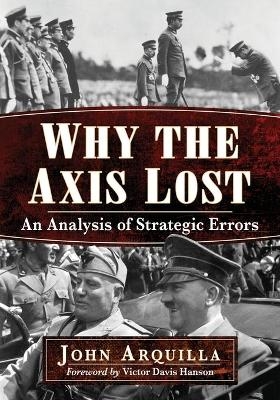
Providing fresh perspective on World War II, this study argues that the Germans, Japanese and Italians made poor design choices in ships, planes, tanks and information security - before and during the war - that forced them to fight with weapons and systems that were too soon outmatched by the Allies'.
The factors leading to the defeat of the Axis Powers in World War II have been debated for decades. One prevalent view is that overwhelming Allied superiority in materials and manpower doomed the Axis. Another holds that key strategic and tactical blunders lost the war--from Hitler halting his panzers outside Dunkirk, allowing more than 300,000 trapped Allied soldiers to escape, to Admiral Yamamoto falling into the trap set by the U.S. Navy at Midway.
Providing a fresh perspective on the war, this study challenges both views and offers an alternative explanation: the Germans, Japanese and Italians made poor design choices in ships, planes, tanks and information security--before and during the war--that forced them to fight with weapons and systems that were too soon outmatched by the Allies. The unprecedented arms race of World War II posed a fundamental "design challenge" the Axis powers sometimes met but never mastered.
The factors leading to the defeat of the Axis Powers in World War II have been debated for decades. One prevalent view is that overwhelming Allied superiority in materials and manpower doomed the Axis. Another holds that key strategic and tactical blunders lost the war--from Hitler halting his panzers outside Dunkirk, allowing more than 300,000 trapped Allied soldiers to escape, to Admiral Yamamoto falling into the trap set by the U.S. Navy at Midway.
Providing a fresh perspective on the war, this study challenges both views and offers an alternative explanation: the Germans, Japanese and Italians made poor design choices in ships, planes, tanks and information security--before and during the war--that forced them to fight with weapons and systems that were too soon outmatched by the Allies. The unprecedented arms race of World War II posed a fundamental "design challenge" the Axis powers sometimes met but never mastered.
John Arquilla is a distinguished professor of defense analysis at the United States Naval Postgraduate School, located in Monterey, California. He is the author of several books and many articles on a range of topics in military affairs, and has served as adviser to senior leaders in conflicts ranging from Desert Storm to the Kosovo War, as well as in several post-9/11 actions.
Table of Contents
Acknowledgmentsviii
Foreword by Victor Davis Hanson
Preface
1. Paths to Victory (or Defeat)
2. From Versailles to the Vistula
3. Rising Tide, Early Reverses
4. At the Flood
5. Turning Points
6. The Brink of Catastrophe
7. Last Chances
8. Cataclysm
9. Why the Axis Lost
10. How World War II Still Guides Strategic Design
Chapter Notes
Works Cited
Index
| Erscheinungsdatum | 31.12.2019 |
|---|---|
| Zusatzinfo | 19 photos, notes, bibliography, index |
| Verlagsort | Jefferson, NC |
| Sprache | englisch |
| Maße | 178 x 254 mm |
| Gewicht | 408 g |
| Themenwelt | Geschichte ► Allgemeine Geschichte ► 1918 bis 1945 |
| Geschichte ► Teilgebiete der Geschichte ► Militärgeschichte | |
| ISBN-10 | 1-4766-7452-3 / 1476674523 |
| ISBN-13 | 978-1-4766-7452-0 / 9781476674520 |
| Zustand | Neuware |
| Informationen gemäß Produktsicherheitsverordnung (GPSR) | |
| Haben Sie eine Frage zum Produkt? |
Mehr entdecken
aus dem Bereich



aus dem Bereich
Deutschland 1933 bis 1945
Buch | Hardcover (2025)
S. Fischer (Verlag)
CHF 47,60
der deutsche Vernichtungskrieg gegen die Sowjetunion. Eine Revision
Buch | Hardcover (2025)
S. Fischer (Verlag)
CHF 49,95


