


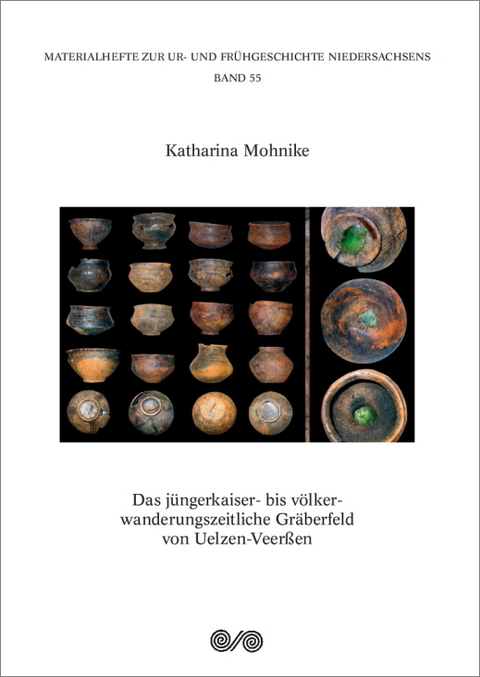
Das jüngerkaiser- bis völkerwanderungszeitliche Gräberfeld von Uelzen-Veerßen
Seiten
2019
|
1., Aufl.
VML Vlg Marie Leidorf (Verlag)
978-3-89646-847-5 (ISBN)
VML Vlg Marie Leidorf (Verlag)
978-3-89646-847-5 (ISBN)
Grundlage der vorliegenden Studie ist die Erfassung der rund 2.700 Grabbefunde von Uelzen-Veerßen, Lüneburg-Oedeme, Bad Bevensen und weiteren Fundstellen des Ilmenaugebietes. Ihre Beschreibung und chronologische Einordnung anhand der Funde aus Keramik, Glas, Knochen, Geweih, Elfenbein, Harz, Stein und Metall stehen im Zentrum der Arbeit. Weitere Themen sind die horizontalstratigraphische Abfolge sowie Gestalt und Ausstattung der Gräber. Der Übergang von älterer zu jüngerer RKZ ist durch markante Veränderungen im Bestattungsbrauch und die Verlagerung vieler Gräberfelder geprägt. Seit dem 4. Jh. wurden fast ausschließlich Urnengräber angelegt, daneben wenige Brandgräber mit organischem Behältnis und seit dem 5. Jh. auch einzelne Körpergräber. Die importarme Ilmenaugruppe ist relativ einheitlich durch “Buckelgräber” charakterisiert, Hügelgräber mit zentralem Brandgrab und z. T. mit Kreisgraben, ggf. mit einer Grabenöffnung nach Süden. Die Bestattungssitten für Kleinkinder und Beigabenzahl variierten lokal. Die Gräberfelder endeten um 500, sichere Gräber des 6./7. Jh. sind äußerst selten, obwohl Pollenanalysen Siedlungskontinuität bis ins 6. Jh. belegen.
This study is based on the documentation of some 2,700 graves from Uelzen-Veerßen, Lüneburg-Oedeme, Bad Bevensen and other sites in the Ilmenau area. Their description and chronological classification on the basis of finds made from pottery, glass, bone, antler, ivory, resin, rock, and metal form the core of the thesis. Other topics are the horizontal stratigraphy as well as the shape and equipment of graves. The transition from the earlier to the later Roman Iron Age is marked by significant changes as to burial customs and the relocation of many cemeteries. Since the 4th century A.D. urn graves were the dominant burial type with only few cremations with a container of organic material and, since the 5th century, also some inhumations. The Ilmenau Group is characterised by scarce imports and relatively homogeneous “hummock graves” [Buckelgräber], tumuli with a central cremation and sometimes a ring ditch usually interrupted at the south. Funeral rites for infants and numbers of grave goods varied on a local basis. All cemeteries ended around A.D. 500 with graves of the 6th/7th century being extraordinarily rare, although pollen analyses imply settlement continuation into the 6th century A.D. This study is based on the documentation of some 2,700 graves from Uelzen-Veerßen, Lüneburg-Oedeme, Bad Bevensen and other sites in the Ilmenau area. Their description and chronological classification on the basis of finds made from pottery, glass, bone, antler, ivory, resin, rock, and metal form the core of the thesis. Other topics are the horizontal stratigraphy as well as the shape and equipment of graves. The transition from the earlier to the later Roman Iron Age is marked by significant changes as to burial customs and the relocation of many cemeteries. Since the 4th century A.D. urn graves were the dominant burial type with only few cremations with a container of organic material and, since the 5th century, also some inhumations. The Ilmenau Group is characterised by scarce imports and relatively homogeneous “hummock graves” [Buckelgräber], tumuli with a central cremation and sometimes a ring ditch usually interrupted at the south. Funeral rites for infants and numbers of grave goods varied on a local basis. All cemeteries ended around A.D. 500 with graves of the 6th/7th century being extraordinarily rare, although pollen analyses imply settlement continuation into the 6th century A.D.
This study is based on the documentation of some 2,700 graves from Uelzen-Veerßen, Lüneburg-Oedeme, Bad Bevensen and other sites in the Ilmenau area. Their description and chronological classification on the basis of finds made from pottery, glass, bone, antler, ivory, resin, rock, and metal form the core of the thesis. Other topics are the horizontal stratigraphy as well as the shape and equipment of graves. The transition from the earlier to the later Roman Iron Age is marked by significant changes as to burial customs and the relocation of many cemeteries. Since the 4th century A.D. urn graves were the dominant burial type with only few cremations with a container of organic material and, since the 5th century, also some inhumations. The Ilmenau Group is characterised by scarce imports and relatively homogeneous “hummock graves” [Buckelgräber], tumuli with a central cremation and sometimes a ring ditch usually interrupted at the south. Funeral rites for infants and numbers of grave goods varied on a local basis. All cemeteries ended around A.D. 500 with graves of the 6th/7th century being extraordinarily rare, although pollen analyses imply settlement continuation into the 6th century A.D. This study is based on the documentation of some 2,700 graves from Uelzen-Veerßen, Lüneburg-Oedeme, Bad Bevensen and other sites in the Ilmenau area. Their description and chronological classification on the basis of finds made from pottery, glass, bone, antler, ivory, resin, rock, and metal form the core of the thesis. Other topics are the horizontal stratigraphy as well as the shape and equipment of graves. The transition from the earlier to the later Roman Iron Age is marked by significant changes as to burial customs and the relocation of many cemeteries. Since the 4th century A.D. urn graves were the dominant burial type with only few cremations with a container of organic material and, since the 5th century, also some inhumations. The Ilmenau Group is characterised by scarce imports and relatively homogeneous “hummock graves” [Buckelgräber], tumuli with a central cremation and sometimes a ring ditch usually interrupted at the south. Funeral rites for infants and numbers of grave goods varied on a local basis. All cemeteries ended around A.D. 500 with graves of the 6th/7th century being extraordinarily rare, although pollen analyses imply settlement continuation into the 6th century A.D.
| Erscheinungsdatum | 29.11.2019 |
|---|---|
| Reihe/Serie | Materialhefte zur Ur- und Frühgeschichte Niedersachsens ; 55 |
| Verlagsort | Rahden/Westf. |
| Sprache | deutsch |
| Maße | 210 x 297 mm |
| Gewicht | 3010 g |
| Einbandart | gebunden |
| Themenwelt | Geschichte ► Allgemeine Geschichte ► Mittelalter |
| Schlagworte | Grabbau • Grabhügel • Römisches Germanien • Siedlungskammer • Stratigraphie |
| ISBN-10 | 3-89646-847-2 / 3896468472 |
| ISBN-13 | 978-3-89646-847-5 / 9783896468475 |
| Zustand | Neuware |
| Informationen gemäß Produktsicherheitsverordnung (GPSR) | |
| Haben Sie eine Frage zum Produkt? |
Mehr entdecken
aus dem Bereich

aus dem Bereich
Geschichte einer Augsburger Familie (1367-1650)
Buch | Softcover (2024)
Kohlhammer (Verlag)
CHF 47,60
der epische Kampf um das Heilige Land
Buch | Hardcover (2025)
C.H.Beck (Verlag)
CHF 49,95


