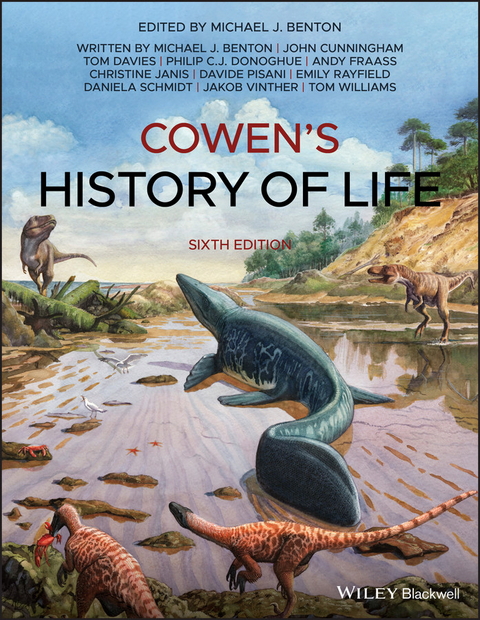
Cowen's History of Life (eBook)
John Wiley & Sons (Verlag)
978-1-119-48220-8 (ISBN)
A newly revised and fully updated edition of the market-leading introduction to paleontology
Designed for students and anyone else with an interest in the history of life on our planet, the new edition of this classic text describes the biological evolution of Earth's organisms, and reconstructs their adaptations and the ecology and environments in which they functioned.
Cowen's History of Life, 6th Edition includes major updates, including substantial rewrites to chapters on the origins of eukaryotes, the Cambrian explosion, the terrestrialization of plants and animals, the Triassic recovery of life, the origin of birds, the end-Cretaceous mass extinction, and human evolution. It also features new chapters on plants, soils and transformation of the land; the Mesozoic marine revolution; and the evolution of oceans and climates. Beginning with the origin of the Earth and the earliest life on earth, the book goes on to offer insightful contributions covering: the evolution of Metazoans; the early vertebrates; life of vertebrates on land; and early amniotes and thermoregulation. The book also looks at: dinosaur diversity, as well as their demise; early mammals; the rise of modern mammals; the Neogene Savannas; primates; life in the ice ages; and more.
- Covers the breadth of the subject in a concise yet specific way for undergrads with no academic background in the topic
- Reorganizes all chapters to reflect the geological series of events, enabling a new focus on big events
- Updated with three brand new chapters and numerous revised ones
- Put together by a new editorial team internationally recognized as the global leaders in paleontology
- Filled with illustrations and photographs throughout
- Includes diagrams to show internal structures of organisms, cladograms, time scales and events, and paleogeographic maps
- Supplemented with a dedicated website that explores additional enriching information and discussion, and which features images for use in visual presentations
Cowen's History of Life, 6th Edition is an ideal book for undergraduate students taking courses in introductory paleontology, as well those on global change and earth systems.
MICHAEL J. BENTON, PHD, is senior member of the Paleobiology Research Group at the University of Bristol, and is the author of two successful Wiley titles, Vertebrate Palaeontology and Introduction to Paleobiology.
A newly revised and fully updated edition of the market-leading introduction to paleontology Designed for students and anyone else with an interest in the history of life on our planet, the new edition of this classic text describes the biological evolution of Earth s organisms, and reconstructs their adaptations and the ecology and environments in which they functioned. Cowen's History of Life, 6th Edition includes major updates, including substantial rewrites to chapters on the origins of eukaryotes, the Cambrian explosion, the terrestrialization of plants and animals, the Triassic recovery of life, the origin of birds, the end-Cretaceous mass extinction, and human evolution. It also features new chapters on plants, soils and transformation of the land; the Mesozoic marine revolution; and the evolution of oceans and climates. Beginning with the origin of the Earth and the earliest life on earth, the book goes on to offer insightful contributions covering: the evolution of Metazoans; the early vertebrates; life of vertebrates on land; and early amniotes and thermoregulation. The book also looks at: dinosaur diversity, as well as their demise; early mammals; the rise of modern mammals; the Neogene Savannas; primates; life in the ice ages; and more. Covers the breadth of the subject in a concise yet specific way for undergrads with no academic background in the topic Reorganizes all chapters to reflect the geological series of events, enabling a new focus on big events Updated with three brand new chapters and numerous revised ones Put together by a new editorial team internationally recognized as the global leaders in paleontology Filled with illustrations and photographs throughout Includes diagrams to show internal structures of organisms, cladograms, time scales and events, and paleogeographic maps Supplemented with a dedicated website that explores additional enriching information and discussion, and which features images for use in visual presentations Cowen's History of Life, 6th Edition is an ideal book for undergraduate students taking courses in introductory paleontology, as well those on global change and earth systems.
MICHAEL J. BENTON, PHD, is senior member of the Paleobiology Research Group at the University of Bristol, and is the author of two successful Wiley titles, Vertebrate Palaeontology and Introduction to Paleobiology.
Title Page 5
Copyright Page 6
Contents 7
Preface 9
About the Companion Website 13
Chapter 1 The Origin of Life on Earth 15
How Geology Works 15
How Paleontology Works 15
The Origin of Life 17
Planets in Our Solar System 18
The Early Earth 22
Life Exists in Cells 22
Making Organic Molecules 24
Toward the First Living Cell 26
Where Did Life Evolve? 27
Energy Sources for the First Life 28
Heterotrophy 28
Photosynthesis 29
References 30
Further Reading 30
Questions for Thought, Study, and Discussion 30
Chapter 2 The Earliest Life on Earth 31
Introduction 31
How to Find the Age of a Fossil 33
Life Alters a Planet 34
Isotope Evidence for Biology 34
Earth’s Oldest Rocks 36
Last Universal Common Ancestor (LUCA) and the Early Evolution of Cells 37
Stromatolites 38
Ancient Stromatolites 40
Identifying Fossil Cells in Ancient Rocks 41
Banded Iron Formations (BIF) 41
Banded Iron Formations, Stromatolites and Oxygen 43
The Great Oxidation Event 44
References 45
Further Reading 45
Questions for Thought, Study, and Discussion 45
Chapter 3 The Origin of Eukaryotes 47
Single-Celled Life 47
Symbiosis and Endosymbiosis 47
The Prokaryotic Ancestors of Eukaryotic Cells 49
Eukaryotes in the Fossil Record 51
The Evolution of Sex 52
The Classification of Eukaryotes 53
Cladistics 54
References 57
Further Reading 58
Question for Thought, Study, and Discussion 58
Chapter 4 The Evolution of Metazoans 59
Proterozoic Microbes 59
Snowball or Slushball Earth 60
The Ediacaran Period 61
Making a Metazoan 62
The Doushantuo Formation 66
Large Ediacaran Organisms 67
Molecular Clocks 71
References 71
Further Reading 71
Question for Thought, Study, and Discussion 72
Chapter 5 The Cambrian Explosion 73
The Cambrian Explosion 73
The Variety of Metazoans 73
The Evolution of Skeletons: Small Shelly Fossils 74
Larger Cambrian Animals 75
Soft-Bodied Cambrian Animals 77
What Caused the Cambrian Explosion? 79
Evolution and Development 79
Oxygen Levels 79
Seawater Chemistry 79
Mineralization 80
Predation 81
Exploiting the Sea Floor 81
References 82
Further Reading 82
Questions for Thought, Study, and Discussion 83
Chapter 6 Changing Life in a Changing World 85
Today’s World 85
Energy and Ecology 85
Biogeography and Paleobiogeography 87
Provinces 87
Poles and Tropics 88
Islands, Continents, and Climates 88
Geographic Isolation and Evolution 89
Diversity Patterns in the Fossil Record 90
Global Tectonics and Global Diversity 92
Changing Faunas Through Time 94
Three Great Faunas 94
Explaining the Three Great Faunas 94
Mass Extinctions 96
Explaining Mass Extinction 97
The Ordovician Mass Extinction 98
The Late Devonian (F–F) Mass Extinction 98
The Permian–Triassic (P–Tr) Extinction 98
Plume Volcanism 98
The Hyperthermal Killing Model 99
Ocean Chemistry Crisis 101
The End-Triassic Extinction 102
Evolutionary Radiations 102
Mass Extinctions 103
Invading a New Habitat 103
New Biological Inventions 103
References 104
Further Reading 104
Diversity Through Time 104
Mass Extinctions 104
Question for Thought, Study, and Discussion 105
Chapter 7 The Early Vertebrates 107
Vertebrates 107
Vertebrate Origin 107
The Cyclostomes – Vertebrates Without Vertebrae 109
Ostracoderms 109
Heterostracans 110
Anaspids 111
Thelodonts 111
Galeaspids 111
Osteostracans 111
The Evolution of Jaws 113
Placoderms 114
Acanthodians 116
Cartilaginous Fishes (Sharks and Rays) 116
Bony Fishes 116
Air Breathing 117
The Problem 117
Respiration in Early Fishes 117
Oxygen Intake 118
Air Gulping and Fishy Lungs 118
Actinopterygii (Rayfin Fishes) 119
Sarcopterygii (Lobefin Fishes) 120
Coelacanths 121
Lungfishes 121
Tetrapodomorpha 122
References 122
Further Reading 122
Question for Thought, Study, and Discussion 122
Chapter 8 Leaving the Water 123
Problems of Life in Air 123
How Plants Engineered the Landscape 124
Genomic Data and the Origin of Land Plants 125
How Plants Adapted to Life on Land 125
The Earliest Land Plants 127
The Bryophytes: Mosses and Relatives 127
The Earliest Tracheophytes 128
The Rhynie Chert as a Window into Early Life on Land 130
Later Devonian Tracheophytes – Diversification of Lycophytes and Euphyllophytes 130
Early Plant Innovation 132
Comparing Plant and Animal Evolution 133
The First Land Animals 134
References 135
Further Reading 136
Plants 136
Animals 136
Question for Thought, Study, and Discussion 136
Chapter 9 Early Tetrapods and Amniote Origins 137
Vertebrates Conquer the Land 137
Tetrapodomorphs 137
From Tetrapodomorph to Tetrapod 139
Limbs and Feet: Why Become Tetrapod? 140
Fresh Food Supplies? 140
Basking? 141
Reproduction? 141
The First Tetrapods: Devonian 141
Tetrapods Diversify: Carboniferous 142
Ancestors of Living Amphibians: Batrachosaurs 143
Ancestors of Living Amniotes: Reptiliomorphs 145
Amniotes and the Amniotic Egg 145
Why Were the First Amniotes Small? 147
Carboniferous Land Ecology 149
Further Reading 150
Question for Thought, Study, and Discussion 150
Chapter 10 Early Amniotes and Thermoregulation 151
The Amniote Radiation 151
Pelycosaurs 152
Pelycosaur Biology and Ecology 152
Locomotion 152
Carnivorous Pelycosaurs 153
Vegetarian Pelycosaurs 154
How Does Herbivory Evolve in Tetrapods? 155
Thermoregulation in Living Reptiles 156
Thermoregulation in Pelycosaurs 157
Permian Changes 158
The Invasion of Gondwana 158
Thermoregulation in Therapsids 158
Therapsid Evolution 159
Dinocephalians 159
Advanced Therapsids 160
Dicynodonts 160
Parareptiles 162
Synapsids and Their Diapsid Replacements 163
Further Reading 163
Question for Thought, Study, and Discussion 163
Chapter 11 The Mesozoic Marine Revolution 165
Mesozoic Ocean Ecosystems 165
Recovering Seas 166
Crisis on the Seabed 166
Reefs 166
Ammonites and Belemnites 168
Fishes 169
Arms Races and New Predatory Modes 170
Ichthyosaurs 171
Sauropterygians 173
Mosasaurs 175
Turtles 177
Crocodiles 178
Air Breathers at Sea 179
References 180
Further Reading 180
Questions for Thought, Study, and Discussion 181
Chapter 12 The Triassic Takeover 183
Diapsids 183
Basal Diapsids 183
Lepidosauromorphs 185
Archosauromorphs 185
The Triassic Diapsid Takeover: The Pattern 186
Rhynchosaurs 187
Triassic Archosaurs: Crurotarsi 187
Dinosaur Ancestors: Avemetatarsalia 188
Respiration, Metabolism, and Locomotion 189
The Carnian Pluvial Episode (CPE) and the Rise of the Dinosaurs 191
Reference 192
Further Reading 192
Question for Thought, Study, and Discussion 193
Chapter 13 Dinosaurs 195
Dinosaurs 195
Theropods 196
Sauropodomorphs 199
Ornithischians 200
Dinosaur Paleobiology 202
Feeding 203
Locomotion 204
How Could Dinosaurs Be So Huge? 204
Metabolic Rate and Temperature in Dinosaurs 205
Dinosaur Eggs and Nests 206
Dinosaur Feathers 208
The Origin of Feathers 210
Dinosaur Behavior 212
References 215
Further Reading 215
Questions for Thought, Study, and Discussion 216
Chapter 14 Birds and the Evolution of Flight 217
Flying Animals 217
Pterosaurs 218
Pterosaur Feeding and Fossils 219
Pterosaur Flight 221
Getting Off the Ground 222
Birds 223
Archaeopteryx 223
The Origin of Flight in Birds 226
Cretaceous Birds 226
Cenozoic Birds 228
The Largest Flying Birds 229
References 230
Further Reading 230
Pterosaurs 230
Birds 230
Questions for Thought, Study, and Discussion 231
Chapter 15 The Cretaceous Terrestrial Revolution 233
Life on Land in the Ascendant 233
Dating the Origin of Angiosperms 234
The Oldest Fossil Angiosperms 234
Angiosperms and Changing Mesozoic Ecology 237
Seeds and Pollination 237
Reasons for Angiosperm Success 239
Pollination and Insect Pollinators 239
Seed Dispersal 241
Fast-Growing Seedlings 242
Explosion in Insects 242
Ants and Termites 244
Later Stages in the Revolution 244
Angiosperm Chemistry 245
Reference 245
Further Reading 245
Questions for Thought, Study, and Discussion 246
Chapter 16 The End of the Dinosaurs 247
The Extinction at the End of the Cretaceous 247
An Asteroid Impact? 248
Iridium and Glass Spherules 248
Finding the Crater 249
The Impact and Its Consequences 251
A Giant Volcanic Eruption? 252
Paleobiological Evidence from the K–Pg Boundary 253
Land Plants 253
Dinosaurs 254
Lizards, Birds, and Mammals 255
Freshwater Communities 256
Marine Life 256
Where Are We? 256
Further Reading 257
Question for Thought, Study, and Discussion 258
Chapter 17 Changing Oceans and Climates 259
Climate 259
Scientific Ocean Drilling and Proxies 260
Changes in Marine Life over Time 261
The Cretaceous Hothouse 263
Hyperthermals 264
Descent into the Icehouse 266
The Pliocene 269
The Ice Ages 269
Climate Change 271
References 275
Further Reading 275
Questions for Thought, Study, and Discussion 275
Chapter 18 The Origin of Mammals 277
The Derived Features of Mammals 277
Cynodonts and Defining the First Mammals 278
Teeth and Tooth Replacement 280
Skulls and Jaws 280
Hearing 281
Locomotion 282
Thermoregulation and Metabolic Level 282
Evolution of Hair 282
Mammalian Reproduction 283
Lactation 283
Early Mammaliaformes 284
Early Crown-Group Mammals 285
Therian Mammals 286
The Inferiority of Mammals 288
Reference 289
Further Reading 289
Questions for Thought, Study, and Discussion 290
Chapter 19 Cenozoic Mammals 291
Evolution Among Cenozoic Mammals 291
Morphological Evidence 292
Molecular Evidence 292
The Paleocene 295
The Eocene 296
The End of the Eocene 297
The Later Cenozoic 298
Ecological Replacement: The Guild Concept 298
Cenozoic Mammals in Dinosaur Guilds 299
The Savanna Story 300
Evolutionary Change over Time 302
Bats 303
Whales 304
Reference 308
Further Reading 308
Questions for Thought, Study, and Discussion 308
Chapter 20 Geography and Evolution 311
Mammals and Geography 311
Australia 311
New Zealand 315
South America 316
Africa 320
Madagascar 322
Islands and Biogeography 323
Further Reading 324
Questions for Thought, Study, and Discussion 325
Chapter 21 Primates 327
Primate Characters 327
The Earliest Primates 328
The Living Prosimians 330
The Origin of Anthropoids 331
The Eocene and Oligocene Radiation of Anthropoids 332
The New World Monkeys (Platyrrhines) 333
The Old World Monkeys 333
Emergence of the Hominoids 334
Early and Middle Miocene Hominoids 334
Late Miocene to Pleistocene Hominoids 336
References 337
Further Reading 337
Questions for Thought, Study, and Discussion 337
Chapter 22 Evolving Toward Humans 339
The Earliest Hominins 339
Early Australopithecines 340
Australopithecus afarensis 341
Australopithecus in South Africa 343
Robust Australopithecines 343
Transitional Species and Early Tool Use 345
Homo erectus and the Modern Body Plan 346
Into Asia 347
After Homo erectus 348
The Origin of Homo sapiens 348
The Neanderthals 350
Ancient DNA 352
Evolution among Humans Today 353
References 355
Further Reading 355
Questions for Thought, Study, and Discussion 355
Chapter 23 Life in the Ice Age 357
Ice Ages and Climatic Change 357
The Present Ice Age 358
Life and Climate in the Ice Ages 358
Faunal Changes 359
Causes of the End?Pleistocene Extinction: Human Hunting 361
Causes of the End?Pleistocene Extinction: Climatic and Environmental Change 362
North America: Human Arrival and Human Hunting 363
North America: Patterns of Megafaunal Extinction 365
South America 366
Old World Continents 367
Australia 368
Island Extinctions 370
The World Today 372
Further Reading 372
Questions for Thought, Study, and Discussion 373
Glossary 375
Index 383
EULA 396
| Erscheint lt. Verlag | 7.8.2019 |
|---|---|
| Sprache | englisch |
| Themenwelt | Geisteswissenschaften ► Archäologie |
| Geschichte ► Allgemeine Geschichte ► Vor- und Frühgeschichte | |
| Naturwissenschaften ► Geowissenschaften ► Geologie | |
| Naturwissenschaften ► Geowissenschaften ► Mineralogie / Paläontologie | |
| Technik | |
| Schlagworte | Archeology • Biological Evolution • Biology • Biowissenschaften • Cladistics • Earth History • earth science • earth sciences • earth system • Evolution • evolutionary change</p> • Geobiology • Geowissenschaften • global change • Life Science • Life Sciences • <p>life history • Paläontologie • Paläontologie, Paläobiologie u. Geobiologie • paleobiology • paleontology • Paleontology, Paleobiology & Geobiology • Phylogenomics • Stratigraphy |
| ISBN-10 | 1-119-48220-8 / 1119482208 |
| ISBN-13 | 978-1-119-48220-8 / 9781119482208 |
| Informationen gemäß Produktsicherheitsverordnung (GPSR) | |
| Haben Sie eine Frage zum Produkt? |
 PDF (Adobe DRM)
Kopierschutz: Adobe-DRM
Adobe-DRM ist ein Kopierschutz, der das eBook vor Mißbrauch schützen soll. Dabei wird das eBook bereits beim Download auf Ihre persönliche Adobe-ID autorisiert. Lesen können Sie das eBook dann nur auf den Geräten, welche ebenfalls auf Ihre Adobe-ID registriert sind.
Details zum Adobe-DRM
Dateiformat: PDF (Portable Document Format)
Mit einem festen Seitenlayout eignet sich die PDF besonders für Fachbücher mit Spalten, Tabellen und Abbildungen. Eine PDF kann auf fast allen Geräten angezeigt werden, ist aber für kleine Displays (Smartphone, eReader) nur eingeschränkt geeignet.
Systemvoraussetzungen:
PC/Mac: Mit einem PC oder Mac können Sie dieses eBook lesen. Sie benötigen eine
eReader: Dieses eBook kann mit (fast) allen eBook-Readern gelesen werden. Mit dem amazon-Kindle ist es aber nicht kompatibel.
Smartphone/Tablet: Egal ob Apple oder Android, dieses eBook können Sie lesen. Sie benötigen eine
Geräteliste und zusätzliche Hinweise
Buying eBooks from abroad
For tax law reasons we can sell eBooks just within Germany and Switzerland. Regrettably we cannot fulfill eBook-orders from other countries.
aus dem Bereich