Zum Hauptinhalt springen
Nicht aus der Schweiz? Besuchen Sie lehmanns.de

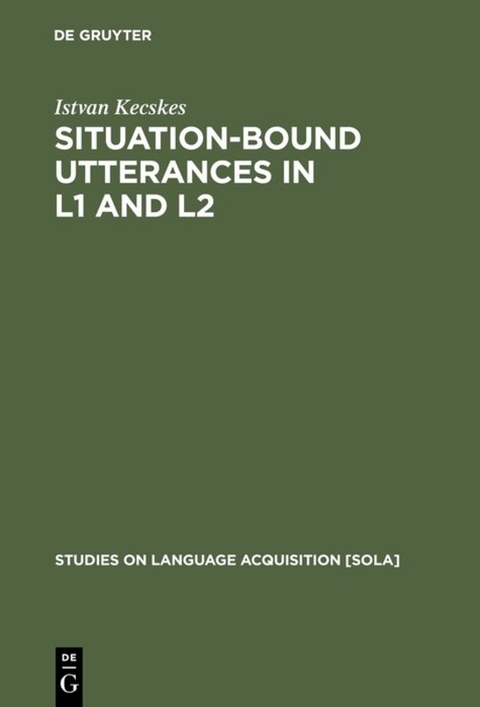
Situation-Bound Utterances in L1 and L2

(Autor)

Buch | Hardcover
VIII, 228 Seiten
2002 | 1. Reprint 2012
de Gruyter Mouton (Verlag)
978-3-11-017358-1 (ISBN)
Lese- und Medienproben

Situation-Bound Utterances in L1 and L2 - Istvan Kecskes
CHF 179,95 inkl. MwSt
This book focuses on a particular type of formulaic expressions called Situation-Bound Utterances (SBUs). Since the meaning of these pragmatic units is shaped by the interplay of linguistic and extralinguistic factors they can be best accounted for in a theoretical framework which represents a knowledge-for-use conception. A unique feature of the book is that it examines the development and use of a particular type of formulae from new perspectives. The comparison of a monolingual and multilingual approach, and the application of the graded salience hypothesis to SBUs within a cognitive-pragmatic theoretical framework reveal that issues such as the role of context in shaping situational meaning, and the existence of common or similar cognitive mechanisms and knowledge structures responsible for cognitive functions and speech behavior in different languages need revision. As a consequence, the book seeks answer to two main questions: 1) origin and extent of context-sensitiveness, and 2) the development of the particular situational functions of SBUs. On the basis of recent research it is argued that context affects comprehension only after highly salient information has been accessed. Search for the appropriate meaning stops if the information accessed initially is compatible with the context, and it continues, if it is not. This approach puts the issue of context-sensitiveness of SBUs into an entirely different perspective. It is also discussed that why exactly these utterances started to be used to express those pragmatic functions and not others. SBUs demonstrate better than any other linguistic unit that there is a strong cognitive-linguistic interdependency. The development of certain SBUs can be accounted for through cognitive mechanisms, and vice versa: learning an SBU for a culturally important category can linguistically reinforce the learning of the category itself. The book uses a cross-linguistic perspective and illustrative examples from several languages which makes its arguments and claims convincing.

Istvan Kecskes is Professor and Director of the TESOL Graduate Programs at the State University of New York at Albany, USA.

Chapter 1: Formulaic Expressions in Language Production

Chapter 2: Literal and Figurative Language

Chapter 3: Formulaic and Creative Aspects of Language Use

Chapter 4: Distinguishing Features of SBUs

Chapter 5: Classification of SBUs

Chapter 6: Easy to Learn Hard to Understand

Chapter 7: Variables Affecting the Use of SBUs in L2

Chapter 8: Conclusion

"This book is a must read for whoever is interested in the exploration of fields as varied as theoretical linguistics, cognition, communication studies, pragmatics, second language acquisition, and bilingualism."François Cooren in: Pragmatics & Cognition 1/2004

"This book is a must read for whoever is interested in the exploration of fields as varied as theoretical linguistics, cognition, communication studies, pragmatics, second language acquisition, and bilingualism."
François Cooren in: Pragmatics & Cognition 1/2004

Erscheint lt. Verlag 11.11.2002
Reihe/Serie Studies on Language Acquisition [SOLA] ; 19
Zusatzinfo 1 b/w ill., 5 b/w tbl.
Verlagsort Berlin/Boston
Sprache englisch
Maße 155 x 230 mm
Gewicht 460 g
Themenwelt Geisteswissenschaften Sprach- / Literaturwissenschaft Sprachwissenschaft
Schlagworte Aufsatzsammlung • Bilingualism • Cognitive grammar • Context (Linguistics) • conversation analysis • Fremdsprachenlernen • Gesprächslinguistik • Grammar, Comparative and general • Hardcover, Softcover / Allgemeine und Vergleichende Sprachwissenschaft • Kommunikationswissenschaft • Konversationsanalyse • Linguistics • Linguistik • Second Language acquisition • Spracherweb • Spracherwerb • sprechsituation
ISBN-10 3-11-017358-1 / 3110173581
ISBN-13 978-3-11-017358-1 / 9783110173581
Zustand Neuware
Informationen gemäß Produktsicherheitsverordnung (GPSR)
Haben Sie eine Frage zum Produkt?
Mehr entdecken
aus dem Bereich