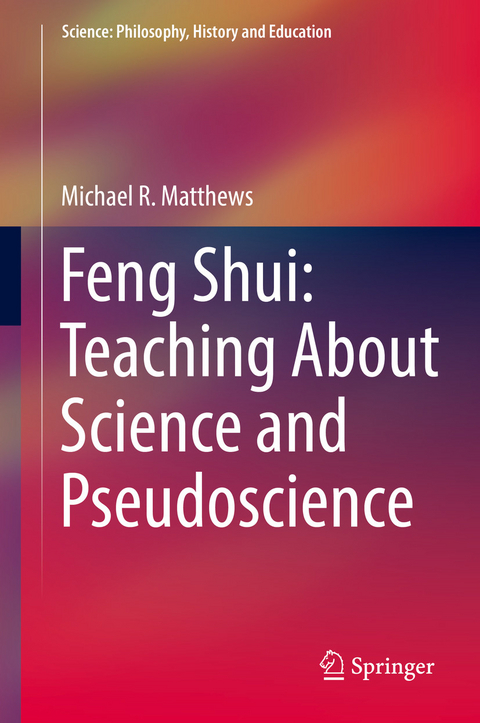
Feng Shui: Teaching About Science and Pseudoscience (eBook)
XX, 340 Seiten
Springer International Publishing (Verlag)
978-3-030-18822-1 (ISBN)
This book provides a richly documented account of the historical, cultural, philosophical and practical dimensions of feng shui. It argues that where feng shui is entrenched educational systems have a responsibility to examine its claims, and that this examination provides opportunities for students to better learn about the key features of the nature of science, the demarcation of science and non-science, the characteristics of pseudoscience, and the engagement of science with culture and worldviews. The arguments presented for feng shui being a pseudoscience can be marshalled when considering a whole range of comparable beliefs and the educational benefit of their appraisal.
Feng shui is a deeply-entrenched, three-millennia-old system of Asian beliefs and practices about nature, architecture, health, and divination that has garnered a growing presence outside of Asia. It is part of a comprehensive and ancient worldview built around belief in chi (qi) the putative universal energy or life-force that animates all existence, the cosmos, the solar system, the earth, and human bodies. Harmonious living requires building in accord with local chi streams; good health requires replenishment and manipulation of internal chi flow; and a beneficent afterlife is enhanced when buried in conformity with chi directions. Traditional Chinese Medicine is based on the proper manipulation of internal chi by acupuncture, tai-chi and qigong exercise, and herbal dietary supplements.
Matthews has produced another tour de force that will repay close study by students, scientists, and all those concerned to understand science, culture, and the science/culture nexus.
Harvey Siegel, Philosophy, University of Miami, USA
With great erudition and even greater fluidity of style, Matthews introduces us to this now-world-wide belief system.
Michael Ruse, Philosophy, Florida State University, USA
The book is one of the best research works published on Feng Shui.
Wang Youjun, Philosophy, Shanghai Normal University, China
The history is fascinating. The analysis makes an important contribution to science literature.
James Alcock, Psychology, York University, Canada
This book provides an in-depth study of Feng Shui in different periods, considering its philosophical, historical and educational dimensions; especially from a perspective of the 'demarcation problem' between science and pseudoscience.
Yao Dazhi, Chinese Academy of Sciences, China
Michael R. Matthews is an Honorary Associate Professor in the School of Education at the University of New South Wales. He has degrees in Science, Psychology, Philosophy, Education and History and Philosophy of Science. He has authored six books, edited nine anthologies, contributed forty book chapters, and published fifty journal articles in philosophy of education, history and philosophy of science, and science education. Different of his books have been translated into Greek, Spanish, Chinese, Turkish and Korean. He was Foundation Editor of the Springer journal Science & Education: Contributions from the History and Philosophy of Science. He was awarded the Joseph H. Hazen Education Prize of the History of Science Society (USA) in recognition of his contributions to the teaching of history of science. He has served as President of the International History, Philosophy and Science Teaching Group, and President of the Inter-Divisional Teaching Commission of the International Union for History and Philosophy of Science. He served two terms as an alderman on the Council of the City of Sydney.
Dedication 6
Foreword 7
Preface and Acknowledgements 9
References 13
Appraisals 14
Contents 16
Part I: Feng Shui: Educational Responsibilities and Opportunities 20
Chapter 1: Introduction 21
What Is Feng Shui? 23
Aversion to Testing 26
Feng Shui in a Science Programme 27
Conclusion 29
Chapter 2: The Cultural Contribution of Science Education 31
Science, Worldviews, and Education 32
Scientific Attitudes 34
A Role for History and Philosophy in Science Education 36
Prevalence of Unscientific Beliefs 37
The Spectrum of Unwarranted Beliefs 41
The Cultural Responsibility of School Science Programmes 44
Religion and Superstition 46
Superstition in Asia 48
Academic Neglect of Feng Shui 50
The Scientific Habit of Mind 52
Scientific Literacy 53
Francis Bacon and Critical Evidential Support 56
Conclusion 57
Part II: Feng Shui: Its Theory and Practice 58
Chapter 3: Feng Shui and Chi 59
Daoist Origins 60
Historical Development 65
Cosmology and Science 69
Chi-fusion 71
Chi and Science 73
Chi-Based Worldviews 76
Conclusion 78
Chapter 4: Feng Shui Practice 80
The Domain of Feng Shui 80
Form and Compass Schools 83
Feng Shui in Hong Kong 87
Feng Shui in Taiwan 90
Feng Shui and Western Architecture and Construction 91
Feng Shui on the Web 93
Divination 97
I Ching or Book of Changes 99
Conclusion 105
Chapter 5: Feng Shui and Traditional Chinese Medicine 106
Chi-Based Medicine 110
Chinese Government’s Promotion of Traditional Chinese Medicine 118
Appraising Acupuncture 121
Conclusion 126
Part III: Feng Shui: A Historical-Philosophical Narrative 128
Chapter 6: Matteo Ricci: A Sixteenth-Century Appraisal of Feng Shui 129
The Jesuit Mission 130
Ricci’s China Travels and Journal 134
Astronomy 137
Observations on Feng Shui 140
Contemporary Appraisal of Matteo Ricci 144
Conclusion 145
Chapter 7: Ernst Johann Eitel: A Nineteenth-Century Appraisal of Feng Shui 146
Feng Shui and Siting Practice 147
Chinese Protoscience and Experiment 150
Science and Metaphysics 153
Romanticism in Chinese Science 155
Chinese Astrology 158
Astronomical Problems for Feng Shui 159
The Five Elements 163
Eitel’s History of Feng Shui 165
The Spirit World 166
Eitel on the Educational Task for China 167
Conclusion 168
Chapter 8: Science, Westernization, and Feng Shui in Early Twentieth-Century China 170
The Chinese Naturalist Tradition 171
Nineteenth-Century Reckoning 173
The Imperial Examinations 176
Early Twentieth-Century Adjustments 177
The ‘New Thought’ and ‘May Fourth’ Movements 179
The Philosophy of Life Debate 186
Conclusion 189
Chapter 9: Feng Shui, Science, and Politics in Contemporary China 190
Education, the Enlightenment Tradition, and the Modernization of China 190
Science, Liberalism, and the Modernization of Chinese Politics 192
Marxism as Official Philosophy 197
Feng Shui and the Chinese Communist Party 199
Feng Shui Rehabilitated 202
Educational Responses 203
Conclusion 204
Part IV: Feng Shui: Considerations from Philosophy of Science 206
Chapter 10: Joseph Needham on Feng Shui and Traditional Chinese Science 207
The Needham Question 207
Chinese Technology 210
Internal and External Impediments to Modern Science in China 212
Neo-Confucianism, the Organicism Worldview, and Chinese Science 217
Appraisal of Needham 223
Conclusion 225
Chapter 11: The Science and Teaching of Energy 227
Energy and Metaphysics 227
History and Conceptual Refinement 228
Animal Magnetism 232
Imponderable Fluids 240
Spiritualist Science 243
Conservation of Energy 246
Teaching About Feng Shui in the Science Programme 248
Energy Literacy 249
HPS-Informed Teaching 250
Multicultural Considerations 256
Conclusion 259
Chapter 12: Scientific Testing of Chi (Qi) Claims 260
Remarkable Qigong Claims 260
Paucity of Tests 268
Philosophical Insulation of Feng Shui 269
Methodological Naturalism 271
Chi as an Intervening Variable 274
Chi as Metaphor 277
Conclusion 278
Chapter 13: Feng Shui as Pseudoscience 280
Demarcation of Science from Non-science 283
Rejecting the Demarcation Project 287
Pseudoscience as a Warranted Category 290
Ecology of Science and Pseudoscience 293
Conclusion 299
Part V: Conclusion 301
Chapter 14: Concluding Remarks 302
References 308
Figure Credits 337
Name Index 339
Subject Index 344
| Erscheint lt. Verlag | 18.7.2019 |
|---|---|
| Reihe/Serie | Science: Philosophy, History and Education | Science: Philosophy, History and Education |
| Zusatzinfo | XX, 340 p. 21 illus. |
| Sprache | englisch |
| Themenwelt | Geisteswissenschaften |
| Medizin / Pharmazie ► Naturheilkunde | |
| Sozialwissenschaften ► Pädagogik ► Erwachsenenbildung | |
| Schlagworte | alternative science • Chang Tsai • Chinese Proto-Science • cultural health • cultural modernization in twentieth century China • Ernst Johann Eitel • Feng Shui and Western Science • Feng Shui as Pseudoscience • Feng shui belief • feng shui in education • Feng Shui in Teaiwan • Feng shui theory and practice • geomancy • history of Feng Shui • Matteo Ricci • Origin of Feng Shui • Pseudoscience • science education • the Five Elements • Traditional Chinese Medicine |
| ISBN-10 | 3-030-18822-1 / 3030188221 |
| ISBN-13 | 978-3-030-18822-1 / 9783030188221 |
| Informationen gemäß Produktsicherheitsverordnung (GPSR) | |
| Haben Sie eine Frage zum Produkt? |
 PDF (Wasserzeichen)
DRM: Digitales Wasserzeichen
Dieses eBook enthält ein digitales Wasserzeichen und ist damit für Sie personalisiert. Bei einer missbräuchlichen Weitergabe des eBooks an Dritte ist eine Rückverfolgung an die Quelle möglich.
Dateiformat: PDF (Portable Document Format)
Mit einem festen Seitenlayout eignet sich die PDF besonders für Fachbücher mit Spalten, Tabellen und Abbildungen. Eine PDF kann auf fast allen Geräten angezeigt werden, ist aber für kleine Displays (Smartphone, eReader) nur eingeschränkt geeignet.
Systemvoraussetzungen:
PC/Mac: Mit einem PC oder Mac können Sie dieses eBook lesen. Sie benötigen dafür einen PDF-Viewer - z.B. den Adobe Reader oder Adobe Digital Editions.
eReader: Dieses eBook kann mit (fast) allen eBook-Readern gelesen werden. Mit dem amazon-Kindle ist es aber nicht kompatibel.
Smartphone/Tablet: Egal ob Apple oder Android, dieses eBook können Sie lesen. Sie benötigen dafür einen PDF-Viewer - z.B. die kostenlose Adobe Digital Editions-App.
Buying eBooks from abroad
For tax law reasons we can sell eBooks just within Germany and Switzerland. Regrettably we cannot fulfill eBook-orders from other countries.
aus dem Bereich