


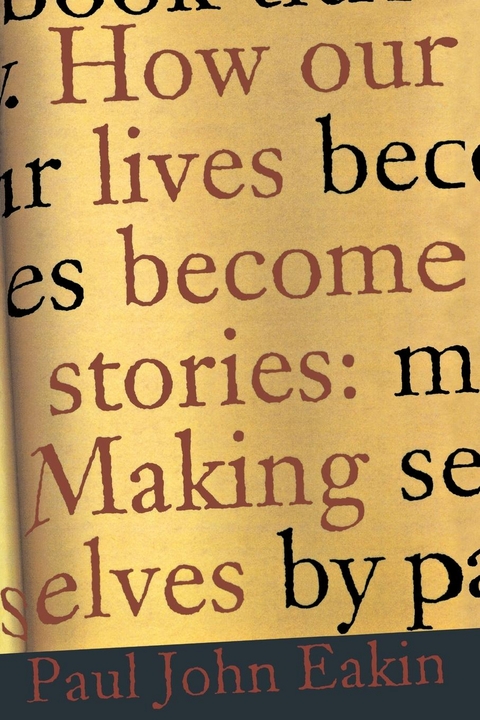
How Our Lives Become Stories (eBook)
224 Seiten
Cornell University Press (Verlag)
978-1-5017-1183-1 (ISBN)
Informed by literary, scientific, and experiential concerns, Eakins enhances our knowledge of the complex forces that shape identity, and confronts the equally complex problems that arise when we write about who we think we are.
The popularity of such books as Frank McCourt's Angela's Ashes, Mary Karr's The Liars' Club, and Kathryn Harrison's controversial The Kiss, has led columnists to call ours "the age of memoir." And while some critics have derided the explosion of memoir as exhibitionistic and self-aggrandizing, literary theorists are now beginning to look seriously at this profusion of autobiographical literature. Informed by literary, scientific, and experiential concerns, How Our Lives Become Stories enhances knowledge of the complex forces that shape identity, and confronts the equally complex problems that arise when we write about who we think we are.
Using life writings as examples—including works by Christa Wolf, Art Spiegelman, Oliver Sacks, Henry Louis Gates, Melanie Thernstrom, and Philip Roth—Paul John Eakin draws on the latest research in neurology, cognitive science, memory studies, developmental psychology, and related fields to rethink the very nature of self-representation. After showing how the experience of living in one's body shapes one's identity, he explores relational and narrative modes of being, emphasizing social sources of identity, and demonstrating that the self and the story of the self are constantly evolving in relation to others. Eakin concludes by engaging the ethical issues raised by the conflict between the authorial impulse to life writing and a traditional, privacy-based ethics that such writings often violate.
The popularity of such books as Frank McCourt's Angela's Ashes, Mary Karr's The Liars' Club, and Kathryn Harrison's controversial The Kiss, has led columnists to call ours "the age of memoir." And while some critics have derided the explosion of memoir as exhibitionistic and self-aggrandizing, literary theorists are now beginning to look seriously at this profusion of autobiographical literature. Informed by literary, scientific, and experiential concerns, How Our Lives Become Stories enhances knowledge of the complex forces that shape identity, and confronts the equally complex problems that arise when we write about who we think we are.
Using life writings as examples—including works by Christa Wolf, Art Spiegelman, Oliver Sacks, Henry Louis Gates, Melanie Thernstrom, and Philip Roth—Paul John Eakin draws on the latest research in neurology, cognitive science, memory studies, developmental psychology, and related fields to rethink the very nature of self-representation. After showing how the experience of living in one's body shapes one's identity, he explores relational and narrative modes of being, emphasizing social sources of identity, and demonstrating that the self and the story of the self are constantly evolving in relation to others. Eakin concludes by engaging the ethical issues raised by the conflict between the authorial impulse to life writing and a traditional, privacy-based ethics that such writings often violate.
Paul John Eakin is Ruth N. Halls Professor Emeritus of English at Indiana University. He is also the author of The New England Girl: Cultural Ideals in Hawthorne, Stowe, Howells, and James; Fictions in Autobiography: Studies in the Art of Self-Invention; and Touching the World: Reference in Autobiography. He is the editor of The Ethics of Life Writing, also from Cornell; On Autobiography by Philippe Lejeune, and American Autobiography: Retrospect and Prospect.
Preface1. Registers of Self2. Relational Selves, Relational Lives: Autobiography and the Myth of Autonomy3. Storied Selves: Identity through Self-Narration4. "The Unseemly Profession": Privacy, Inviolate Personality, and the Ethics of Life WritingWorks Cited
Index
| Erscheint lt. Verlag | 30.6.2019 |
|---|---|
| Verlagsort | Ithaca |
| Sprache | englisch |
| Maße | 140 x 140 mm |
| Themenwelt | Literatur ► Essays / Feuilleton |
| Geisteswissenschaften ► Sprach- / Literaturwissenschaft ► Anglistik / Amerikanistik | |
| Geisteswissenschaften ► Sprach- / Literaturwissenschaft ► Literaturwissenschaft | |
| Schlagworte | autobiographical essays • autobiographical literature • autobiographical truth • autobiography studies • Autobiography theory • autobiography writing • autobiography writing examples • composition writing guide • contemporary autobiography • Creative Nonfiction • Ethics of Life Writing • good memoir writing • how do i write my memoir • how to write a autobiography • how to write a memoir • how to write my autobiography • How We Create Identity in Narrative • Identity and narrative • life narratives • life storytelling • Life Writing • limits of authobiography • memoir class • memoir narratives • memoir studies • memoir theory • memoir writing • memoir writing guide • Memory Studies • nonfiction writing guide • On Autobiography • On Writing • Reading Autobiography • Reference in Autobiography • Self-representation • self-representation writing • the age of memoir • writing a memoir • writing guide • writing memoir good • writing my autobiography • writing reference |
| ISBN-10 | 1-5017-1183-0 / 1501711830 |
| ISBN-13 | 978-1-5017-1183-1 / 9781501711831 |
| Informationen gemäß Produktsicherheitsverordnung (GPSR) | |
| Haben Sie eine Frage zum Produkt? |
 PDF (Adobe DRM)
Kopierschutz: Adobe-DRM
Adobe-DRM ist ein Kopierschutz, der das eBook vor Mißbrauch schützen soll. Dabei wird das eBook bereits beim Download auf Ihre persönliche Adobe-ID autorisiert. Lesen können Sie das eBook dann nur auf den Geräten, welche ebenfalls auf Ihre Adobe-ID registriert sind.
Details zum Adobe-DRM
Dateiformat: PDF (Portable Document Format)
Mit einem festen Seitenlayout eignet sich die PDF besonders für Fachbücher mit Spalten, Tabellen und Abbildungen. Eine PDF kann auf fast allen Geräten angezeigt werden, ist aber für kleine Displays (Smartphone, eReader) nur eingeschränkt geeignet.
Systemvoraussetzungen:
PC/Mac: Mit einem PC oder Mac können Sie dieses eBook lesen. Sie benötigen eine
eReader: Dieses eBook kann mit (fast) allen eBook-Readern gelesen werden. Mit dem amazon-Kindle ist es aber nicht kompatibel.
Smartphone/Tablet: Egal ob Apple oder Android, dieses eBook können Sie lesen. Sie benötigen eine
Geräteliste und zusätzliche Hinweise
Buying eBooks from abroad
For tax law reasons we can sell eBooks just within Germany and Switzerland. Regrettably we cannot fulfill eBook-orders from other countries.
aus dem Bereich


