


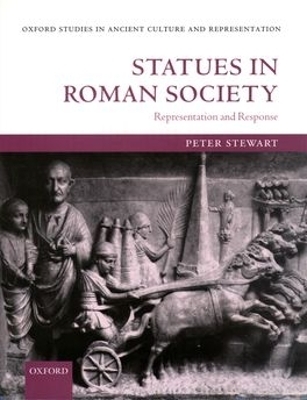
Statues in Roman Society
Representation and Response
Seiten
2004
Oxford University Press (Verlag)
978-0-19-924094-4 (ISBN)
Oxford University Press (Verlag)
978-0-19-924094-4 (ISBN)
Statues were everywhere in the Roman world. They served as objects of cult, honours to emperors and noblemen, and memorials to the dead. Combining close attention to individual Roman texts and images with an unprecedented broad perspective on this remarkable phenomenon, Statues in Roman Society explains the impact which all kinds of statuary had on the ancient population.
Statues are among the most familiar remnants of classical art. Yet their prominence in ancient society is often ignored. In the Roman world statues were ubiquitous. Whether they were displayed as public honours or memorials, collected as works of art, dedicated to deities, venerated as gods, or violated as symbols of a defeated political regime, they were recognized individually and collectively as objects of enormous significance.
By analysing ancient texts and images, Statues in Roman Society unravels the web of associations which surrounded Roman statues. Addressing all categories of statuary together for the first time, it illuminates them in ancient terms, explaining expectations of what statues were or ought to be and describing the Romans' uneasy relationship with 'the other population' in their midst.
Statues are among the most familiar remnants of classical art. Yet their prominence in ancient society is often ignored. In the Roman world statues were ubiquitous. Whether they were displayed as public honours or memorials, collected as works of art, dedicated to deities, venerated as gods, or violated as symbols of a defeated political regime, they were recognized individually and collectively as objects of enormous significance.
By analysing ancient texts and images, Statues in Roman Society unravels the web of associations which surrounded Roman statues. Addressing all categories of statuary together for the first time, it illuminates them in ancient terms, explaining expectations of what statues were or ought to be and describing the Romans' uneasy relationship with 'the other population' in their midst.
Peter Stewart is Lecturer in Classical Art and its Heritage at the Courtauld Institute of Art, London
Introduction ; 1. Defining statues in word and image ; 2. The appearance of statues ; 3. Portrait statues and the statuesque ; 4. The other population of Rome ; 5. Statues in the Empire ; 6. Simulacra and signa ; 7. The private sphere ; 8. Touching statues ; Conclusions
| Erscheint lt. Verlag | 5.2.2004 |
|---|---|
| Reihe/Serie | Oxford Studies in Ancient Culture Representation |
| Zusatzinfo | numerous halftones |
| Verlagsort | Oxford |
| Sprache | englisch |
| Maße | 195 x 254 mm |
| Gewicht | 866 g |
| Themenwelt | Kunst / Musik / Theater ► Kunstgeschichte / Kunststile |
| Kunst / Musik / Theater ► Malerei / Plastik | |
| Geschichte ► Allgemeine Geschichte ► Vor- und Frühgeschichte | |
| Geisteswissenschaften ► Geschichte ► Regional- / Ländergeschichte | |
| Geisteswissenschaften ► Sprach- / Literaturwissenschaft ► Anglistik / Amerikanistik | |
| Geisteswissenschaften ► Sprach- / Literaturwissenschaft ► Literaturwissenschaft | |
| ISBN-10 | 0-19-924094-9 / 0199240949 |
| ISBN-13 | 978-0-19-924094-4 / 9780199240944 |
| Zustand | Neuware |
| Informationen gemäß Produktsicherheitsverordnung (GPSR) | |
| Haben Sie eine Frage zum Produkt? |
Mehr entdecken
aus dem Bereich



aus dem Bereich
Reise in die Römerzeit
Buch | Hardcover (2025)
Galiani Berlin (Verlag)
CHF 44,75
auf den Spuren der frühen Zivilisationen
Buch | Hardcover (2023)
C.H.Beck (Verlag)
CHF 27,95


