


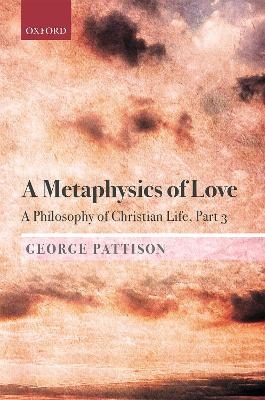
A Rhetorics of the Word
A Philosophy of Christian Life, Part II
Seiten
2019
Oxford University Press (Verlag)
978-0-19-881351-4 (ISBN)
Oxford University Press (Verlag)
978-0-19-881351-4 (ISBN)
Language has been a major theme in philosophy of religion for more than half a century. The present work looks to the sense of being called that lies at the heart of Christian life and asks what this shows us about what it is to be human and what the God-relationship means for those having such a call.
A Rhetorics of the Word is the second volume of a three-part philosophy of Christian life. It approaches Christian life as expressive of a divine calling or vocation. The word Church (ekklesia) and the role of naming in baptism indicate the fundamental place of calling in Christian life. However, ideas of vocation are difficult to access in a world shaped by the experience of disenchantment. The difficulties of articulating vocation are explored with reference to Weber, Heidegger, and Kierkegaard. These are further connected to a general crisis of language, manifesting in the degradation of political discourse (Arendt) and the impact of new communications technology on human discourse. This impact can be seen as reinforcing an occlusion of language in favour of rationality already evidenced in the philosophical tradition and technocratic management. New possibilities for thinking vocation are pursued through the biblical prophets (with emphasis on Buber's and Rosenzweig's reinterpretation of the call of Moses), Saint John, and Russian philosophies of language (Florensky to Bakhtin). Vocation emerges as bound up with the possibility of being name-bearers, enabling a mutuality of call and response. This is then evidenced further in ethics and poetics, where Levinas and Hermann Broch (The Death of Virgil) become major points of reference. In conclusion, the themes of calling and the name are seen to shape the possibility of love-the subject of the final part of the philosophy of Christian life: A Metaphysics of Love.
A Rhetorics of the Word is the second volume of a three-part philosophy of Christian life. It approaches Christian life as expressive of a divine calling or vocation. The word Church (ekklesia) and the role of naming in baptism indicate the fundamental place of calling in Christian life. However, ideas of vocation are difficult to access in a world shaped by the experience of disenchantment. The difficulties of articulating vocation are explored with reference to Weber, Heidegger, and Kierkegaard. These are further connected to a general crisis of language, manifesting in the degradation of political discourse (Arendt) and the impact of new communications technology on human discourse. This impact can be seen as reinforcing an occlusion of language in favour of rationality already evidenced in the philosophical tradition and technocratic management. New possibilities for thinking vocation are pursued through the biblical prophets (with emphasis on Buber's and Rosenzweig's reinterpretation of the call of Moses), Saint John, and Russian philosophies of language (Florensky to Bakhtin). Vocation emerges as bound up with the possibility of being name-bearers, enabling a mutuality of call and response. This is then evidenced further in ethics and poetics, where Levinas and Hermann Broch (The Death of Virgil) become major points of reference. In conclusion, the themes of calling and the name are seen to shape the possibility of love-the subject of the final part of the philosophy of Christian life: A Metaphysics of Love.
George Pattison has published extensively in the area of theology and modern European thought, with particular emphasis on existentialism (especially Kierkegaard, Dostoevsky, Heidegger), art and literature, and Russian religious thought. After 14 years as a parish priest, he held posts in Cambridge, Aarhus, and Oxford universities before moving to Glasgow in 2013. He is also a visiting professor at the University of Copenhagen.
Introduction
1: A Crisis of Vocation
2: Political Calling in an Age of Technology
3: Prophetic Calling: At the Burning Bush
4: In the Beginning was the Word
5: At the Name of Jesus
6: The Call of Conscience
7: Poetic Vocation
Conclusion
| Erscheinungsdatum | 21.02.2020 |
|---|---|
| Verlagsort | Oxford |
| Sprache | englisch |
| Maße | 158 x 232 mm |
| Gewicht | 568 g |
| Themenwelt | Geisteswissenschaften ► Philosophie |
| Religion / Theologie ► Christentum ► Kirchengeschichte | |
| ISBN-10 | 0-19-881351-1 / 0198813511 |
| ISBN-13 | 978-0-19-881351-4 / 9780198813514 |
| Zustand | Neuware |
| Informationen gemäß Produktsicherheitsverordnung (GPSR) | |
| Haben Sie eine Frage zum Produkt? |
Mehr entdecken
aus dem Bereich

aus dem Bereich
eine andere Geschichte der Papststadt
Buch | Softcover (2024)
C.H.Beck (Verlag)
CHF 25,20
die Macht des Dunklen in unserer Zeit und wie wir ihr entgegentreten
Buch | Hardcover (2025)
Verlag Herder
CHF 27,90


