


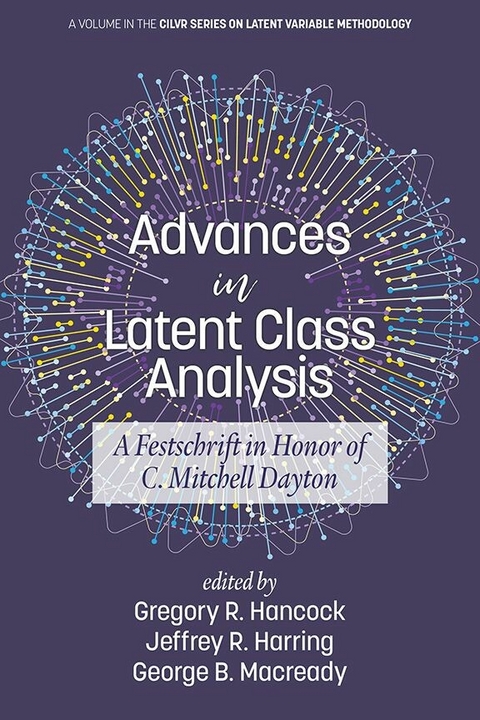
For latent class analysis to take these developmental leaps required contributions that were methodological, certainly, as well as didactic. Among the leaders on both fronts was C. Mitchell “Chan” Dayton, at the University of Maryland, whose work in latent class analysis spanning several decades helped the method to expand and reach its current potential. The current volume in the Center for Integrated Latent Variable Research (CILVR) series reflects the diversity that is latent class analysis today, celebrating work related to, made possible by, and inspired by Chan’s noted contributions, and signaling the even more exciting future yet to come.
What is latent class analysis? If you asked that question thirty or forty years ago you would have gotten a different answer than you would today. Closer to its time of inception, latent class analysis was viewed primarily as a categorical data analysis technique, often framed as a factor analysis model where both the measured variable indicators and underlying latent variables are categorical. Today, however, it rests within much broader mixture and diagnostic modeling framework, integrating measured and latent variables that may be categorical and/or continuous, and where latent classes serve to define the subpopulations for whom many aspects of the focal measured and latent variable model may differ.For latent class analysis to take these developmental leaps required contributions that were methodological, certainly, as well as didactic. Among the leaders on both fronts was C. Mitchell "e;Chan"e; Dayton, at the University of Maryland, whose work in latent class analysis spanning several decades helped the method to expand and reach its current potential. The current volume in the Center for Integrated Latent Variable Research (CILVR) series reflects the diversity that is latent class analysis today, celebrating work related to, made possible by, and inspired by Chan's noted contributions, and signaling the even more exciting future yet to come.
| Erscheint lt. Verlag | 1.5.2019 |
|---|---|
| Sprache | englisch |
| Themenwelt | Schulbuch / Wörterbuch ► Lexikon / Chroniken |
| Geisteswissenschaften | |
| Mathematik / Informatik ► Informatik ► Datenbanken | |
| Mathematik / Informatik ► Mathematik | |
| ISBN-10 | 1-64113-563-8 / 1641135638 |
| ISBN-13 | 978-1-64113-563-4 / 9781641135634 |
| Informationen gemäß Produktsicherheitsverordnung (GPSR) | |
| Haben Sie eine Frage zum Produkt? |
 PDF (Adobe DRM)
Größe: 5,2 MB
Kopierschutz: Adobe-DRM
Adobe-DRM ist ein Kopierschutz, der das eBook vor Mißbrauch schützen soll. Dabei wird das eBook bereits beim Download auf Ihre persönliche Adobe-ID autorisiert. Lesen können Sie das eBook dann nur auf den Geräten, welche ebenfalls auf Ihre Adobe-ID registriert sind.
Details zum Adobe-DRM
Dateiformat: PDF (Portable Document Format)
Mit einem festen Seitenlayout eignet sich die PDF besonders für Fachbücher mit Spalten, Tabellen und Abbildungen. Eine PDF kann auf fast allen Geräten angezeigt werden, ist aber für kleine Displays (Smartphone, eReader) nur eingeschränkt geeignet.
Systemvoraussetzungen:
PC/Mac: Mit einem PC oder Mac können Sie dieses eBook lesen. Sie benötigen eine
eReader: Dieses eBook kann mit (fast) allen eBook-Readern gelesen werden. Mit dem amazon-Kindle ist es aber nicht kompatibel.
Smartphone/Tablet: Egal ob Apple oder Android, dieses eBook können Sie lesen. Sie benötigen eine
Geräteliste und zusätzliche Hinweise
Buying eBooks from abroad
For tax law reasons we can sell eBooks just within Germany and Switzerland. Regrettably we cannot fulfill eBook-orders from other countries.
 EPUB (Adobe DRM)
Kopierschutz: Adobe-DRM
Adobe-DRM ist ein Kopierschutz, der das eBook vor Mißbrauch schützen soll. Dabei wird das eBook bereits beim Download auf Ihre persönliche Adobe-ID autorisiert. Lesen können Sie das eBook dann nur auf den Geräten, welche ebenfalls auf Ihre Adobe-ID registriert sind.
Details zum Adobe-DRM
Dateiformat: EPUB (Electronic Publication)
EPUB ist ein offener Standard für eBooks und eignet sich besonders zur Darstellung von Belletristik und Sachbüchern. Der Fließtext wird dynamisch an die Display- und Schriftgröße angepasst. Auch für mobile Lesegeräte ist EPUB daher gut geeignet.
Systemvoraussetzungen:
PC/Mac: Mit einem PC oder Mac können Sie dieses eBook lesen. Sie benötigen eine
eReader: Dieses eBook kann mit (fast) allen eBook-Readern gelesen werden. Mit dem amazon-Kindle ist es aber nicht kompatibel.
Smartphone/Tablet: Egal ob Apple oder Android, dieses eBook können Sie lesen. Sie benötigen eine
Geräteliste und zusätzliche Hinweise
Buying eBooks from abroad
For tax law reasons we can sell eBooks just within Germany and Switzerland. Regrettably we cannot fulfill eBook-orders from other countries.
aus dem Bereich


