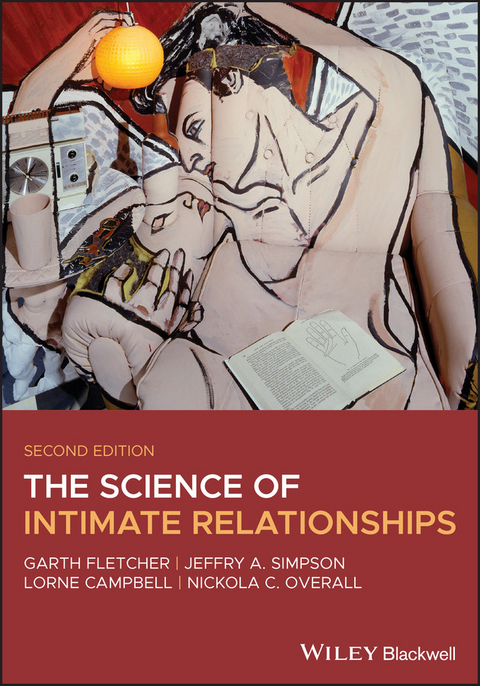
The Science of Intimate Relationships (eBook)
John Wiley & Sons (Verlag)
9781119430094 (ISBN)
Provides a unique interdisciplinary approach to the science of intimate human relationships
This newly updated edition of a popular text is the first to present a full-blooded interdisciplinary and theoretically coherent approach to the latest scientific findings relating to human sexual relationships. Written by recognized leaders in the field in a style that is rigorous yet accessible, it looks beyond the core knowledge in social and evolutionary psychology to incorporate material and perspectives from cognitive science (including brain-imaging studies), developmental psychology, anthropology, comparative psychology, clinical psychology, genetic research, sociology, and biology.
Written by an international team of acclaimed experts in the field, The Science of Intimate Relationships offers a wealth of thought-provoking ideas and insights into the science behind the initiation, maintenance, and termination of romantic relationships. The 2nd Edition features two new chapters on health and relationships, and friends and family, both of which shed new light on the complex links among human nature, culture, and romantic love. It covers key topics such as mate selection, attachment theory, love, communication, sex, relationship dissolution, violence, mind-reading, and the relationship brain.
- Provides a coherent and theoretically integrative approach to the subject of intimate relationships
- Offers an interdisciplinary perspective that looks beyond social and evolutionary psychology to many other scientific fields of study
- Includes two new chapters on 'Relationships and Health' and 'Friends and Family', added in response to feedback from professors who have used the textbook with their classes
- Presented by recognized leaders in the field of relationships
- Features PowerPoint slides and an online Teaching Handbook
The Science of Intimate Relationships, 2nd Edition is designed for upper-level undergraduate students of human sexuality, psychology, anthropology, and other related fields.
GARTH FLETCHER, PHD, is Professor of Psychology at Victoria University of Wellington, New Zealand.
JEFFRY A. SIMPSON, PHD, is Professor of Psychology and Director of the Doctoral Minor in Interpersonal Relationships at the University of Minnesota, USA.
LORNE CAMPBELL, PHD, is Professor of Psychology at the University of Western Ontario, Canada.
NICKOLA C. OVERALL, PHD, is Professor of Psychology at the University of Auckland, New Zealand.
GARTH FLETCHER, PHD, is Professor of Psychology at Victoria University of Wellington, New Zealand. JEFFRY A. SIMPSON, PHD, is Professor of Psychology and Director of the Doctoral Minor in Interpersonal Relationships at the University of Minnesota, USA. LORNE CAMPBELL, PHD, is Professor of Psychology at the University of Western Ontario, Canada. NICKOLA C. OVERALL, PHD, is Professor of Psychology at the University of Auckland, New Zealand.
Preface
Chapter 1: Introduction: The Science of Intimate Relationships
Chapter 2: Intimate Relationships in Context: Key Theories, Concepts, and Human Nature
Chapter 3: The Intimate Relationship Mind
Chapter 4: The Intimate Relationship Body
Chapter 5: Intimate Relationships and Health
Chapter 6: Born to Bond: From Infancy to Adulthood
Chapter 7: Selecting Mates
Chapter 8: Family and Friends
Chapter 9: Love, Sweet Love
Chapter 10: Reading Minds, Partners, and Relationships
Chapter 11: Communication and Interaction
Chapter 12: Sex and Passion
Chapter 13: Relationship Violence
Chapter 14: Relationship Dissolution
Chapter 15: Assembling the Relationship Elephant
Glossary
References
Index
1
Introduction: The Science of Intimate Relationships
Focus of the book – domains of scientific study – interdisciplinary links – relationship mind and body – common sense and pop psychology – research methods – book overview – summary and conclusions
The emergence of a science of relationships represents a frontier – perhaps the last major frontier – in the study of humankind.
Berscheid and Peplau (1983)
The first known academic treatise on intimate relationships was Plato's Symposium, written approximately 2300 years ago. In this historic document, Aristophanes tells a tale of a curious mythical being that is spherical in form with two complete sets of arms, legs, and genitalia. Because of the strength and speed of these creatures (they cart‐wheeled around on four arms and four legs), they posed a threat to the gods. Accordingly, Zeus split them in half and rearranged their genitals so that they were forced to embrace each other front on to have sexual relations. Some of the original beings had two sets of male genitalia, some had two sets of female genitalia, and some had one set of female and one set of male genitalia. Thus, procreation of the species was possible only by members of the original male–female creatures getting together. Possibly in deference to the sexual orientation of some of his audience (or to the tenor of that time), Aristophanes was quick to add that males who sought union with other males were “bold and manly,” whereas individuals who originated from the hermaphrodite creatures were adulterers or promiscuous women (Sayre 1995, p. 106). Regardless of sexual orientation, the need for love is thus born of the longing to reunite with one's long‐lost other half and to achieve an ancient unity destroyed by the gods.
As this allegory suggests, individuals are alone and incomplete – an isolation that can be banished, or at least ameliorated, when humans pair‐off and experience the intimacy that can only be gained in a close, emotionally connected relationship. Such intimacy, the experience of reuniting with one's long‐lost other half, reaches its peak in parent–infant bonding and in the intimate high of romantic sexual relationships. But such intimacy is also experienced quite powerfully and deeply in platonic relationships, familial relationships, and in the long sunset of sexual relationships that have lost their passionate urgency and settled into a deep form of close companionship.
Just like Plato's mythical beings, then, humans have a basic need to be accepted, appreciated, and cared for, and to reciprocate such attitudes and behaviors – in short, to love and to be loved (Baumeister and Leary 1995). This is especially true for finding a sexual or romantic partner, a quest that can range from a one‐night stand to seeking out a mate for life. Indeed, for most people the goal of forming a permanent, sexual liaison with another person is a pivotal goal in life in which a massive outlay of energy is invested.
In this textbook, we confine our attention largely to intimate relationships that are sexual or romantic rather than other types of relationships, such as parent–child relationships, platonic friendships, casual friendships, or co‐worker relationships. Obviously, intimate relationships can be, and often are, influenced by these other types of relationships. When these connections are important or salient, we will address them. Moreover, we discuss certain categories of nonsexual relationships that are centrally related to adult intimate relationships, the most important being parent–child relationships. And we discuss both heterosexual and same‐sex relationships, including their similarities and differences. Nevertheless, our attention is focused on heterosexual relationships, simply because most scientific research has investigated heterosexual relationships.
This introductory chapter sets the scene for the book by tracing the history of scientific work on relationships, dissecting what is true (and false) about common sense and pop psychology, briefly discussing basic research methods in the field, and finally presenting a brief overview of the book's content. We have boldfaced all technical terms the first time they appear in each chapter of the book, and provide brief definitions of each term in the glossary at the end of the book.
The Science of Intimate Relationships: A Brief History and Analysis
As Plato's Symposium attests, humans have been theorizing about relationships for eons. This is not surprising, given the proclivity of humans to develop causal models and explanations, many of which are based on culturally shared understandings. Indeed, this is one hallmark of our species. Consistently, many of the topics covered in this book have been discussed in literature and plays hundreds of years before any rigorous scientific investigation of relationships appeared (think Homer, Shakespeare, and Jane Austen).
The first scientific forays into intimate relationships did not take place until the twentieth century. To give you some idea of the way in which scientific work has taken on Tsunami proportions in relatively recent years, we used a popular scholarly database – Google Scholar – to assess the number of publications in scientific journals devoted to the topic of romantic relationships during the 28 years from 1988 to 2015. As shown in Figure 1.1, the number of publications has rapidly increased over this period of time, from 90 in 1988–1991 to 4750 in 2012–2015. Moreover, typifying a remarkable acceleration in publications, 74% of these publications have been produced between 2008 and 2015.
Figure 1.1 Publications from 1988 to 2015 – sexual or romantic relationships.
Domains of Study
Publications relevant to romantic relationships have appeared across a diverse set of disciplines, including cross‐cultural and anthropological studies, neuroscience, clinical and family psychology, developmental psychology, the science of sexual behavior, evolutionary psychology, and social and personality psychology. Figure 1.2 gives our take on the pioneering contributions in each field. Notably, all of the pioneering contributions were published in the second half of the twentieth century, with two stunning exceptions – two publications in the second half of the nineteenth century by Charles Darwin (more on Darwin later).
Figure 1.2 Major scientific domains studying sexual relationships from distal to proximal levels, along with seminal publications.
Scientific approaches to the study of intimate relationships differ according to their goals and level of focus (see Figure 1.2). At the most general level, all human sciences have the same core aims – the explanation, prediction, and control of human behavior – although certain aims are sometimes emphasized depending on the particular approach. For example, clinical psychology emphasizes the prediction and control of relationship phenomena (especially relationship functioning, success, and stability), whereas social psychology and evolutionary psychology focus more on explanation.
Different approaches to the study of human relationships concentrate on different goals or questions, and, thus differ in their specific domain(s) of investigation. The study of social development, for example, is interested in understanding the development of bonding and attachment in childhood and how it relates to the development of intimate relationships across the life span (termed an ontogenetic approach). Evolutionary psychology is primarily concerned with understanding the evolutionary origins of human courting, sexual behavior, mate selection, parenting, and so forth. Thus, evolutionary psychology is primarily concerned with distal causes stemming from our remote evolutionary past in order to clarify current human behavioral, cognitive, and emotional tendencies. Social psychology, in contrast, takes human dispositions (behavioral, cognitive, and emotional) as givens, and seeks to model the way in which our dispositions combine with external contingencies in our local environment to produce important behavior, social judgments, and emotions. Thus, social psychology offers much more fine‐grained predictions and explanations of particular behaviors and cognitions that occur in specific situations (a proximal level) than does evolutionary psychology. Anthropological and cross‐cultural approaches, on the other hand, focus on the way in which broad cultural and institutional contexts frame and guide the behavior of individuals and couples. Whereas social psychology tends to focus on the links between the individual and the dyadic relationship (e.g. how one person's traits influence his or her partner and relationship outcomes), anthropological approaches tend to focus on connections between the couple (e.g. the rules and norms in relationship) and the wider culture in which the relationship is embedded.
An Example
A social psychological approach to understanding how people select mates might be to postulate a psychological model examining the importance that each partner places on particular characteristics (which will vary across individuals) and how they are...
| Erscheint lt. Verlag | 17.6.2019 |
|---|---|
| Sprache | englisch |
| Themenwelt | Geisteswissenschaften ► Psychologie ► Familien- / Systemische Therapie |
| Geisteswissenschaften ► Psychologie ► Sexualität / Partnerschaft | |
| Geisteswissenschaften ► Psychologie ► Sozialpsychologie | |
| Medizin / Pharmazie ► Medizinische Fachgebiete ► Psychiatrie / Psychotherapie | |
| Schlagworte | Attraction • cognitive science • Developmental Psychology • developmental psychology</p> • Evolutionary Psychology • Family • Human sexuality • Interpersonal relations • Love • <p>marriage • Psychologie • Psychology • Psychology of Sexuality & Gender • relationships • Relationships, Marriage & Family • romantic relationships • sexual attraction • Sexual- u. Geschlechtspsychologie • Social Psychology • Sozialpsychologie • Zwischenmenschliche Beziehungen, Ehe u. Familie |
| ISBN-13 | 9781119430094 / 9781119430094 |
| Informationen gemäß Produktsicherheitsverordnung (GPSR) | |
| Haben Sie eine Frage zum Produkt? |
 EPUB (Adobe DRM)
Kopierschutz: Adobe-DRM
Adobe-DRM ist ein Kopierschutz, der das eBook vor Mißbrauch schützen soll. Dabei wird das eBook bereits beim Download auf Ihre persönliche Adobe-ID autorisiert. Lesen können Sie das eBook dann nur auf den Geräten, welche ebenfalls auf Ihre Adobe-ID registriert sind.
Details zum Adobe-DRM
Dateiformat: EPUB (Electronic Publication)
EPUB ist ein offener Standard für eBooks und eignet sich besonders zur Darstellung von Belletristik und Sachbüchern. Der Fließtext wird dynamisch an die Display- und Schriftgröße angepasst. Auch für mobile Lesegeräte ist EPUB daher gut geeignet.
Systemvoraussetzungen:
PC/Mac: Mit einem PC oder Mac können Sie dieses eBook lesen. Sie benötigen eine
eReader: Dieses eBook kann mit (fast) allen eBook-Readern gelesen werden. Mit dem amazon-Kindle ist es aber nicht kompatibel.
Smartphone/Tablet: Egal ob Apple oder Android, dieses eBook können Sie lesen. Sie benötigen eine
Geräteliste und zusätzliche Hinweise
Buying eBooks from abroad
For tax law reasons we can sell eBooks just within Germany and Switzerland. Regrettably we cannot fulfill eBook-orders from other countries.
aus dem Bereich