


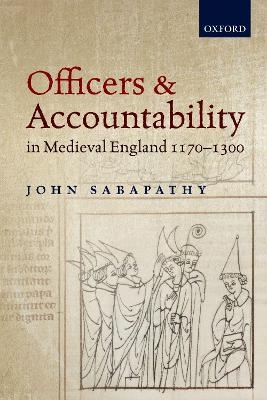
Officers and Accountability in Medieval England 1170-1300
Seiten
2019
Oxford University Press (Verlag)
978-0-19-884798-4 (ISBN)
Oxford University Press (Verlag)
978-0-19-884798-4 (ISBN)
A volume which examines twelfth and thirteenth century officers and the practices used to regulate them in England, placing them not only within a British context but also a wider European one and exploring how administration, law, politics, and norms where used to control the insolence of office.
The later twelfth and thirteenth centuries were a pivotal period for the development of European government and governance. A mentality emerged that trusted to procedures of accountability as a means of controlling officers' conduct. The mentality was not inherently new, but it became qualitatively more complex and quantitatively more widespread in this period, across European countries, and across different sorts of officer. The officers exposed to these methods were not just 'state' ones, but also seignorial, ecclasistical, and university-college officers, as well as urban-communal ones. This study surveys these officers and the practices used to regulate them in England. It places them not only within a British context but also a wide European one and explores how administration, law, politics, and norms tried to control the insolence of office.
The devices for institutionalising accountability analysed here reflected an extraordinarily creative response in England, and beyond, to the problem of complex government: inquests, audits, accounts, scrutiny panels, sindication. Many of them have shaped the way in which we think about accountability today. Some remain with us. So too do their practical problems. How can one delegate control effectively? How does accountability relate to responsibility? What relationship does accountability have with justice? This study offers answers for these questions in the Middle Ages, and is the first of its kind dedicated to an examination of this important topic in this period.
The later twelfth and thirteenth centuries were a pivotal period for the development of European government and governance. A mentality emerged that trusted to procedures of accountability as a means of controlling officers' conduct. The mentality was not inherently new, but it became qualitatively more complex and quantitatively more widespread in this period, across European countries, and across different sorts of officer. The officers exposed to these methods were not just 'state' ones, but also seignorial, ecclasistical, and university-college officers, as well as urban-communal ones. This study surveys these officers and the practices used to regulate them in England. It places them not only within a British context but also a wide European one and explores how administration, law, politics, and norms tried to control the insolence of office.
The devices for institutionalising accountability analysed here reflected an extraordinarily creative response in England, and beyond, to the problem of complex government: inquests, audits, accounts, scrutiny panels, sindication. Many of them have shaped the way in which we think about accountability today. Some remain with us. So too do their practical problems. How can one delegate control effectively? How does accountability relate to responsibility? What relationship does accountability have with justice? This study offers answers for these questions in the Middle Ages, and is the first of its kind dedicated to an examination of this important topic in this period.
John Sabapathy is a Senior Lecturer in Medieval History at University College London. He is the co-editor of Individuals and Institutions in Medieval Scholasticism and is writing The Cultivation of Christendom, a history of thirteenth-century Europe for the Oxford History of Medieval Europe.
1: Introduction
2: Bailiffs and stewards
3: Sheriffs
4: Bishops
5: Wardens and Fellows
6: Conclusions
Select Bibliography
| Erscheinungsdatum | 16.09.2019 |
|---|---|
| Verlagsort | Oxford |
| Sprache | englisch |
| Maße | 156 x 232 mm |
| Gewicht | 498 g |
| Themenwelt | Geschichte ► Allgemeine Geschichte ► Mittelalter |
| Geisteswissenschaften ► Geschichte ► Regional- / Ländergeschichte | |
| Geschichte ► Teilgebiete der Geschichte ► Kulturgeschichte | |
| Sozialwissenschaften ► Politik / Verwaltung ► Politische Theorie | |
| ISBN-10 | 0-19-884798-X / 019884798X |
| ISBN-13 | 978-0-19-884798-4 / 9780198847984 |
| Zustand | Neuware |
| Informationen gemäß Produktsicherheitsverordnung (GPSR) | |
| Haben Sie eine Frage zum Produkt? |
Mehr entdecken
aus dem Bereich


aus dem Bereich
Geschichte einer Augsburger Familie (1367-1650)
Buch | Softcover (2024)
Kohlhammer (Verlag)
CHF 47,60


