


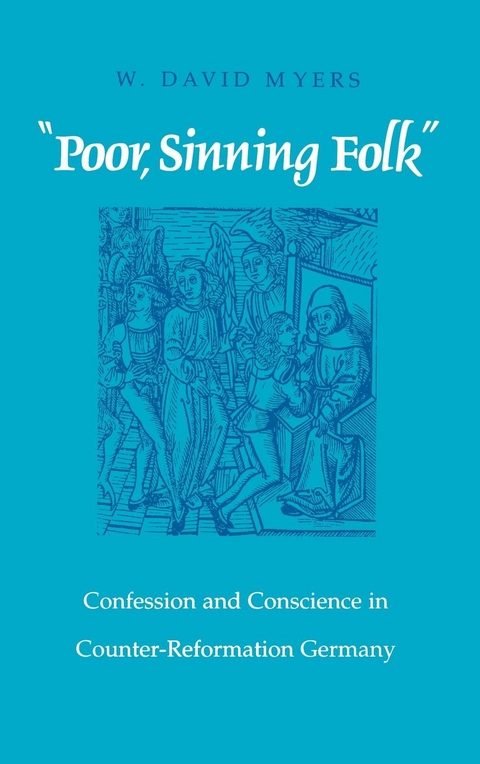
"Poor Sinning Folk" (eBook)
224 Seiten
Cornell University Press (Verlag)
978-1-5017-4470-9 (ISBN)
In "Poor, Sinning Folk," W. David Myers investigates the sixteenth-century fate of the medieval Christian sacrament of penance, the process of confessing to a priest in secret one's sins against God and other humans.
In "Poor, Sinning Folk," W. David Myers investigates the sixteenth-century fate of the medieval Christian sacrament of penance, the process of confessing to a priest in secret one's sins against God and other humans. In Pre-Reformation Germany, numerous layers of public ritual, expectation, and display surrounded the central secret act of confessing and conditioned its meaning. Less frequent and less private than the ritual familiar to modern Catholics, medieval penance was for most German-speaking Christians a seasonal event with social as well as spiritual ramifications for participants.
Protestantism swept confession away from many German lands. Even where Catholicism survived and flourished, as in the lands comprising modern Bavaria, the sacrament of penance changed profoundly. The modern confessional booth was introduced, making the sacrament more prominent, more secure from scandal, and ultimately more private. This reform coincided with the efforts of secular rulers to fashion a more disciplined, obedient population.
New religious orders, most notably the Society of Jesus in Bavaria, saw the frequent confession of lay people as a means to piety and spiritual discipline amidst the temptations of worldly affairs. By the middle of the seventeenth century, political and religious forces combined to forge the sacrament of penance into an effective instrument of spiritual discipline which would fashion the modern Catholic conscience and endure essentially unchanged into the late twentieth century.
In "Poor, Sinning Folk," W. David Myers investigates the sixteenth-century fate of the medieval Christian sacrament of penance, the process of confessing to a priest in secret one's sins against God and other humans. In Pre-Reformation Germany, numerous layers of public ritual, expectation, and display surrounded the central secret act of confessing and conditioned its meaning. Less frequent and less private than the ritual familiar to modern Catholics, medieval penance was for most German-speaking Christians a seasonal event with social as well as spiritual ramifications for participants. Protestantism swept confession away from many German lands. Even where Catholicism survived and flourished, as in the lands comprising modern Bavaria, the sacrament of penance changed profoundly. The modern confessional booth was introduced, making the sacrament more prominent, more secure from scandal, and ultimately more private. This reform coincided with the efforts of secular rulers to fashion a more disciplined, obedient population. New religious orders, most notably the Society of Jesus in Bavaria, saw the frequent confession of lay people as a means to piety and spiritual discipline amidst the temptations of worldly affairs. By the middle of the seventeenth century, political and religious forces combined to forge the sacrament of penance into an effective instrument of spiritual discipline which would fashion the modern Catholic conscience and endure essentially unchanged into the late twentieth century.
W. David Myers is Assistant Professor of History at Fordham University.
| Erscheint lt. Verlag | 15.5.2019 |
|---|---|
| Verlagsort | Ithaca |
| Sprache | englisch |
| Maße | 150 x 150 mm |
| Themenwelt | Geisteswissenschaften ► Geschichte ► Regional- / Ländergeschichte |
| Geschichte ► Teilgebiete der Geschichte ► Religionsgeschichte | |
| Religion / Theologie ► Christentum ► Gebete / Lieder / Meditationen | |
| Religion / Theologie ► Christentum ► Kirchengeschichte | |
| ISBN-10 | 1-5017-4470-4 / 1501744704 |
| ISBN-13 | 978-1-5017-4470-9 / 9781501744709 |
| Informationen gemäß Produktsicherheitsverordnung (GPSR) | |
| Haben Sie eine Frage zum Produkt? |
 PDF (Adobe DRM)
Kopierschutz: Adobe-DRM
Adobe-DRM ist ein Kopierschutz, der das eBook vor Mißbrauch schützen soll. Dabei wird das eBook bereits beim Download auf Ihre persönliche Adobe-ID autorisiert. Lesen können Sie das eBook dann nur auf den Geräten, welche ebenfalls auf Ihre Adobe-ID registriert sind.
Details zum Adobe-DRM
Dateiformat: PDF (Portable Document Format)
Mit einem festen Seitenlayout eignet sich die PDF besonders für Fachbücher mit Spalten, Tabellen und Abbildungen. Eine PDF kann auf fast allen Geräten angezeigt werden, ist aber für kleine Displays (Smartphone, eReader) nur eingeschränkt geeignet.
Systemvoraussetzungen:
PC/Mac: Mit einem PC oder Mac können Sie dieses eBook lesen. Sie benötigen eine
eReader: Dieses eBook kann mit (fast) allen eBook-Readern gelesen werden. Mit dem amazon-Kindle ist es aber nicht kompatibel.
Smartphone/Tablet: Egal ob Apple oder Android, dieses eBook können Sie lesen. Sie benötigen eine
Geräteliste und zusätzliche Hinweise
Buying eBooks from abroad
For tax law reasons we can sell eBooks just within Germany and Switzerland. Regrettably we cannot fulfill eBook-orders from other countries.


