


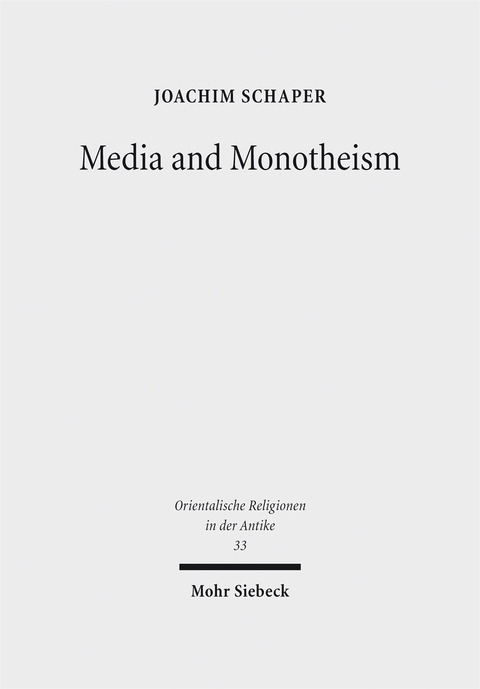
Media and Monotheism
Presence, Representation, and Abstraction in Ancient Judah
Seiten
Der Mensch ist ein "animal symbolicum" (Cassirer), und zum Symbolisieren benutzt er Medien. Das ist zentral für Joachim Schapers Studie zur Transformation der vorexilischen, monolatrischen Jahwe-Religion in den Monotheismus der nachexilischen Zeit. Der Autor zeigt, dass der Auslöser das Entstehen einer neuen Konstellation wichtiger Medien war: Schrift, Bild und Geld. Sie führte zu einer entscheidenden Zunahme der Abstraktion in der Repräsentation, die den Übergang von der Monolatrie zum Monotheismus auslöste.
'Symbolising' - i.e., representing through the use of media - is a more elementary, more foundational activity than the self-conscious use of the intellect. Its exploration is central to this investigation of the transformation of the pre-exilic Yahweh religion into the monotheism of the post-exilic period. That transformation was triggered by a new constellation of key media in the pre-exilic and exilic periods: writing, images, and money. The central objective is to understand how their use contributed to a decisive increase in abstraction in representation and led to changes in the conceptualisation of divine presence and its representation that ultimately resulted in the transition from monolatry to monotheism. In this study, Joachim Schaper explores neglected areas of Judahite material culture and contributes to an in-depth reconstruction of Judah's religious history in its most important epoch, and thus of one of the key developments in the religious history of humanity.
'Symbolising' - i.e., representing through the use of media - is a more elementary, more foundational activity than the self-conscious use of the intellect. Its exploration is central to this investigation of the transformation of the pre-exilic Yahweh religion into the monotheism of the post-exilic period. That transformation was triggered by a new constellation of key media in the pre-exilic and exilic periods: writing, images, and money. The central objective is to understand how their use contributed to a decisive increase in abstraction in representation and led to changes in the conceptualisation of divine presence and its representation that ultimately resulted in the transition from monolatry to monotheism. In this study, Joachim Schaper explores neglected areas of Judahite material culture and contributes to an in-depth reconstruction of Judah's religious history in its most important epoch, and thus of one of the key developments in the religious history of humanity.
Born in 1965; 1993: PhD (Cantab); 1999: Habilitation; 2005-12: Reader, then Professor in Hebrew, Old Testament and Early Jewish Studies; since 2012: Professor of Hebrew and Semitic Languages at the University of Aberdeen; 2016-19: President of the International Organization for the Study of the Old Testament.
| Erscheinungsdatum | 24.07.2019 |
|---|---|
| Reihe/Serie | Orientalische Religionen in der Antike |
| Verlagsort | Tübingen |
| Sprache | englisch |
| Maße | 181 x 250 mm |
| Gewicht | 720 g |
| Themenwelt | Geschichte ► Allgemeine Geschichte ► Vor- und Frühgeschichte |
| Religion / Theologie ► Christentum ► Bibelausgaben / Bibelkommentare | |
| Geisteswissenschaften ► Sprach- / Literaturwissenschaft ► Literaturwissenschaft | |
| Schlagworte | Aniconism • History • history of money • History of writing • MONEY • monolatry • of • Reforms • Religious • religious reforms • Writing |
| ISBN-10 | 3-16-157510-5 / 3161575105 |
| ISBN-13 | 978-3-16-157510-5 / 9783161575105 |
| Zustand | Neuware |
| Informationen gemäß Produktsicherheitsverordnung (GPSR) | |
| Haben Sie eine Frage zum Produkt? |
Mehr entdecken
aus dem Bereich
aus dem Bereich
Konzepte – Methoden – Theorien
Buch | Softcover (2024)
UTB (Verlag)
CHF 55,85
auf den Spuren der frühen Zivilisationen
Buch | Hardcover (2023)
C.H.Beck (Verlag)
CHF 27,95


