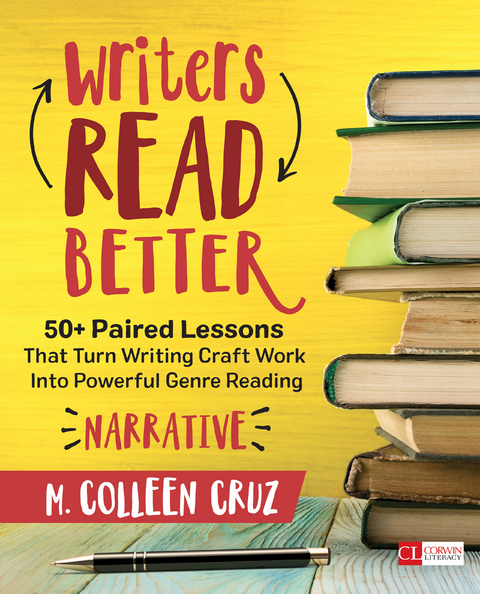
Writers Read Better: Narrative (eBook)
312 Seiten
Corwin (Verlag)
978-1-5443-8577-8 (ISBN)

List of Videos
Solutions at a Glance
Acknowledgments
Introduction: Preparing for Aligned or Complementary Units on Narrative Reading and Writing
PART 1: LESSONS FOR GENERATING STORY: ENVISIONING CHARACTERS AND SETTINGS
LESSON 1
Writing: Write Our Truest Selves
Reading: Characters Offer Clues to Authors’ Selves
LESSON 2
Writing: Flaws and Quirks for Character Development
Reading: Studying Flaws to Seek Deeper Meaning
LESSON 3
Writing: Finding Freedom in Familiar Character Types
Reading: Identifying Archetypes to Develop Depth of Understanding
LESSON 4
Writing: Maps, Photographs, and Songs as Tools for Setting Creation
Reading: Connecting Setting to Meaning
LESSON 5
Writing: Letting Characters and Settings Lead Us to Story
Reading: Following the Path of a Story to Understand Other Elements
LESSON 6
Writing: Finding Important Ideas in the Most Personal Piece of Our Lives
Reading: Focusing on the Details of a Text to Uncover Bigger Notions
LESSON 7
Writing: Studying Places for Stories to Explore
Reading: Making the Connection Between Place and an Author’s Message
LESSON 8
Writing: Revising the Arc to Match the Meaning
Reading: Connecting the Shape of the Plot to the Theme
FOR DIGITAL CLASSROOMS
Writing: Apps and Tools to Help Keep Track of Story Ideas
Reading: Reading Stories Digitally Requires Readers to Purposefully Set Themselves up to Reread
PART 2: LESSONS FOR DRAFTING A NARRATIVE, FOLLOWING PLOT, AND FINDING SIGNIFICANCE
LESSON 9
Writing: Draft Fast to Create Energy
Reading: Reading Voluminously to Build Momentum
LESSON 10
Writing: Drafting Stand-Alone Scenes
Reading: Studying One Scene for Larger Understanding
LESSON 11
Writing: Deciding When to Summarize
Reading: Summarizing Text to Check for Comprehension
LESSON 12
Writing: Research for Personal Writing
Reading: Noting When a Writer Uses Research or Artifacts
LESSON 13
Writing: Drafting With Truth in Mind, Leaving Space for Facts
Reading: Deciphering an Author’s Truth and Perspective
LESSON 14
Writing: Drafting With Perspective in Mind
Reading: Considering the Author’s Choice of Perspective and Its Effects
LESSON 15
Writing: Research Makes Fiction Believable
Reading: Researching Outside a Text Can Open New Interpretations
FOR DIGITAL CLASSROOMS
Writing: Choosing the Best Platform for Your Story
Reading: The Platform Affects the Way You Interact With a Story
PART 3: LESSONS FOR REVISING FOR MEANING AND SIGNIFICANCE: ANALYSIS AND CRITIQUE
LESSON 16
Writing: Exploring Deeper Meaning in Drafts to Begin Revision
Reading: Identifying an Author’s Deeper Meaning Through Rereading and Writing
LESSON 17
Writing: Compelling Stories Thrive on Conflict
Reading: Identifying the Scenes That Point to Conflict in a Story
LESSON 18
Writing: Craft Settings That Connect With Characters’ Emotions
Reading: Noticing a Relationship Between Setting and Character
LESSON 19
Writing: Stories Extend and Elaborate on Larger Ideas
Reading: Tracking the Weight of a Story
LESSON 20
Writing: Increasing Suspense Through Revision
Reading: Spotting Moves Authors Use to Build Suspense Helps Readers Make Predictions
LESSON 21
Writing: Craft Dialogue to Match Character Personality and Uniqueness
Reading: Dialogue Gives Insights Into Characters
LESSON 22
Writing: The Narrator’s Voice Makes Perspective Clear
Reading: The Narrator’s Voice Sets up a Reader’s Inferences and Interpretations
LESSON 23
Writing: Knowing the Significance of a Personal Story Can Help Writers to Foreshadow
Reading: Identifying Foreshadowing in a Story to Help Discover Theme
FOR DIGITAL CLASSROOMS
Writing: Revising Digitally Allows for Powerful Peer Feedback
Reading: Other Readers Can Give New Perspectives
PART 4: LESSONS FOR PERFECTING THE PROSE AND PURPOSE: DEEP INTERPRETATION
LESSON 24
Writing: Designing Beginnings and Endings That Entice and Linger
Reading: Savoring Beginnings and Endings
LESSON 25
Writing: Fewer Words Can Make More Impact
Reading: Considering Words Used and Not Used When Interpreting
LESSON 26
Writing: Using Symbolism to Give Readers Direction
Reading: Interpreting Symbols in Stories—When Everything Can Have Meaning
LESSON 27
Writing: Choosing and Smoothing Tense
Reading: Looking to Tense for Meaning
LESSON 28
Writing: The Many Purposes of Narrative Paragraphs
Reading: Reading Narrative Paragraphs on Surface and Inferential Levels
LESSON 29
Writing: Using Tools to Make Smart Spelling Decisions
Reading: Knowing an Author Carefully Chooses Words Helps Readers Develop Deeper Understanding
LESSON 30
Writing: Making Publishing Decisions Based on the Intended Audience
Reading: Judging the Effectiveness of an Author’s Decisions
FOR DIGITAL CLASSROOMS
Writing: Using Digital Tools to Call Attention to Theme
Reading: Looking Across Highlights, Bookmarks, and Notes to Help Identify Unifying Themes
Resources
References and Further Reading
Index
| Reihe/Serie | Corwin Literacy | Corwin Literacy |
|---|---|
| Verlagsort | Thousand Oaks |
| Sprache | englisch |
| Themenwelt | Schulbuch / Wörterbuch ► Lektüren / Interpretationen |
| Schulbuch / Wörterbuch ► Schulbuch / Allgemeinbildende Schulen | |
| Schulbuch / Wörterbuch ► Wörterbuch / Fremdsprachen | |
| Geisteswissenschaften ► Sprach- / Literaturwissenschaft ► Sprachwissenschaft | |
| Sozialwissenschaften ► Pädagogik ► Schulpädagogik / Grundschule | |
| Schlagworte | Character development • characters • developing plot • Drafting • drafting narrative • inferring • Literacy • literacy skills • narrative genre study • narrative reading • reading lessons • revising • revising lessons • Setting • story elements • Themes • writing lessons • writing-to-reading connection |
| ISBN-10 | 1-5443-8577-3 / 1544385773 |
| ISBN-13 | 978-1-5443-8577-8 / 9781544385778 |
| Informationen gemäß Produktsicherheitsverordnung (GPSR) | |
| Haben Sie eine Frage zum Produkt? |
 PDF (Adobe DRM)
Kopierschutz: Adobe-DRM
Adobe-DRM ist ein Kopierschutz, der das eBook vor Mißbrauch schützen soll. Dabei wird das eBook bereits beim Download auf Ihre persönliche Adobe-ID autorisiert. Lesen können Sie das eBook dann nur auf den Geräten, welche ebenfalls auf Ihre Adobe-ID registriert sind.
Details zum Adobe-DRM
Dateiformat: PDF (Portable Document Format)
Mit einem festen Seitenlayout eignet sich die PDF besonders für Fachbücher mit Spalten, Tabellen und Abbildungen. Eine PDF kann auf fast allen Geräten angezeigt werden, ist aber für kleine Displays (Smartphone, eReader) nur eingeschränkt geeignet.
Systemvoraussetzungen:
PC/Mac: Mit einem PC oder Mac können Sie dieses eBook lesen. Sie benötigen eine
eReader: Dieses eBook kann mit (fast) allen eBook-Readern gelesen werden. Mit dem amazon-Kindle ist es aber nicht kompatibel.
Smartphone/Tablet: Egal ob Apple oder Android, dieses eBook können Sie lesen. Sie benötigen eine
Geräteliste und zusätzliche Hinweise
Buying eBooks from abroad
For tax law reasons we can sell eBooks just within Germany and Switzerland. Regrettably we cannot fulfill eBook-orders from other countries.
aus dem Bereich