


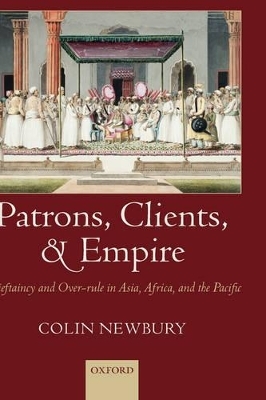
Patrons, Clients, and Empire
Chieftaincy and Over-rule in Asia, Africa, and the Pacific
Seiten
2003
Oxford University Press (Verlag)
978-0-19-925781-2 (ISBN)
Oxford University Press (Verlag)
978-0-19-925781-2 (ISBN)
This study of relationships between the indigenous leadership of traditional states and colonizing Europeans from the 17th to the 20th century challenges stereotypes of despotic imperial power in Asian, African, and Pacific colonies. It seeks to answer how European officials were able to govern so many societies over such a long period of time.
Patrons, Clients, and Empire challenges the stereotypes of despotic imperial power in Asian, African, and Pacific colonies by analysing the relationship between rulers and rulers on both sides of the imperial equation. It seeks an answer to the question: how were European officials able to govern so many societies for so long? Rejecting the usual explanations of 'collaboration' and indirect rule', this study looks to pre-imperial structures in the indigenous hierarchies which supplied patrimonial models of chieftaincy for territorial government. For nawabs, chiefs, emirs, sultans, and their officials and followers there were dynastic and economic advantages in accepting the terms of European over-rule, as well as the threat of deposition. For European officials, few in numbers and with limited military and financial resources, there were ready-made systems of local government that could be co-opted, reformed, or left relatively untouched. Both sides played politics as patrons and clients within a dual system of administration based on a mixture of force and self-interest.
Surveying a wide variety of cases and employing a patron-client model, this study embraces pre-colonial, colonial, and post-colonial politics in new states. It covers the chronology of early European dependency on local rulers; the reasons for reversal of status among chiefs and administrators; the longer period of political bargaining over access to local resources in terms of land, labour, and taxes; and the ultimate fate of indigenous rulers in the period of party politics leading to independence.
Patrons, Clients, and Empire challenges the stereotypes of despotic imperial power in Asian, African, and Pacific colonies by analysing the relationship between rulers and rulers on both sides of the imperial equation. It seeks an answer to the question: how were European officials able to govern so many societies for so long? Rejecting the usual explanations of 'collaboration' and indirect rule', this study looks to pre-imperial structures in the indigenous hierarchies which supplied patrimonial models of chieftaincy for territorial government. For nawabs, chiefs, emirs, sultans, and their officials and followers there were dynastic and economic advantages in accepting the terms of European over-rule, as well as the threat of deposition. For European officials, few in numbers and with limited military and financial resources, there were ready-made systems of local government that could be co-opted, reformed, or left relatively untouched. Both sides played politics as patrons and clients within a dual system of administration based on a mixture of force and self-interest.
Surveying a wide variety of cases and employing a patron-client model, this study embraces pre-colonial, colonial, and post-colonial politics in new states. It covers the chronology of early European dependency on local rulers; the reasons for reversal of status among chiefs and administrators; the longer period of political bargaining over access to local resources in terms of land, labour, and taxes; and the ultimate fate of indigenous rulers in the period of party politics leading to independence.
Introduction ; PART I. INDIAN STATES ; 1. Trade and Dependency ; 2. Reversal of Status ; 3. Clients and Brokers ; 4. Rulers and Raj ; Summary ; PART II. NORTH AFRICA ; 5. Egypt and Sudan ; 6. Morocco ; Summary ; PART III. SUB-SAHARAN AFRICA ; 7. Western Africa ; 8. East-Central Africa ; 9. Southern Africa ; Summary ; PART IV. MARITIME SOUTH-EAST ASIA ; 10. Malaya ; Summary ; PART V. PACIFIC ISLANDS ; 11. Hawaii ; 12. Fiji ; 13. Tonga ; Summary ; Conclusion ; List of Sources Used ; Index
| Erscheint lt. Verlag | 1.2.2003 |
|---|---|
| Zusatzinfo | 10 maps, 4 figs, 1 table |
| Verlagsort | Oxford |
| Sprache | englisch |
| Maße | 162 x 242 mm |
| Gewicht | 625 g |
| Themenwelt | Geschichte ► Allgemeine Geschichte ► Neuzeit (bis 1918) |
| Geschichte ► Teilgebiete der Geschichte ► Kulturgeschichte | |
| Geschichte ► Teilgebiete der Geschichte ► Wirtschaftsgeschichte | |
| ISBN-10 | 0-19-925781-7 / 0199257817 |
| ISBN-13 | 978-0-19-925781-2 / 9780199257812 |
| Zustand | Neuware |
| Informationen gemäß Produktsicherheitsverordnung (GPSR) | |
| Haben Sie eine Frage zum Produkt? |
Mehr entdecken
aus dem Bereich


aus dem Bereich
Geschichte einer wilden Handlung
Buch | Hardcover (2024)
C.H.Beck (Verlag)
CHF 47,60


