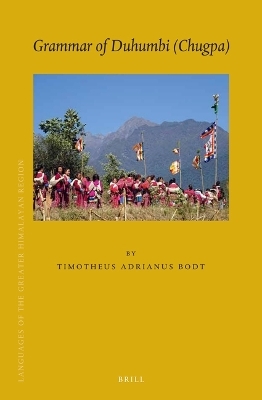
Grammar of Duhumbi (Chugpa)
Brill (Verlag)
978-90-04-40947-7 (ISBN)
With Grammar of Duhumbi (Chugpa), Timotheus Adrianus (Tim) Bodt provides the first comprehensive description of any of the Western Kho-Bwa languages, a sub-group of eight linguistic varieties of the Kho-Bwa cluster (Tibeto-Burman).
Duhumbi is spoken by 600 people in the Chug valley in West Kameng district, Arunachal Pradesh, India. The Duhumbi people, known to the outside world as Chugpa or Chug Monpa, belong to the Monpa Scheduled Tribe. Despite that affiliation, Duhumbi is not intelligible to speakers of any of the other Monpa languages except Khispi (Lishpa).
The volume Grammar of Duhumbi (Chugpa) describes all aspects of the language, including phonology, morphology, lexicon, syntax and discourse. Moreover, it also contains links to additional resources freely accessible on-line.
Timotheus Adrianus Bodt, Ph.D. (2017), University of Bern, is currently affiliated as associate researcher (postdoc) to the School of Oriental and African Studies, University of London. He has published two monographs and several journal articles focusing on the linguistic, ethnographic and historical background of the Tibet-Bhutan-India borderlands.
Preface
Acknowledgements
List of tables
List of Glosses, conventions and symbols
1 The Duhumbi and their language
1.1 Geographical setting
1.2 Geopolitical setting
1.3 Autonyms, exonyms and population
1.4 Origin and settlement
1.5 Livelihood, culture and religion
1.6 Duhumbi ngak
1.7 The data and corpus
2 Phonology and orthography
2.1 Transcription systems and orthographies
2.2 Non-native and marginal phonemes and allophones
2.3 The vowel system
2.4 The consonant system
2.5 Syllable structure and phonotactics
2.6 Prosodic features of Duhumbi
2.7 Two-way contrast on plosives and affricates
3 Parts of speech
3.1 Nominal versus verbal parts of speech
3.2 Pronouns
3.3 Nouns
3.4 Proper nouns
3.5 Adjectives
3.6 Demonstratives
3.7 Numerals
3.8 Postpositions
3.9 Adverbs
3.10 Expressives
3.11 Interrogatives
3.12 Verbal parts of speech
3.13 Other parts of speech
4 Lexical aspects
4.1 Nouns
4.2 Proper nouns
4.3 Adjectives
4.4 Adverbs
4.5 Expressives
4.6 Numerals
4.7 Lexical registers
4.8 Complex predicates
4.9 Particular verbs
4.10 Interjections
4.11 The borrowed lexicon
5 Nominalisations
5.1 Pure derivational nominalisers
5.2 Nominaliser -ba nom
5.3 Nominaliser -baʔ inf
6 The noun phrase
6.1 Constituent order in noun phrases
6.2 Grammatical relations and case markers
6.3 Other nominal suffixes
6.4 Intensity
6.5 Use of adjectives
6.6 Use of demonstratives
6.7 Use of the numeral hin ‘one’
6.8 Use of the postposition naŋ- ‘in’
6.9 Use of interrogatives
7 Verbal morphology
7.1 Imperfective -da ipfv
7.2 Past tenses
7.3 Non-past tenses
7.4 Summary of verbal morphology
8 Non-verbal predicates
8.1 Verb and copula-less clauses
8.2 Copula beʔ cop.ex
8.3 Copula le cop.le
8.4 Copula giʨʰa cop.eq
8.5 Copula ɕi cop.as
8.6 Copula in possessive relations
8.7 Copular verb ʥu- ‘be’
8.8 Negative copular verbs and copula balaŋ
8.9 Limited conjugational flexibility of copular verbs
9 Serial verb constructions
9.1 Types of SVC
9.2 SVCs in various contexts
9.3 SVCs and prosody
9.4 Modifying verbs
9.5 Symmetrical SVCs
9.6 Asymmetrical SVCs
9.7 SVCs in a historical-comparative perspective
10 Non-declarative clause types
10.1 Interrogatives
10.2 Question markers
10.3 Formation of questions
10.4 Question sub-types
10.5 Moods
11 Complex sentences
11.1 Imperfective phrases and clauses
11.2 Subordination with -ba nom and -baʔ inf
11.3 Subordination with -tʰaŋ lcn
11.4 Other cotemporal subordinators
11.5 Conditional with -se cond
11.6 Copular causal subordination
11.7 Conjunctions
11.8 Modifying suffixes and clitics
12 Discourse structure
12.1 Discourse structuring
12.2 Discourse particles
12.3 Topic, focus and emphasis
13 Texts
13.1 Duhumbi text genres
13.2 Metadata of texts
13.3 Metadata of speakers
13.4 Descriptions of all texts
13.5 Zenodo DOIs of texts
13.6 Elicitation files
13.7 Text: NNK; CHUK260413A2A
13.8 Text LGT; CHUK300412J2
13.9 Text: LEL; CHUKx13A6
13.10 Text: DTPK; CHUK131014
References
Index
Figures
| Erscheinungsdatum | 27.01.2020 |
|---|---|
| Reihe/Serie | Languages of the Greater Himalayan Region ; 23 |
| Verlagsort | Leiden |
| Sprache | englisch |
| Maße | 155 x 235 mm |
| Gewicht | 1352 g |
| Themenwelt | Geisteswissenschaften ► Sprach- / Literaturwissenschaft ► Anglistik / Amerikanistik |
| Geisteswissenschaften ► Sprach- / Literaturwissenschaft ► Sprachwissenschaft | |
| ISBN-10 | 90-04-40947-5 / 9004409475 |
| ISBN-13 | 978-90-04-40947-7 / 9789004409477 |
| Zustand | Neuware |
| Informationen gemäß Produktsicherheitsverordnung (GPSR) | |
| Haben Sie eine Frage zum Produkt? |
aus dem Bereich