


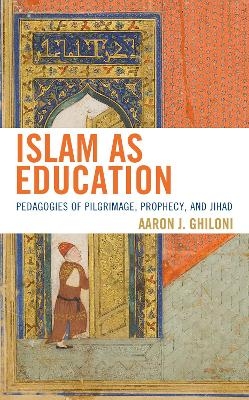
Islam as Education
Pedagogies of Pilgrimage, Prophecy, and Jihad
Seiten
2019
Lexington Books/Fortress Academic (Verlag)
978-1-9787-0759-7 (ISBN)
Lexington Books/Fortress Academic (Verlag)
978-1-9787-0759-7 (ISBN)
Islam as Education explores knowledge and education in Islam from 800–1500 CE, focusing on pedagogical dimensions of three theological concepts: pilgrimage, jihad, and prophecy. Ghiloni then compares these concepts with the educational theory of philosopher John Dewey, providing tools for intercultural and interreligious learning.
Motivated by the intellectual historian Shahab Ahmed’s observation that “the history of Islamic paideia has yet to be written,” Islam as Education explores multiple forms that the search for knowledge and the transmission of wisdom have taken in Islam, focusing on the classical period (800–1500 CE). Ghiloni draws on a wide range of Islamic primary source material, ranging from sacred texts and parables to neglected pedagogical literature and paintings. He depicts three Islamic religious practices—pilgrimage, prophecy, and jihad—as modes of pedagogy: embodied ways of defining, defusing, and defending sacred knowledge.
Islam as Education’s educational heuristic not only aids in understanding Islam, but also provides guidance for intercultural and interreligious relations. Ghiloni argues that Islam’s grand (knowledge) tradition serves as a bridge between Muslims and non-Muslims, and compares it with the educational theory of John Dewey, the celebrated American pragmatist. Based on this discussion, a final chapter develops practical tools for learning from cultural and religious difference.
Motivated by the intellectual historian Shahab Ahmed’s observation that “the history of Islamic paideia has yet to be written,” Islam as Education explores multiple forms that the search for knowledge and the transmission of wisdom have taken in Islam, focusing on the classical period (800–1500 CE). Ghiloni draws on a wide range of Islamic primary source material, ranging from sacred texts and parables to neglected pedagogical literature and paintings. He depicts three Islamic religious practices—pilgrimage, prophecy, and jihad—as modes of pedagogy: embodied ways of defining, defusing, and defending sacred knowledge.
Islam as Education’s educational heuristic not only aids in understanding Islam, but also provides guidance for intercultural and interreligious relations. Ghiloni argues that Islam’s grand (knowledge) tradition serves as a bridge between Muslims and non-Muslims, and compares it with the educational theory of John Dewey, the celebrated American pragmatist. Based on this discussion, a final chapter develops practical tools for learning from cultural and religious difference.
Aaron J. Ghiloni is a research fellow of the Centre for Public and Contextual Theology at Charles Sturt University.
Part I: Paideia
1.Loving Knowledge
2.Civilizing Knowledge
3.Preserving and Adapting Knowledge
Part II: Pedagogies
Introduction to Part II
4.Seeking Knowledge: Pilgrimage
5.Defending Knowledge: Jihad
6.Limiting Knowledge: Prophecy
Conclusion: Knowledge from Difference
| Erscheinungsdatum | 25.08.2019 |
|---|---|
| Zusatzinfo | 2 b/w photos; |
| Sprache | englisch |
| Maße | 162 x 227 mm |
| Gewicht | 503 g |
| Themenwelt | Geisteswissenschaften ► Religion / Theologie ► Islam |
| Sozialwissenschaften ► Soziologie ► Spezielle Soziologien | |
| ISBN-10 | 1-9787-0759-2 / 1978707592 |
| ISBN-13 | 978-1-9787-0759-7 / 9781978707597 |
| Zustand | Neuware |
| Informationen gemäß Produktsicherheitsverordnung (GPSR) | |
| Haben Sie eine Frage zum Produkt? |
Mehr entdecken
aus dem Bereich

aus dem Bereich


