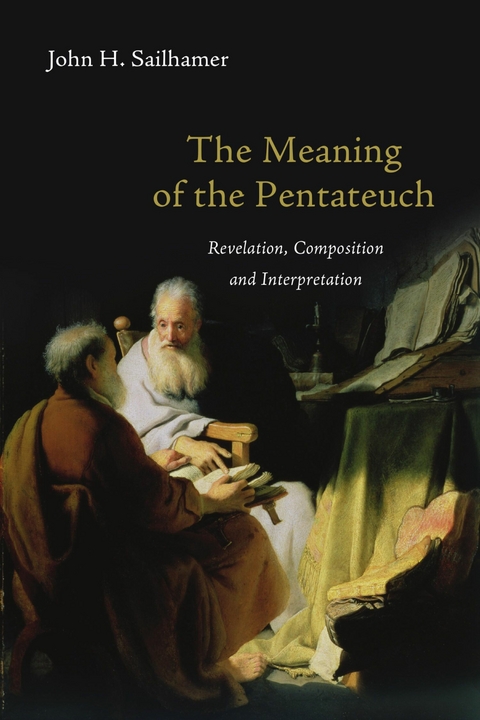
Meaning of the Pentateuch (eBook)
IVP Academic (Verlag)
978-0-8308-7888-8 (ISBN)
John H. Sailhamer is professor of Old Testament at Golden Gate Baptist Theological Seminary in Brea, California. He is the author of several books, including Introduction to Old Testament Theology and The Pentateuch as Narrative.
Biblical Foundations Book AwardThe Pentateuch is the foundation for understanding the Old Testament and the Bible as a whole. Yet through the centuries it has been probed and dissected, weighed and examined, its text peeled back for its underlying history, its discourse analyzed and its words weighed. Could there be any stone in Sinai yet unturned?Surprisingly, there is. From a career of study, John Sailhamer sums up his perspective on the Pentateuch by first settling the hermeneutical question of where we should set our attention. Rather than focus on the history behind the text, Sailhamer is convinced that it is the text itself that should be our primary focus. Along the way he demonstrates that this was in fact the focus of many interpreters in the precritical era.Persuaded of the singular vision of the Pentateuch, Sailhamer searches out clues left by the author and the later editor of the Pentateuch that will disclose the meaning of this great work. By paying particular attention to the poetic seams in the text, he rediscovers a message that surprisingly brings us to the threshold of the New Testament gospel.
John H. Sailhamer (1946-2017) was professor of Old Testament at Gateway Seminary (formerly Golden Gate Baptist Theological Seminary) in Brea, California. He is the author of several books, including Introduction to Old Testament Theology and The Meaning of the Pentateuch.
Chapter 1
Understanding the Nature and Goal of Old Testament Theology
OT THEOLOGY IS THE STUDY OF THE THEOLOGY and message of the OT.1 A wide diversity of opinion exists concerning the nature of theology. This diversity arises in large part from how one’s understanding of the term theology is affected by the word old in “Old Testament.” Is it correct to say that OT theology is merely that branch of theology that has the OT as its subject matter? Does not the term old have a significant qualifying effect on the sense of the term theology? Does not the idea of an Old Testament theology suggest a distinction between an Old and a New Testament theology? If so, the sense of the term theology may well shift semantically in either case.
THE NATURE AND GOAL OF THEOLOGY
The term theology is sometimes linked to the highly charged notions of “revelation” and “religion.” With such a move one often finds subtle shifts in the meaning of the word “theology.” Among evangelical biblical theologians and scholars the word revelation2 describes an act of God in which he makes his will known. In this book we take the similar position that God has revealed himself in the OT and in the whole Bible. A theology of the OT in such a setting is understood as a study of divine revelation presented in the OT.
In contrast to the term revelation, the term religion describes the human response to an act of divine revelation. An OT theology that has religion as its object is a study of the human responses to God’s revelation and not a study of the divine revelation itself.3
When our understanding of the nature and purpose of theology is related to either of these terms, the particular nature and task of theology takes on its own distinct meaning. Such a shift of meaning can have a fundamental effect on our understanding of the terms religion and revelation and ultimately on the task of an OT theology.
Theology and revelation. Theology can be understood as the revelation of divine truth or as the recording of historical divine acts. Evangelical theologians traditionally have understood the task of theology as the study of divine revelation, a “God-given” way of thinking (habitus Theosdotos divinitus datus). “With respect to its principle, revealed theology is called a God-given way of thinking [habituš; not as though it is immediately infused into one’s mind, but because its fundamental basis [principium] is not human reason but rather divine revelation. Therefore revealed theology is called wisdom coming from on high.”4
Theology has its ground in a work of God—a spoken word or a divine act.5 God has spoken to his human creatures and has acted among them in various ways and times (Heb 1:1-2). He has revealed himself in observable and communicable ways. Theology’s task is to pick up the conversation and pursue the line of discourse and disclosure initiated by God.
As a human work, theology cannot claim to speak with divine authority, nor can it be handled as divine authority, but it can and must attempt to speak on behalf of God’s revelation, and hence it should be handled with the same care as that authority itself. To the extent that theology can rightly grasp God’s revelation and accurately translate it into a particular setting, theology can lay claim to some amount of normativity. “But we have this treasure in earthen vessels, that the excellency of the power may be of God and not of us” (2 Cor 4:7).
However much theology may claim to speak for God or on God’s behalf, as an act of revelation it is a human word. Theology stands on the human side of the divine act of revelation. It is always subject to self-examination and criticism. It is a “mirror viewed darkly” (1 Cor 13:12) through which we must look for a word from God.6
In this book the sense of the term theology raises several questions. How can an OT theology make normative claims to NT Christians? Does not the term Old suggest obsolescence? Does it not suggest a replacement by something New? Is it not a serious problem to label one part of the Bible “Old” and the other “New” and then hold them both as normative? How can both continue as a single word from God? How can a single word come to us labeled both as “Old” and “New”?7 The problem itself is not new. It lies in the way of every Christian attempt to understand the meaning of the two Testaments, the OT and the NT.
An understanding of the term theology that sees its task as the restatement of God’s revelation and hence as normative has far-reaching implications for an evangelical understanding of and approach to OT theology. It will influence much of what is proposed for OT theology in this book.
Theology and religion. The term theology can also ground its meaning in the notion of religion, a human act of discovering past beliefs about God. In such cases the task of OT theology runs the risk of being understood merely as a human act of discovering and recording religious beliefs of the people in the OT. Emanuel Hirsch argued that this view of theology owes its origin to the eighteenth-century theologian Sigmund Jacob Baumgarten. Baumgarten distinguished divine revelation in the Bible from the ancient religion of Israel witnessed to in Scripture. The Bible was no longer approached as revelation, that is, the “manifestation of things previously unknown” (rerum ignotarum manifestatio),8 but as the written record of revelation played out in historical acts recorded and witnessed in the Bible.
Baumgarten thus tilted the classical view of the Bible as revelation toward the notion of the Bible as the written record of divine acts. The term inspiration came to be “the means by which direct revelation was communicated and recorded in books.”9 Thus for Baumgarten, divine revelation was not identified with Scripture, but rather Scripture was identified as a record of that which had been revealed and communicated directly to the mind of the biblical writers. According to Hirsch, “German Protestant theology reached a decisive stage with Baumgarten. It went from being a faith based on the Bible to being one based on revelation—a revelation for which the Bible was in reality nothing more than a record once given.”10
For Baumgarten the Bible itself was not divine revelation but merely one of many possible responses to divine revelation. It was little more than a religious artifact, not a book where one might hope to find divine wisdom. Such a distinction in understanding the OT meant a removal of the normative status from the concept of theology. Theology was reduced to being merely a restatement of ancient beliefs about God. OT theology was given the task of recounting what the biblical writers believed to be true about God. Theology must only say, “This is what they believed about God.” It does not ask, “What does the OT demand of me?” It sought only to discover what its readers in ancient Israel understood about God’s demands of them.
Should theology claim to be normative? This book is about the classical evangelical view of revelation and the Bible, particularly the Pentateuch, and its meaning for the church today. In dealing with questions such as the above, we cannot avoid difficult questions about the normative status of the theology of the OT.11 A crucial question it raises for OT theology is whether the OT’s theology can be understood as normative for the Christian’s life of faith. Is the OT also our NT as it was to Jesus and the early church?12 Those questions are not the basis for proceeding with the description of OT theology, but they help us clarify our understanding of the theological meaning of the OT and its teaching. They affect one’s approach to doing OT theology.
The task of biblical theology is to state God’s Word (the Bible) to the church clearly and precisely. What could be expected of biblical theology other than an understandable statement of the meaning of God’s words that come to us as the Word, “Holy Scripture”? Such a theology does not claim to be normative in the same way the Bible itself makes that claim. An OT theology can only attempt to present the claims of biblical narrative in human terms. Biblical theology of the OT is only a clay vessel for holding the message of the Bible’s own written texts.13
Such is the understanding of the term theology that undergirds this book. Theology is the restatement and explication of God’s written revelation, the Bible.14 It intends to state what should be heard as normative for the faith and practice of the biblical reader.
Theology, like all other fields of study, is a human endeavor. As such, it is subject to all the limitations of human fallibility. No statement of the Bible’s theological message can claim to speak with the same authority as the Bible itself. Only the Bible is infallible and authoritative, not our interpretations or theological opinions.
OLD TESTAMENT THEOLOGY
Definition of Old Testament theology. There is no unanimous opinion about the nature and goal of biblical theology.15 That is because there is no unanimous opinion about the nature of biblical studies themselves. Many scholars search for the earliest traces of belief in the ancient records lying behind present canonical Scripture. Others look for the meaning that lies in the final shape of the...
| Erscheint lt. Verlag | 18.7.2010 |
|---|---|
| Verlagsort | Lisle |
| Sprache | englisch |
| Themenwelt | Geisteswissenschaften ► Religion / Theologie ► Christentum |
| Schlagworte | Bible • Biblical Studies • Conservative • Covenant • dueteronomy • evangelical • Exegesis • Exodus • Faith • Fresh • Genesis • Hebrew • hermeneutics • Historical • Israelite • Law • Leviticus • Moses • Numbers • Old Testament • Old Testament Studies • OT • Pastor • scholar • Scripture • Tanak • Theology • Torah |
| ISBN-10 | 0-8308-7888-2 / 0830878882 |
| ISBN-13 | 978-0-8308-7888-8 / 9780830878888 |
| Informationen gemäß Produktsicherheitsverordnung (GPSR) | |
| Haben Sie eine Frage zum Produkt? |
 EPUB (Adobe DRM)
Kopierschutz: Adobe-DRM
Adobe-DRM ist ein Kopierschutz, der das eBook vor Mißbrauch schützen soll. Dabei wird das eBook bereits beim Download auf Ihre persönliche Adobe-ID autorisiert. Lesen können Sie das eBook dann nur auf den Geräten, welche ebenfalls auf Ihre Adobe-ID registriert sind.
Details zum Adobe-DRM
Dateiformat: EPUB (Electronic Publication)
EPUB ist ein offener Standard für eBooks und eignet sich besonders zur Darstellung von Belletristik und Sachbüchern. Der Fließtext wird dynamisch an die Display- und Schriftgröße angepasst. Auch für mobile Lesegeräte ist EPUB daher gut geeignet.
Systemvoraussetzungen:
PC/Mac: Mit einem PC oder Mac können Sie dieses eBook lesen. Sie benötigen eine
eReader: Dieses eBook kann mit (fast) allen eBook-Readern gelesen werden. Mit dem amazon-Kindle ist es aber nicht kompatibel.
Smartphone/Tablet: Egal ob Apple oder Android, dieses eBook können Sie lesen. Sie benötigen eine
Geräteliste und zusätzliche Hinweise
Buying eBooks from abroad
For tax law reasons we can sell eBooks just within Germany and Switzerland. Regrettably we cannot fulfill eBook-orders from other countries.
aus dem Bereich