


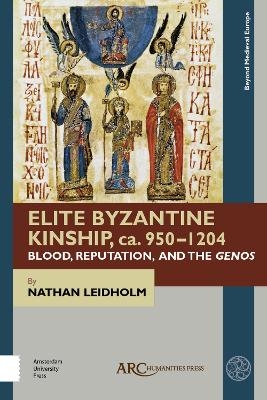
Elite Byzantine Kinship, ca. 950-1204
Blood, Reputation, and the Genos
Seiten
2019
|
New edition
ARC Humanities Press (Verlag)
978-1-64189-028-1 (ISBN)
ARC Humanities Press (Verlag)
978-1-64189-028-1 (ISBN)
This study explores the development and function of the Byzantine aristocratic family group, or genos, as a distinct social concept, considering particularly its political and cultural role, in the tenth through twelfth centuries.
This study explores the role and function of the Byzantine aristocratic family group, or genos, as a distinct social entity, particularly its political and cultural role, as it appears in a variety of sources in the tenth through twelfth centuries. While the genos has served as a central component of many historical arguments attempting to explain the changes occurring in this period, no scholar has yet produced a study focused on the genos as a social unit, and even the concept’s basic definition remains unclear. At the same time, historians of Late Antiquity, Medieval Europe, and Byzantium have all struggled to find meaningful ways to analyze and interpret kinship structures beyond the household or nuclear family. This work seeks to ameliorate these shortcomings and, in so doing, addresses aspects of cultural, social, and political change in Byzantium through the lens of kinship.
This study explores the role and function of the Byzantine aristocratic family group, or genos, as a distinct social entity, particularly its political and cultural role, as it appears in a variety of sources in the tenth through twelfth centuries. While the genos has served as a central component of many historical arguments attempting to explain the changes occurring in this period, no scholar has yet produced a study focused on the genos as a social unit, and even the concept’s basic definition remains unclear. At the same time, historians of Late Antiquity, Medieval Europe, and Byzantium have all struggled to find meaningful ways to analyze and interpret kinship structures beyond the household or nuclear family. This work seeks to ameliorate these shortcomings and, in so doing, addresses aspects of cultural, social, and political change in Byzantium through the lens of kinship.
Nathan Leidholm is an Assistant Professor at Bilkent University. He earned his PhD in Byzantine History from the University of Chicago in 2016.
Introduction
1. Defining "The Family" in Byzantine Sources and Modern Historiography
2. The Language of Kinship
3. Marriage Impediments and the Concept of Family
4. Interrogating Consanguinity in a Byzantine Context
5. Family Names and the Politics of Reputation
6. Kinship and Political Developments of the Eleventh and Twelfth Centuries
Conclusion
| Erscheinungsdatum | 31.08.2019 |
|---|---|
| Reihe/Serie | Beyond Medieval Europe |
| Zusatzinfo | 3 Illustrations, black and white |
| Sprache | englisch |
| Maße | 156 x 234 mm |
| Themenwelt | Geschichte ► Allgemeine Geschichte ► Mittelalter |
| Geisteswissenschaften ► Geschichte ► Regional- / Ländergeschichte | |
| Geschichte ► Teilgebiete der Geschichte ► Kulturgeschichte | |
| ISBN-10 | 1-64189-028-2 / 1641890282 |
| ISBN-13 | 978-1-64189-028-1 / 9781641890281 |
| Zustand | Neuware |
| Informationen gemäß Produktsicherheitsverordnung (GPSR) | |
| Haben Sie eine Frage zum Produkt? |
Mehr entdecken
aus dem Bereich


aus dem Bereich
Geschichte einer Augsburger Familie (1367-1650)
Buch | Softcover (2024)
Kohlhammer (Verlag)
CHF 47,60


