


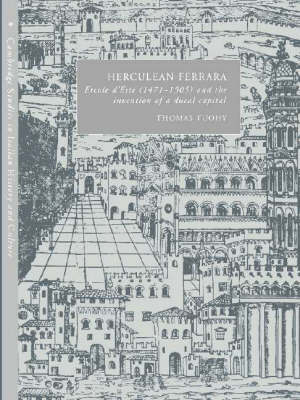
Herculean Ferrara
Ercole d'Este (1471–1505) and the Invention of a Ducal Capital
Seiten
1996
Cambridge University Press (Verlag)
978-0-521-46471-0 (ISBN)
Cambridge University Press (Verlag)
978-0-521-46471-0 (ISBN)
- Titel erscheint in neuer Auflage
- Artikel merken
Zu diesem Artikel existiert eine Nachauflage
The court of Ercole d'Este was one of the most glittering in Renaissance Italy. This book re-establishes Ercole's originality and importance, and sheds light on some general aspects of artist/patron relations during the Renaissance.
Ercole d'Este (1471–1505) is perhaps best known as the father of Isabella d'Este, marchioness of Mantua, but his court in Ferrara was one of the most glittering in Renaissance Italy. He was an extremely prolific builder and laid out plans which doubled the size of the city. He was also the leader in the revival of classical theatre, an enthusiastic patron of musicians, and a creator of magnificent court spectacles. Very little survives to testify to Ercole's achievements, largely on account of a devastating earthquake in 1570, but considerable archival evidence has been used to re-establish the duke's achievements and the extent to which he was personally involved in his patronage. This evidence runs contrary to many currently held assumptions, and although Herculean Ferrara deals with one court and one ruler it also challenges some of the basic notions about the relationship between artist and patron during the Renaissance.
Ercole d'Este (1471–1505) is perhaps best known as the father of Isabella d'Este, marchioness of Mantua, but his court in Ferrara was one of the most glittering in Renaissance Italy. He was an extremely prolific builder and laid out plans which doubled the size of the city. He was also the leader in the revival of classical theatre, an enthusiastic patron of musicians, and a creator of magnificent court spectacles. Very little survives to testify to Ercole's achievements, largely on account of a devastating earthquake in 1570, but considerable archival evidence has been used to re-establish the duke's achievements and the extent to which he was personally involved in his patronage. This evidence runs contrary to many currently held assumptions, and although Herculean Ferrara deals with one court and one ruler it also challenges some of the basic notions about the relationship between artist and patron during the Renaissance.
Acknowledgements; List of illustrations; Preface; 1. The d'Este of Ferrara; 2. The Estense inheritance; 3. The ducal palace; 4. The ducal capital; 5. Court errant: the itinerant court; 6. Princely piety; 7. The decoration and furnishing of palaces; 8. The ephemera of magnificence; 9. As the duke commands; Gazetteer; Plans and genealogical table; Abbreviations and the currency of Ferrara; Sources; Inventory of registers of the camera ducale; Bibliography; Appendices.
| Erscheint lt. Verlag | 30.5.1996 |
|---|---|
| Reihe/Serie | Cambridge Studies in Italian History and Culture |
| Zusatzinfo | 60 Halftones, unspecified |
| Verlagsort | Cambridge |
| Sprache | englisch |
| Maße | 195 x 254 mm |
| Gewicht | 1771 g |
| Themenwelt | Geschichte ► Allgemeine Geschichte ► Mittelalter |
| Geisteswissenschaften ► Geschichte ► Regional- / Ländergeschichte | |
| ISBN-10 | 0-521-46471-4 / 0521464714 |
| ISBN-13 | 978-0-521-46471-0 / 9780521464710 |
| Zustand | Neuware |
| Informationen gemäß Produktsicherheitsverordnung (GPSR) | |
| Haben Sie eine Frage zum Produkt? |
Mehr entdecken
aus dem Bereich

aus dem Bereich
Geschichte einer Augsburger Familie (1367-1650)
Buch | Softcover (2024)
Kohlhammer (Verlag)
CHF 47,60


