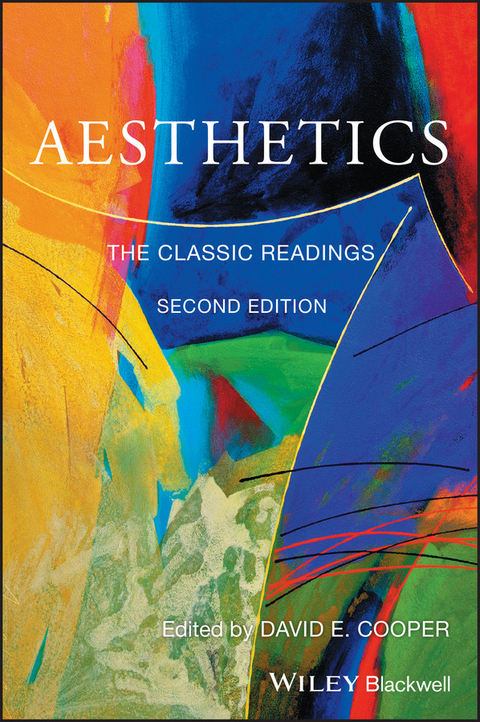
Aesthetics (eBook)
John Wiley & Sons (Verlag)
978-1-119-11682-0 (ISBN)

The newly expanded and revised edition of Cooper's popular anthology featuring classic writings on aesthetics, both historical and contemporary
The second edition of this bestselling anthology collects essays of canonical significance in aesthetics and the philosophy of art, featuring a wide range of topics from the nature of beauty and the criteria for aesthetic judgement to the value of art and the appreciation of nature.
- Includes texts by classical philosophers like Plato and Kant alongside essays from art critics like Clive Bell, with new readings from Leonardo da Vinci, Oscar Wilde, Walter Pater, Ronald W. Hepburn, and Arthur C. Danto among others
- Intersperses philosophical scholarship with diverse contributions from artists, poets, novelists, and critics
- Broadens the scope of aesthetics beyond the Western tradition, including important texts by Asian philosophers from Mo Tzu to Tanizaki
- Includes a fully-updated introduction to the discipline written by the editor, as well as prefaces to each text and chapter-specific lists of further reading
DAVID E. COOPER is Emeritus Professor of Philosophy at Durham University and has been a visiting professor at universities in the US, Canada, Malta, and Sri Lanka. His many books include Philosophy: The Classic Readings (Wiley Blackwell, 2009, edited with P.S. Fosl), World Philosophies: A Historical Introduction (Wiley Blackwell, Second Edition, 2002), Existentialism: A Reconstruction (Wiley Blackwell, Second Edition, 1999) and Animals and Misanthropy (2018).
DAVID E. COOPER is Emeritus Professor of Philosophy at Durham University and has been a visiting professor at universities in the US, Canada, Malta, and Sri Lanka. His many books include Philosophy: The Classic Readings (Wiley Blackwell, 2009, edited with P.S. Fosl), World Philosophies: A Historical Introduction (Wiley Blackwell, Second Edition, 2002), Existentialism: A Reconstruction (Wiley Blackwell, Second Edition, 1999) and Animals and Misanthropy (2018).
Acknowledgments vii
Introduction 1
1 Plato, The Republic, Book 10 9
2 Aristotle, Poetics, Chapters 1-15 28
3 (A) Mo Tzu, "Against music"
(B) Hsun Tzu, "A discussion of music" 44
4 Plotinus, Enneads, 1.6 55
5 (A) Leon Battista Alberti, On Painting, from Books II and III
(B) Leonardo da Vinci, Notebooks (Selections) 66
6 Shih-t'ao, "Quotes on Painting" 77
7 David Hume, "Of the standard of taste" 89
8 Immanuel Kant, "Critique of aesthetic judgement,"Sections 1-14, 16, 23-4, 28 108
9 Friedrich Schiller, On the Aesthetic Education of Man, Letters 26-7 139
10 G.W.F. Hegel, Introduction to Aesthetics, Chapters 1-3 154
11 Arthur Schopenhauer, The World as Will and Representation, Vol. I, Section 52 168
12 (A) Walter Pater, The Renaissance, from Preface and Conclusion
(B) Oscar Wilde, "The Decay of Lying" (Selections) 183
13 Leo Tolstoy, "On art" 196
14 Clive Bell, "The aesthetic hypothesis" 210
15 A.K. Coomaraswamy, The Dance of Si´va, Essays 3.4 227
16 Junichiro¯ Tanizaki, In Praise of Shadows (Selections) 243
17 John Dewey, Art as Experience, Chapters 1-2 257
18 Martin Heidegger, "The origin of the work of art," from Lectures 1 and 2 280
19 R.G. Collingwood, The Principles of Art, Chapter 7 296
20 Ronald W. Hepburn, "Aesthetic appreciation of nature" 319
21 Arthur C. Danto, "The Artworld" 337
Index 353
Introduction
Aesthetic issues, as this volume of readings shows, have been discussed by philosophers, both Eastern and Western, since classical times. The term “aesthetics,” however, was only coined in the eighteenth century by the German philosopher, Alexander Baumgarten, whose main work, Aesthetica, was published in 1750. Deriving it from the Greek word aesthesis, Baumgarten understood by the term “the science of sensory knowledge” in general and it had no particular reference to the examination of taste, beauty and other concepts that we now think of as aesthetic ones.
It was still in Baumgarten’s sense that Immanuel Kant, in his Critique of Pure Reason, used the term in the title of that part of the work, “Transcendental Aesthetic,” that addressed what Kant saw as the conditions – space and time – of all sensory experience. But it was Kant, too, who in his 1790 work, Critique of Judgement, did most to establish the now familiar use of the word. For in this immensely influential work, what Kant called aesthetic judgements were judgements of taste that registered, above all, the appreciation of beauty. A concern with beauty was central, five years later, to Friedrich Schiller’s letters on The Aesthetic Education of Man, while a few decades after this G.W.F. Hegel gave the title Aesthetics to his Berlin lectures on “the philosophy of fine art.”
This potted history of the term “aesthetics” is enough to indicate that the branch of philosophy to which it now refers is something of a hybrid. For Hegel and his followers, aesthetics is essentially the philosophy of art, while for Kant and those who follow him, it is first and foremost philosophical reflection on a range of attitudes and judgements involved in the appreciation of beauty and other aesthetic qualities. Plato’s question about the moral and political responsibility of artists and poets will belong to aesthetics on the Hegelian understanding of the subject, but not perhaps on the Kantian. Conversely, reflection on the beauty of natural phenomena will belong to the subject on Kant’s understanding but not, it seems, if aesthetics is the same as philosophy of art.
The difference between the two understandings is not a merely semantic one, for it reflects substantial disagreements. For Hegel, to use the same term for the study of the appreciation both of artworks and of nature would disguise fundamental differences between the two kinds of appreciation. For Kant, by contrast, distinctions between art and nature are secondary, for the same sort of pleasure may be taken both in a painting of flowers and in the flowers themselves.
That said, the differences between the two approaches should not be exaggerated and they do not render the label “Aesthetics” useless or even ambiguous. For one thing, works of art are clearly among the things that people aesthetically enjoy – so there is going be to a significant overlap between philosophy of art and reflection on aesthetic appreciation. Second, it is rarely obvious if a philosophical question about art is entirely independent of ones about appreciation – or vice‐versa. The question of whether art should be morally beneficial, for instance, cannot be settled without considering the debate between those who claim and those who deny that aesthetic enjoyment of something has nothing to do with its moral qualities. Equally, issues about the appreciation of natural environments will not be independent of art history if there is truth in the idea – espoused by theorists of “The Picturesque” and Oscar Wilde alike – that experience of art necessarily shapes people’s perceptions of nature. Third, many questions asked by aestheticians – including such favorites as “Is beauty in the eye of the beholder?” – are very general ones that encompass art and nature appreciation alike. Finally, whatever the eventual verdict on the dispute between Kant and Hegel, it is one that itself very much belongs to the subject matter of aesthetics. “‘Natural objects cannot be appreciated in the manner of works of art.’ Discuss.” is a question that often figures on aesthetics exam papers.
In this volume of readings – as in most philosophy departments – an accommodating, catholic attitude is adopted to the scope of aesthetics. Some of the selected texts, like Plato’s and Arthur Danto’s, discuss art but not aesthetic judgement. Others, like Plotinus’s and Kant’s, discuss beauty and appreciation, but not art. Several others, unsurprisingly, discuss all of these.
My account, in terms of the influences exerted by Kant and Hegel, of how the subject matter of aesthetics came to be understood is familiar and helps to explain the variety of issues covered. To say that this subject matter is the philosophy of art and reflection on aesthetic experience is not intended, though, as a sharp definition. It can only be as sharp as the notions of art and aesthetic experience themselves are – that is, not very. It might seem that such lack of clarity impugns the integrity of aesthetics, but this is not so. For one thing, attention to such fuzzy notions and the attempt to clarify them become an important part of the subject itself. Second, there are plenty of questions that can be raised in relation to art and aesthetic experience which do not presuppose that these are sharp, homogenous notions – questions about, say, music’s capacity to express feeling, or the respective responsibilities of artist and audience for the response to an art work.
When, as in this volume, the concern is not with contemporary journal literature but with classic texts that have shaped modern discussion, it is insufficient simply to demarcate, however crudely, the area of aesthetics. It is necessary, as well, to attend to why and how these earlier philosophers addressed issues in this area. In keeping with the general tenor of contemporary philosophy, today’s aestheticians tend to operate with a fine scalpel, working on specific problems – about, for example, representation or expression – without invading the large areas which surround them. But when great metaphysicians like Kant and Hegel discuss art or aesthetic judgement, it is very much the larger scene which concerns them. For Hegel, the main questions about art relate to its status, in relation to religion and philosophy, as a vehicle of truth, and its place and significance within the culture of a people. For Kant, aesthetic experience is important, first and foremost, for what it shows about the nature of human beings, their mental faculties, and their place in the universe. In this largeness of vision, not only Kant and Hegel, but many other philosophers represented in this volume, are engaged in a more ambitious enterprise than most contemporary aestheticians.
What will surely strike readers about many of the texts I have selected – from Plato and Hsun Tzu to Dewey and Heidegger – are the attempts their authors make to place art or aesthetic experience. By this, I mean the efforts made, inter alia, to explore the religious significance of art, to identify the role artworks play within the life of a community, to gauge whether aesthetic experience is “natural” or something which enables human beings to transcend their natural condition, and to measure the value of art against other values, notably those of morality. For example, it was Schiller’s ambition to show that “aesthetic play” is capable of harmonizing the cognitive and sensual aspects of our existence that are ordinarily in tragic conflict with one another. Again, A.K. Coomaraswamy argues, in keeping with Indian tradition, that aesthetic pleasure is indicative of the religious sense of a universe that is a beautiful whole.
Many of the texts manifest the conviction that art and aesthetic appreciation are at once profoundly important yet deeply puzzling – phenomena that really should not occur at all on familiar, “naturalistic” pictures of human evolution, and hence call for correspondingly deep explanation. That people should want to titivate and enjoy their surroundings is no great puzzle. But whatever the explanation of this desire, it does not go far in accounting for the passions and energies dedicated to the making and appreciation of works of art, whose connection with the practicalities and ornamentation of life is often remote. It explains even less the enormous significance that people in nearly every culture have attached to the making of artworks and to the capacity to appreciate not only these, but the forms of the natural world as well.
Hence the efforts, alluded to above, to explain or “place” the aesthetic by rooting it in some less puzzling, more obviously “natural,” dimension of life – the desire for order, say, as John Dewey suggests – or, alternatively, by construing it, like Clive Bell, as indicative of our not being purely “natural” creatures after all, but ones who also occupy a more exalted realm of which art and beauty offer us intimations. Hence, too, the attempts – by Plato, Mo Tzu, Walter Pater and Tolstoy, for instance ‐ to decide whether it is sensible to devote so much energy to art and its appreciation, and to assign them such importance, given the existence of moral and other pressing demands on our attention.
One should recognize, but not exaggerate, differences between aesthetics as practiced by the authors in this...
| Erscheint lt. Verlag | 8.4.2019 |
|---|---|
| Reihe/Serie | Philosophy: The Classic Readings |
| Philosophy: The Classic Readings | Philosophy: The Classic Readings |
| Sprache | englisch |
| Themenwelt | Geisteswissenschaften ► Philosophie ► Allgemeines / Lexika |
| Schlagworte | Aesthetics • Aristotle • Art & Applied Arts • art and aesthetics • Art and philosophy • Art History & Theory • Arthur Danto • Ästhetik • Clive Bell • Continental Philosophy • Coomaraswamy • Hegel • Heidegger • Hsun Tzu • Hume, Shih-t’ao • John Dewey • Kant, Schiller • Kunstgeschichte • Kunstgeschichte u. -theorie • Kunst u. Angewandte Kunst • Leonardo da Vinci • Leon Battista Alberti • <p>Art criticism • Oscar Wilde • Philosophical aesthetics • Philosophie • Philosophie der Kunst • Philosophy • philosophy of art • philosophy of art</p> • Plato • Plotinus • Poetics, Mo Tzu • R.G. Collingwood • Ronald Hepburn • Schopenhauer • Tanizaki • The Republic • Tolstoy • Walter Pater |
| ISBN-10 | 1-119-11682-1 / 1119116821 |
| ISBN-13 | 978-1-119-11682-0 / 9781119116820 |
| Informationen gemäß Produktsicherheitsverordnung (GPSR) | |
| Haben Sie eine Frage zum Produkt? |
 EPUB (Adobe DRM)
Kopierschutz: Adobe-DRM
Adobe-DRM ist ein Kopierschutz, der das eBook vor Mißbrauch schützen soll. Dabei wird das eBook bereits beim Download auf Ihre persönliche Adobe-ID autorisiert. Lesen können Sie das eBook dann nur auf den Geräten, welche ebenfalls auf Ihre Adobe-ID registriert sind.
Details zum Adobe-DRM
Dateiformat: EPUB (Electronic Publication)
EPUB ist ein offener Standard für eBooks und eignet sich besonders zur Darstellung von Belletristik und Sachbüchern. Der Fließtext wird dynamisch an die Display- und Schriftgröße angepasst. Auch für mobile Lesegeräte ist EPUB daher gut geeignet.
Systemvoraussetzungen:
PC/Mac: Mit einem PC oder Mac können Sie dieses eBook lesen. Sie benötigen eine
eReader: Dieses eBook kann mit (fast) allen eBook-Readern gelesen werden. Mit dem amazon-Kindle ist es aber nicht kompatibel.
Smartphone/Tablet: Egal ob Apple oder Android, dieses eBook können Sie lesen. Sie benötigen eine
Geräteliste und zusätzliche Hinweise
Buying eBooks from abroad
For tax law reasons we can sell eBooks just within Germany and Switzerland. Regrettably we cannot fulfill eBook-orders from other countries.
aus dem Bereich