Zum Hauptinhalt springen
Nicht aus der Schweiz? Besuchen Sie lehmanns.de
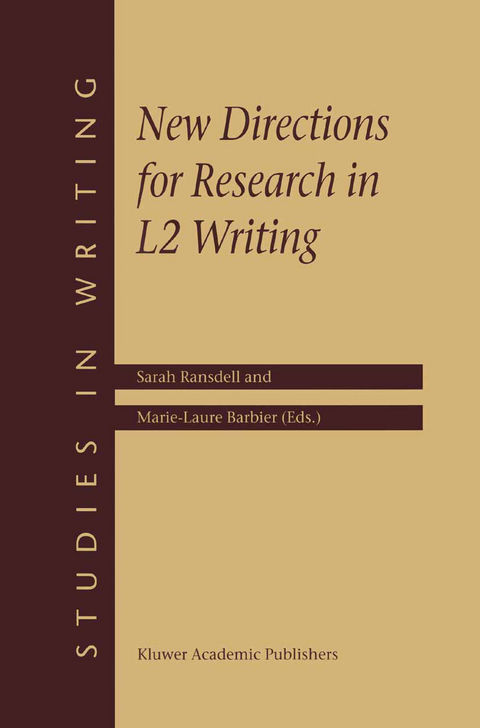
New Directions for Research in L2 Writing -

New Directions for Research in L2 Writing

S. Ransdell, M.-L. Barbier (Herausgeber)

Buch | Softcover
277 Seiten
2002 | Softcover reprint of the original 1st ed. 2002
Kluwer Academic Publishers (Verlag)
9781402005398 (ISBN)
CHF 149,75 inkl. MwSt
GERT RIJLAARSDAM UniversityofAmsterdam & Utrecht University, the Netherlands Multilingualism is becoming the default in our global world. The present-day global citizens use different languages in different situations. Apart from their mother tongue, they learn languages that give them access to other regions, nations, and worlds. In all countries ofthe European Union, for instance, at least one foreign lan­ guage is mandatory in secondary schools. Most students are taught English as a for­ eign language, the lingua franca in Europe. In large parts of the USA, students move from Spanish to English schooling. In parts of Canada, bilingual education is stan­ dard. In Catalonia (Spain) children learn Catalonian and Spanish, in Hong Kong English and Chinese. The smaller the world becomes, the more languages are used and learned. For writing process research, this development into multilingualism entails at least two challenges. First ofall, studying the relation between writing in L1 and L2 provides an opportunity for collaborative studies, in different language settings. Second, the issue ofgeneralization of findings comes to the fore. It becomes evident now that we have unjustly neglected this issue in writing process research. We for­ got to ask whether it is feasible to talk about 'writing processes' in general, without referring to the language of the written texts, and without taking into account the educational and linguistic culture in which these texts originate.

An Introduction to New Directions for Research in L2 Writing.- Critical Examination of L2 Writing Process Research.- Building an Empirically-Based Model of Efl Learners’ Writing Processes.- The Relationships Between Bilingual Children’s Reading and Writing in Their Two Languages.- Linguistic Knowledge, Metacognitive Knowledge and Retrieval Speed in L1, L2,and ELF Writing: A structural equation modelling approach.- Early Exposure to An L2 Predicts Good L1 as Well as Good L2 Writing.- The Effects Of Training a Good Working Memory Startegy on L1 And L2 Writing.- A Comparison Between Notetaking in L1 and L2 by Undergraduate Students.- Collaborative Writing in L2: The Effect of Group Interaction on Text Quality.- Investigation Learners’ Goals in the Context of Adult Second-Language Writing.- When and Why Talking Can Make Writing Harder.- A Problem-Posing Approach to Using Native Languagae Writng in English Literacy Instruction.- References.- Author Index.- List of Contributors.

Reihe/Serie Studies in Writing ; 11
Zusatzinfo X, 277 p.
Sprache englisch
Maße 155 x 235 mm
Themenwelt Geisteswissenschaften Psychologie Allgemeine Psychologie
Geisteswissenschaften Sprach- / Literaturwissenschaft Sprachwissenschaft
ISBN-13 9781402005398 / 9781402005398
Zustand Neuware
Informationen gemäß Produktsicherheitsverordnung (GPSR)
Haben Sie eine Frage zum Produkt?
Mehr entdecken
aus dem Bereich
Das Trainer-Manual

von Martin Bohus; Ruben Vonderlin

Buch | Softcover (2025)
Schattauer (Verlag)
CHF 96,55
Lernen, Emotion, Motivation, Gedächtnis

von Gernot Horstmann; Gesine Dreisbach

Buch | Softcover (2025)
Beltz (Verlag)
CHF 39,20
Wahrnehmung, Aufmerksamkeit, Denken, Sprache

von Miriam Spering; Thomas Schmidt

Buch | Softcover (2025)
Julius Beltz (Verlag)
CHF 39,20