


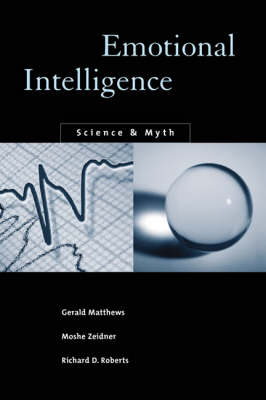
Emotional Intelligence
Science and Myth
Seiten
2003
Bradford Books (Verlag)
978-0-262-13418-7 (ISBN)
Bradford Books (Verlag)
978-0-262-13418-7 (ISBN)
- Titel ist leider vergriffen;
keine Neuauflage - Artikel merken
This text offers a comprehensive critical review of Emotional Intelligence (EI). It examines thinking on the nature, components, determinants, and consequences of EI, and evaluates the state of the art in EI theory, research, assessment, and applications.
Emotional intelligence (EI) is one of the most widely discussed topics in current psychology. Although first mentioned in the professional literature nearly two decades ago, in the past five years it has received extensive media attention. The term "emotional intelligence" refers to the ability to identify, express and understand emotions; to assimilate emotions into thought; and to regulate both positive and negative emotions in oneself and others. Yet despite the flourishing research programs and broad popular interest, scientific evidence for a clearly identified construct of EI is sparse. It remains to be seen whether there is anything to EI that researchers in the fields of personality, intelligence, and applied psychology do not already know. This book offers a comprehensive critical review of EI. It examines current thinking on the nature, components, determinants and consequences of EI, and it evaluates the state of the art in EI theory, research, assessment and applications. The book highlights the extent to which empirical evidence supports EI as a valid construct and debunks some of the more extravagant claims that appear in the popular media.
Finally, the book examines the potential use of EI to guide practical interventions in various clinical, occupational, and educational settings.
Emotional intelligence (EI) is one of the most widely discussed topics in current psychology. Although first mentioned in the professional literature nearly two decades ago, in the past five years it has received extensive media attention. The term "emotional intelligence" refers to the ability to identify, express and understand emotions; to assimilate emotions into thought; and to regulate both positive and negative emotions in oneself and others. Yet despite the flourishing research programs and broad popular interest, scientific evidence for a clearly identified construct of EI is sparse. It remains to be seen whether there is anything to EI that researchers in the fields of personality, intelligence, and applied psychology do not already know. This book offers a comprehensive critical review of EI. It examines current thinking on the nature, components, determinants and consequences of EI, and it evaluates the state of the art in EI theory, research, assessment and applications. The book highlights the extent to which empirical evidence supports EI as a valid construct and debunks some of the more extravagant claims that appear in the popular media.
Finally, the book examines the potential use of EI to guide practical interventions in various clinical, occupational, and educational settings.
| Erscheint lt. Verlag | 17.1.2003 |
|---|---|
| Reihe/Serie | Bradford Books |
| Zusatzinfo | 29 |
| Verlagsort | Massachusetts |
| Sprache | englisch |
| Maße | 152 x 229 mm |
| Gewicht | 1098 g |
| Themenwelt | Geisteswissenschaften ► Psychologie ► Allgemeine Psychologie |
| Geisteswissenschaften ► Psychologie ► Biopsychologie / Neurowissenschaften | |
| Geisteswissenschaften ► Psychologie ► Verhaltenstherapie | |
| ISBN-10 | 0-262-13418-7 / 0262134187 |
| ISBN-13 | 978-0-262-13418-7 / 9780262134187 |
| Zustand | Neuware |
| Informationen gemäß Produktsicherheitsverordnung (GPSR) | |
| Haben Sie eine Frage zum Produkt? |
Mehr entdecken
aus dem Bereich
aus dem Bereich
Paket bestehend aus »Das Patienten-Manual« und »Das Trainer-Manual«
Buch | Softcover (2025)
Schattauer (Verlag)
CHF 125,95


