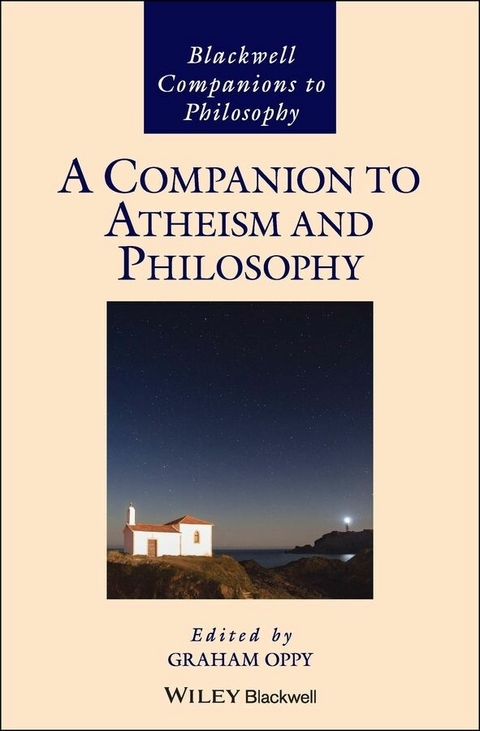
A Companion to Atheism and Philosophy (eBook)
John Wiley & Sons (Verlag)
978-1-119-11922-7 (ISBN)
PROSE 2020 Single Volume Reference Finalist!
Philosophers throughout history have debated the existence of gods, but it is only in recent years that the absence of such a belief has become a significant topic of philosophical analysis, in particular for philosophers of religion. Although it is difficult to trace the historical contours of atheism as the lack of belief in a higher power, the reasoned, reflective, and thoughtful rejection of theism has become commonplace in many modern intellectual circles, including academic philosophy where disciplinary data indicates that a large majority of philosophers self-identify as atheists. As the first book of its kind to bring together a collection of writing on the philosophical aspects of atheism both historical and contemporary, the Companion to Atheism and Philosophy stages an explicit, constructive, and comprehensive conversation between philosophy and atheism to examine the ways in which atheist thought intersects with ideas and positions from a variety of philosophical and theological sub-disciplines.
The Companion begins by addressing the foundational questions and lingering controversies which underpin philosophical thought about atheism, exploring the implications of major developments in the history of philosophy for the modern atheistic worldview. Divided into eight distinct sections, essays consider a range of thinkers who were widely believed to have been atheists-including David Hume, Mary Wollstonecraft, Karl Marx, and Elizabeth Cady Stanton-and survey different kinds of objections to theism and atheism, including logical, evidential, normative, and prudential. Later chapters trace the relationship between atheism and metaphysics, epistemology, ethics, and political philosophy oriented around topics such as pragmatism, postmodernism, freedom, education, violence, and happiness.
Deftly curated and thoughtfully composed, A Companion to Atheism and Philosophy is the most ambitious and authoritative account of philosophical thinking on atheism available, and is a first-rate resource for academics, professionals, and students of philosophy, religious studies, and theology.
Graham Oppy is Professor of Philosophy at Monash University, CEO of the Australasian Association of Philosophy, and a member of the Council of the Australian Academy of Humanities. He has published a wide range of books in philosophy of religion, including Naturalism and Religion, Atheism and Agnosticism, and Reading Philosophy of Religion, and has recently focused on the development of atheistic and naturalistic understandings of religion.
PROSE 2020 Single Volume Reference Finalist!Philosophers throughout history have debated the existence of gods, but it is only in recent years that the absence of such a belief has become a significant topic of philosophical analysis, in particular for philosophers of religion. Although it is difficult to trace the historical contours of atheism as the lack of belief in a higher power, the reasoned, reflective, and thoughtful rejection of theism has become commonplace in many modern intellectual circles, including academic philosophy where disciplinary data indicates that a large majority of philosophers self-identify as atheists. As the first book of its kind to bring together a collection of writing on the philosophical aspects of atheism both historical and contemporary, the Companion to Atheism and Philosophy stages an explicit, constructive, and comprehensive conversation between philosophy and atheism to examine the ways in which atheist thought intersects with ideas and positions from a variety of philosophical and theological sub-disciplines. The Companion begins by addressing the foundational questions and lingering controversies which underpin philosophical thought about atheism, exploring the implications of major developments in the history of philosophy for the modern atheistic worldview. Divided into eight distinct sections, essays consider a range of thinkers who were widely believed to have been atheists including David Hume, Mary Wollstonecraft, Karl Marx, and Elizabeth Cady Stanton and survey different kinds of objections to theism and atheism, including logical, evidential, normative, and prudential. Later chapters trace the relationship between atheism and metaphysics, epistemology, ethics, and political philosophy oriented around topics such as pragmatism, postmodernism, freedom, education, violence, and happiness. Deftly curated and thoughtfully composed, A Companion to Atheism and Philosophy is the most ambitious and authoritative account of philosophical thinking on atheism available, and is a first-rate resource for academics, professionals, and students of philosophy, religious studies, and theology.
Graham Oppy is Professor of Philosophy at Monash University, CEO of the Australasian Association of Philosophy, and a member of the Council of the Australian Academy of Humanities. He has published a wide range of books in philosophy of religion, including Naturalism and Religion, Atheism and Agnosticism, and Reading Philosophy of Religion, and has recently focused on the development of atheistic and naturalistic understandings of religion.
Notes on Contributors viii
Acknowledgments xii
Introduction 1
Graham Oppy
Part I Individual Thinkers 13
1 Hume 15
Jennifer Smalligan Marusic´
2 Holbach 28
Michael LeBuffe and Emilie Gourdon
3 Marx 43
Vanessa Wills
4 Wollstonecraft 58
Sandrine Bergès
5 Cady Stanton 71
Claudette Fillard
6 Russell 83
Carolyn Swanson
Part II Philosophical Movements 97
7 Empiricism 99
Gregory Dawes
8 Pragmatism 111
Robert Almeder
9 Existentialism 123
Mariam Thalos
10 Postmodernism 138
Christopher Watkin
11 Naturalism 152
Eric Steinhart
Part III Critiques of Theism 167
12 Logical Objections to Theism 169
Stephen Law
13 Evidential Objections to Theism 191
Herman Philipse
14 Normative Objections to Theism 204
Stephen Maitzen
15 Prudential Objections to Theism 216
Guy Kahane
Part IV Metaphysics 235
16 Freedom 237
Alfred Mele
17 Supernatural 250
Berit Brogaard
18 Death 262
Beth Seacord
Part V Epistemology 275
19 Skepticism 277
Duncan Pritchard
20 Methods of Science 291
Elliott Sober
21 Evidence 303
Michael Tooley
22 Evolution 323
Michael Ruse
Part VI Ethics 341
23 Meta-Ethics 343
Elizabeth Tropman
24 Meaning 355
Thaddeus Metz
25 Normative Skepticism 367
Susana Nuccetelli
Part VII Politics 381
26 Education 383
Jennifer Bleazby
27 Happiness 396
Gregory S. Paul
28 Violence 421
Steve Clarke
29 Church and State 436
Cristina Lafont
Part VIII Critiques of Atheism 449
30 Logical Objections to Atheism 451
Christopher Gregory Weaver
31 Evidential Objections to Atheism 476
Helen De Cruz
32 Normative Objections to Atheism 491
C. Stephen Evans
33 Prudential Objections to Atheism 506
Amanda Askell
Bibliography 521
Index 565
"The volume is noteworthy for its clarity and breadth and its fair and objective examination of debates surrounding atheism...Highly recommended." - A. Jaeger, Benedictine College for CHOICE Connect, December 2019 Vol. 57 No. 4
Notes on Contributors
Robert Almeder is Distinguished Emeritus Philosopher from Georgia State University. He has published over one hundred peer‐reviewed essays and 26 books focusing mostly on American philosophy, epistemology, philosophy of science and mind‐body problem. He is a former editor of The American Philosophical Quarterly, and chaired for three years the Fulbright Foundation Committee on the Discipline of Philosophy. Recent books include Truth and Skepticism (2011), Harmless Naturalism (1999), ‘Materialism, Reincarnation, and Cartesian Dualism’ (under review).
Amanda Askell received her PhD in philosophy from New York University for a thesis on infinite ethics. Prior to this, she completed a BPhil in philosophy at the University of Oxford. Her research interests include ethics, formal epistemology, and decision theory.
Sandrine Bergès is an Associate Professor in the Department of Philosophy at Bilkent University, Ankara, Turkey. She is the author of the Guidebook to Wollstonecraft's A Vindication of the Rights of Woman (2013). co‐editor with Alan Coffee of The Social and Political Philosophy of Mary Wollstonecraft (2016) and with Alan Coffee and Eileen Hunt Botting of Wollstonecraftian Mind (2016).
Jennifer Bleazby is a philosopher of education in the Faculty of Education, Monash University, Australia. She is the author of Social Reconstruction Learning: Dualism, Dewey and Philosophy in Schools (2013) and an editor of the forthcoming collection, Theory and Philosophy in Educational Research: Methodological Dialogues (2017).
Berit Brogaard is professor of philosophy at University of Miami and the Director of the Brogaard Lab for Multisensory Research. Her areas of research include philosophy of perception, philosophy of emotion, philosophy of language and cognitive science. She is the author of the books Transient Truths (2012), On Romantic Love (2015), The Superhuman Mind (2015), and Seeing & Saying (2018).
Steve Clarke is an associate professor in the School of Humanities and Social Sciences at Charles Sturt University and a Senior Research Associate of the Uehiro Centre for Practical Ethics, Charles Sturt University and a Senior Research Fellow in the Wellcome Centre for Ethics and Humanities, University of Oxford.
Gregory W. Dawes holds a joint professorial appointment in the departments of Philosophy and Theology & Religion at the University of Otago. He works in both the history and philosophy of religion, his books including The Historical Jesus Question (2001), Theism and Explanation (2009), Galileo and the Conflict between Religion and Science (2017), and Philosophy, Religion and Knowledge (2017).
Helen De Cruz is a senior lecturer in philosophy at Oxford Brookes University. Her areas of specialization are philosophy of religion and philosophy of cognitive science. She co‐wrote A Natural History of Natural Theology (2015), also wrote Religious Disagreement (2019) and is currently writing a monograph entitled The Significance of Religious Disagreement.
C. Stephen Evans is University Professor of Philosophy at Baylor University and holds Professorial Fellow positions at Australian Catholic University and the University of St. Andrews. He is well‐known as a Kierkegaard scholar, and his most recent books are God and Moral Obligation and Natural Signs and Knowledge of God.
Claudette Fillard is Professor Emeritus, having taught American Civilization and Literature, at Université Lumière‐Lyon 2. She specialized in the history of American feminism and her research and publications eventually focused on Elizabeth Cady Stanton.
Emilie Gourdon is a doctoral student in history in the EHESS (Ecole des hautes études en sciences sociales) in Paris. Her thesis, Les réputations du Baron d’Holbach investigates Holbach with an emphasis on the underground literature of the eighteenth century.
Guy Kahane is associate professor at the Faculty of Philosophy, University of Oxford, and Fellow and tutor in philosophy at Pembroke College, Oxford. He is also Director of Studies at the Uehiro Centre for Practical Ethics and Associate Editor of the Journal of Practical Ethics.
Cristina Lafont is professor of philosophy at Northwestern University. Her books include: The Linguistic Turn in Hermeneutic Philosophy (1999), Heidegger, Language and World‐Disclosure (2000), and Global Governance and Human Rights (2012).
Stephen Law is reader in philosophy at Heythrop College, University of London. He is the author of a number of books on philosophy including The Philosophy Gym: 25 Short Adventures in Thinking (2003) and The Evil God Challenge (forthcoming).
Michael LeBuffe is professor and Baier chair in early modern philosophy at the University of Otago. His works include From Bondage to Freedom: Spinoza on Human Excellence (2010) and Spinoza on Reason (2017).
Stephen Maitzen is the W. G. Clark professor of philosophy at Acadia University. His interests include vagueness and ontology; the concept of ultimacy in regard to being, value, and purpose; and the perennial pseudo‐question ‘Why is there something rather than nothing?’ He has received Acadia’s highest award for excellence in teaching.
Jennifer Smalligan Marušić is associate professor of philosophy at Brandeis University. She works primarily on early modern philosophy, especially Locke and Hume.
Alfred Mele is the William H. and Lucyle T. Werkmeister Professor of Philosophy at Florida State University. He is the author of 11 books and over 200 articles and the editor or co‐editor of six books. He is past director of the Big Questions in Free Will project (2010–2013) and the Philosophy and Science of Self‐Control project (2014–2017).
Thaddeus Metz is currently distinguished research professor of philosophy at the University of Johannesburg (2015–2019). Other recent works of his related to atheism and life’s meaning include “Meaning of Life and Afterlife” (2017) and “God’s Role in a Meaningful Life” (2018).
Susana Nuccetelli is professor of philosophy at St. Cloud State University in Minnesota. Besides essays in ethics and other core areas of philosophy, she has authored several monographs and co‐edited Ethical Naturalism: Current Debates (2012) and Themes from G. E. Moore (2007).
Graham Oppy is Professor of Philosophy at Monash University, CEO of the Australasian Association of Philosophy, and a member of the Council of the Australian Academy of Humanities. He has published a wide range of books in philosophy of religion, including Naturalism and Religion, Atheism and Agnosticism, and Reading Philosophy of Religion, and has recently focused on the development of atheistic and naturalistic understandings of religion.
Gregory S. Paul is a freelance author and illustrator. He is well‐known for his work in palaeontology as well as for his work in philosophy of religion. He is the author and illustrator of Predatory Dinosaurs of the World (1988), The Complete Illustrated Guide to Dinosaur Skeletons (1996), Dinosaurs of the Air (2002), and The Princeton Field Guide to Dinosaurs (2010).
Herman Philipse is distinguished professor of philosophy at Utrecht University, The Netherlands. His main books in English are: Heidegger’s Philosophy of Being. A Critical Interpretation (1998), and God in the Age of Science? A Critique of Religious Reason (2012).
Duncan Pritchard is Chancellor’s professor of philosophy at the University of California, Irvine, and professor of philosophy at the University of Edinburgh. His monographs include Epistemic Luck (2005), The Nature and Value of Knowledge (co‐authored, 2010), Epistemological Disjunctivism (2012), and Epistemic Angst (2015).
Michael Ruse is the Lucyle T. Werkmeister professor of philosophy and director of the program in the history and philosophy of science at Florida State University. He is the author of Atheism: What Everyone Needs to Know and co‐editor of the Oxford Handbook to Atheism.
Beth Seacord is professor of philosophy at the College of Southern Nevada. She specializes in ethics, applied ethics, and philosophy of religion. Her doctoral dissertation, from the University of Colorado at Boulder, is titled Unto the Least of These: Animal Suffering and the Problem of Evil.
Elliott Sober is Hans Reichenbach professor and William F. Vilas research professor at University of Wisconsin, Madison. His books include: Unto Others: The Evolution and Psychology of Unselfish Behaviour (co‐author David S. Wilson); Evidence and Evolution: The Logic behind the Science; Ockham's Razors: A User's Manual; and Did Darwin write the Origin Backwards?
Eric Steinhart is professor of philosophy at William Paterson University. His recent books includes: Your Digital Afterlives: Computational Theories of Life after Death and More Precisely: The Math You need to do Philosophy. He writes on new and emerging religious movements as well as on computational...
| Erscheint lt. Verlag | 22.3.2019 |
|---|---|
| Reihe/Serie | Blackwell Companions to Philosophy |
| Blackwell Companions to Philosophy | Blackwell Companions to Philosophy |
| Sprache | englisch |
| Themenwelt | Geisteswissenschaften ► Philosophie ► Allgemeines / Lexika |
| Geisteswissenschaften ► Philosophie ► Philosophie der Neuzeit | |
| Geisteswissenschaften ► Religion / Theologie | |
| Schlagworte | Atheism • Atheism and philosophy • atheist epistemology • atheist ethics • critiques of atheism • Empiricism • Existentialism • Geschichte der westlichen Philosophie • Historical Western Philosophy • Hume • Marx • Naturalism • objections to theism • Philosophie • Philosophy • Philosophy of Religion • Positivism • Pragmatism • Religionsphilosophie • Russell • Wollstonecraft |
| ISBN-10 | 1-119-11922-7 / 1119119227 |
| ISBN-13 | 978-1-119-11922-7 / 9781119119227 |
| Informationen gemäß Produktsicherheitsverordnung (GPSR) | |
| Haben Sie eine Frage zum Produkt? |
 EPUB (Adobe DRM)
Kopierschutz: Adobe-DRM
Adobe-DRM ist ein Kopierschutz, der das eBook vor Mißbrauch schützen soll. Dabei wird das eBook bereits beim Download auf Ihre persönliche Adobe-ID autorisiert. Lesen können Sie das eBook dann nur auf den Geräten, welche ebenfalls auf Ihre Adobe-ID registriert sind.
Details zum Adobe-DRM
Dateiformat: EPUB (Electronic Publication)
EPUB ist ein offener Standard für eBooks und eignet sich besonders zur Darstellung von Belletristik und Sachbüchern. Der Fließtext wird dynamisch an die Display- und Schriftgröße angepasst. Auch für mobile Lesegeräte ist EPUB daher gut geeignet.
Systemvoraussetzungen:
PC/Mac: Mit einem PC oder Mac können Sie dieses eBook lesen. Sie benötigen eine
eReader: Dieses eBook kann mit (fast) allen eBook-Readern gelesen werden. Mit dem amazon-Kindle ist es aber nicht kompatibel.
Smartphone/Tablet: Egal ob Apple oder Android, dieses eBook können Sie lesen. Sie benötigen eine
Geräteliste und zusätzliche Hinweise
Buying eBooks from abroad
For tax law reasons we can sell eBooks just within Germany and Switzerland. Regrettably we cannot fulfill eBook-orders from other countries.
aus dem Bereich