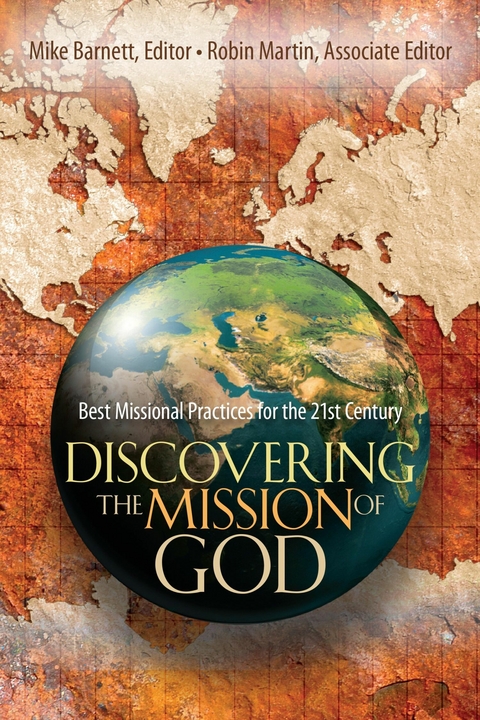
Discovering the Mission of God (eBook)
888 Seiten
IVP Academic (Verlag)
978-0-8308-5985-6 (ISBN)
Mike Barnett (Ph.D., Southwestern Seminary) is dean of the College of Intercultural Studies at Columbia International University. He teaches courses on church-planting movements, leadership and teams, creative access (business as mission), and the history of global Christianity. He also serves as national vice president of publications for the Evangelical Missiological Society. He has a business background and continues to work in international business development. He and his wife, Cindy, served for twelve years with the International Mission Board. Robin Martin has written for newspapers and magazines and worked as an editor for twenty-five years. She has served with the International Mission Board in East Asia, Central Asia, London and Cyprus--part of that time as a member of an overseas correspondent team. She is a graduate of Baylor University and currently lives and works in Virginia with her husband, Don, and children Donnie, Sarah and Stirling--her favorite assignments to date.
Biblical Foundations Book Award"e;God cannot lead you on the basis of information you do not have."e; Ralph WinterWhat is God's mission in the world? For anyone passionate about discovering God's heart for the nations, Discovering the Mission of God will reveal his plans for you. Written by 21st-century field workers, scholars and church leaders, this book weaves together the basic components of God?s global mission and challenges readers to identify where they fit in the mission of God.Discovering the Mission of God explores the mission of God as presented in the Bible, expressed throughout church history and in cutting-edge best practices being used around the world today. Drawing from a new generation of scholar-practitioners, this comprehensive reader provides global perspective, recent missiological research, case studies, recommended further readings and relevant discussion questions at the end of each chapter.Contributors include:Bryan E. BeyerKaren O'Dell BullockR. Bruce CarltonGary R. CorwinDon DentRobert EdwardsNathan EvansDavid GarrisonH. Al GilbertKevin GreesonJim HaneyJ. Scott HolsteR. Alton JamesPatrick LaiWilliam J. LarkinChristopher R. LittleAlex LucStan MayClyde MeadorA. Scott MoreauD. Kurt NelsonHoward NorrishMeg PageJohn PiperRobert L. PlummerJerry RankinNik RipkenTom SteffenEd StetzerJohn Mark TerryLaNette W. ThompsonGreg TurnerPreben VangJoel. F. WilliamsChristopher J. H. WrightWilliam R. YountDiscovering the Mission of God is an indispensable resource for anyone wanting a better picture of what God is doing in the world and how to find one's place in God's global plan.
Mike Barnett (Ph.D., Southwestern Seminary) is dean of the College of Intercultural Studies at Columbia International University. He teaches courses on church-planting movements, leadership and teams, creative access (business as mission), and the history of global Christianity. He also serves as national vice president of publications for the Evangelical Missiological Society. He has a business background and continues to work in international business development. He and his wife, Cindy, served for twelve years with the International Mission Board. Robin Martin has written for newspapers and magazines and worked as an editor for twenty-five years. She has served with the International Mission Board in East Asia, Central Asia, London and Cyprus--part of that time as a member of an overseas correspondent team. She is a graduate of Baylor University and currently lives and works in Virginia with her husband, Don, and children Donnie, Sarah and Stirling--her favorite assignments to date.
1
Word of God and Mission of God
Reading the Whole Bible for Mission
Christopher J. H. Wright
A Short Personal Journey
I remember them so vividly from my childhood—the great banner texts around the walls of the missionary conventions in Northern Ireland where I would help my father at the stall of the Unevangelized Fields Mission, of which he was Irish Secretary after spending twenty years in Brazil. “Go ye into all the world and preach the Gospel to every creature,” they urged me, along with other similar imperatives in glowing Gothic calligraphy. By the age of twelve I could have quoted all the key ones: “Go ye therefore and make disciples . . .” “How shall they hear . . . ?” “You shall be my witnesses . . . to the ends of the earth.” “Whom shall we send? . . . Here am I, send me.” I knew my missionary Bible verses. I had responded to many a rousing sermon on most of them.
By the age of twenty-one I had a degree in theology from Cambridge, where the same texts had been curiously lacking. At least it is curious to me now. At the time there seemed to be little connection at all between theology and mission in the minds of the lecturers, or of myself, or, for all I knew, in the mind of God. “Theology” was all about God—what God was like, what God had said and done, and what mostly dead people had speculated on such questions. “Mission” was about us, the living, and what we’ve been doing since Carey (who, of course, was the first missionary, we so erroneously thought). Or more precisely, mission is what we evangelicals do since we’re the ones who know the Bible told us (or some of us, at least) to go and be missionaries. “The Bible” was somewhere in the middle—the object of critical study by theologians and the source of motivational texts for missionaries.
“Mission is what we do.” That was the assumption—supported, of course, by clear biblical commands that were taken seriously by at least some people in the church. Mission was a task that some specially called folks got involved with. I had little concept at that time that mission should have been the very heartbeat of theology and the key to knowing how to interpret the Bible (hermeneutics).
Many years later, including years when I was teaching theology as a missionary in India, I found myself teaching a module called “The Biblical Basis of Mission” at All Nations Christian College, an international mission-training institution in England. The module title itself embodies the same assumption. Mission is the noun, the given reality. It is something we do, and we basically know what it is. And the reason why we know we should be doing it—the basis, foundation, or grounds on which we justify it—must be found in the Bible. As good evangelicals we need a biblical basis for everything we do. What, then, is the biblical basis for mission? Roll out the texts. Add some that nobody else has thought of. Do some joined-up theology. Add some motivational fervor. And the class is heartwarmingly appreciative. Now they have even more biblical support for what they already believed anyway, for these are All Nations students after all. They only came because they are committed to doing mission.
There is the task (mission). Here are some folks who are going to do it (the missionaries). And here are the bits of the Bible that might encourage them (the missionary texts). That is what everybody seemed to mean by the biblical basis of mission.
This mild caricature is not in the least derogatory in intent. I believe passionately that mission is what we should be doing, and I believe the Bible endorses and mandates it. However, the more I taught that course, the more I used to introduce it by telling the students that I would like to change its name from “The Biblical Basis of Mission” to “The Missional Basis of the Bible.” I wanted them to see not just that the Bible contains a number of texts which happen to provide a rationale for missionary endeavor, but that the whole Bible is itself a “missional” phenomenon.
The Bible as the Product of God’s Mission
A missional understanding of the Bible begins with the Bible’s very existence.[1] For those who affirm some relationship (however articulated) between these texts and the self-revelation of our creator God, the whole canon of Scripture is a missional phenomenon in the sense that it witnesses to the self-giving movement of this God toward his creation and toward us, human beings who have been made in God’s own image but who are wayward and wanton. The writings which now comprise our Bible are themselves the product of, and witness to, the ultimate mission of God.
The very existence of the Bible is incontrovertible evidence of the God who refused to forsake his rebellious creation, who refused to give up, who was and is determined to redeem and restore fallen creation to his original design for it. . . . The very existence of such a collection of writings testifies to a God who breaks through to human beings, who disclosed himself to them, who will not leave them unilluminated in their darkness . . . who takes the initiative in re-establishing broken relationships with us.[2]
Furthermore, the processes by which these texts came to be written were often profoundly missional in nature. Many of the biblical texts emerged out of events, struggles, crises, or conflicts in which the people of God engaged with the constantly changing and challenging task of articulating and living out their understanding of God’s revelation and redemptive action in the world. Sometimes these were struggles internal to the people of God themselves; sometimes they were highly argumentative (polemical) struggles with the competing religious claims and worldviews that surrounded them. So a missional reading of such texts is definitely not a matter of first finding the “real” meaning by objective interpretation (exegesis), and then cranking up some “missiological implications” as a sermon (homiletic) supplement to the text itself. Rather, a missional reading will observe how a text often has its origin in some issue, need, controversy, or threat that the people of God needed to address in the context of their mission. The text in itself is a product of mission in action.
This is easily demonstrated in the case of the New Testament.[3] Most of Paul’s letters were written in the heat of his missionary efforts: wrestling with the theological basis of the inclusion of the Gentiles, affirming the need for Jew and Gentile to accept one another in Christ and in the church, tackling the baffling range of new problems that assailed young churches as the gospel took root in the world of Greek polytheism, confronting incipient heresies with clear affirmations of the supremacy and sufficiency of Jesus Christ, and so on. And why were the Gospels so called? Because they were written to explain the significance of the evangel—the good news about Jesus of Nazareth, especially his death and resurrection. Confidence in these things was essential to the missionary task of the expanding church. And the person to whom we owe the largest portion of the New Testament, Luke, shapes his two volumes in such a way that the missionary mandate to the disciples to be Christ’s witnesses to the nations comes as the climax to volume one and the introduction to volume two.
But we can also see in the Old Testament that many texts emerged out of the engagement of the Israelites with the surrounding world in the light of the God they knew in their history and in covenantal relationship. People produced texts in relation to what they believed God had done, was doing, or would do in their world. Genesis presents a theology of creation that stands in sharp contrast to the polytheistic creation myths of Mesopotamia. Exodus records the exodus as an act of Yahweh that comprehensively confronted and defeated the power of Pharaoh and all his rival claims to deity and allegiance. The historical narratives portray the long and sorrowful story of Israel’s struggle with the culture and religion of Canaan. Texts from the time of the Babylonian exile of Israel, as well as postexilic texts, emerge out of the task that the small remnant community of Israel faced to define their continuing identity as a community of faith in successive empires of varying hostility or tolerance. Wisdom texts interact with international wisdom traditions in the surrounding cultures, but do so with staunch monotheistic disinfectant. And in worship and prophecy, Israelites reflect on the relationship between their God, Yahweh, and the rest of the nations—sometimes negatively, sometimes positively—and on the nature of their own role as Yahweh’s elect priesthood in their midst. All of these are themes and conflicts that are highly relevant to missional engagement between God’s people and the world of nations.
The Bible, then, is a missional phenomenon in itself. The writings which now comprise our Bible are themselves the product of, and witness to, the ultimate mission of God. The individual texts within it often reflect the struggles of being a people with a mission in a world of competing cultural and religious claims. And the canon eventually consolidates the recognition that it is through these texts that the people whom God has called to be his own (in both Testaments) have been shaped as a community of memory and hope, a community of mission, a community of failure and striving.
In short, a missional hermeneutic proceeds from the assumption that the whole Bible renders to us the story of God’s mission through...
| Erscheint lt. Verlag | 3.8.2012 |
|---|---|
| Mitarbeit |
Stellvertretende Herausgeber: Robin Martin |
| Verlagsort | Lisle |
| Sprache | englisch |
| Themenwelt | Religion / Theologie ► Christentum ► Kirchengeschichte |
| Schlagworte | christian missionary • Christian Missions • Church • God • Gospel • Great Commission • ministry • Missiology • Missionary • missions • share the gospel |
| ISBN-10 | 0-8308-5985-3 / 0830859853 |
| ISBN-13 | 978-0-8308-5985-6 / 9780830859856 |
| Informationen gemäß Produktsicherheitsverordnung (GPSR) | |
| Haben Sie eine Frage zum Produkt? |
 EPUB (Adobe DRM)
Kopierschutz: Adobe-DRM
Adobe-DRM ist ein Kopierschutz, der das eBook vor Mißbrauch schützen soll. Dabei wird das eBook bereits beim Download auf Ihre persönliche Adobe-ID autorisiert. Lesen können Sie das eBook dann nur auf den Geräten, welche ebenfalls auf Ihre Adobe-ID registriert sind.
Details zum Adobe-DRM
Dateiformat: EPUB (Electronic Publication)
EPUB ist ein offener Standard für eBooks und eignet sich besonders zur Darstellung von Belletristik und Sachbüchern. Der Fließtext wird dynamisch an die Display- und Schriftgröße angepasst. Auch für mobile Lesegeräte ist EPUB daher gut geeignet.
Systemvoraussetzungen:
PC/Mac: Mit einem PC oder Mac können Sie dieses eBook lesen. Sie benötigen eine
eReader: Dieses eBook kann mit (fast) allen eBook-Readern gelesen werden. Mit dem amazon-Kindle ist es aber nicht kompatibel.
Smartphone/Tablet: Egal ob Apple oder Android, dieses eBook können Sie lesen. Sie benötigen eine
Geräteliste und zusätzliche Hinweise
Buying eBooks from abroad
For tax law reasons we can sell eBooks just within Germany and Switzerland. Regrettably we cannot fulfill eBook-orders from other countries.
aus dem Bereich