


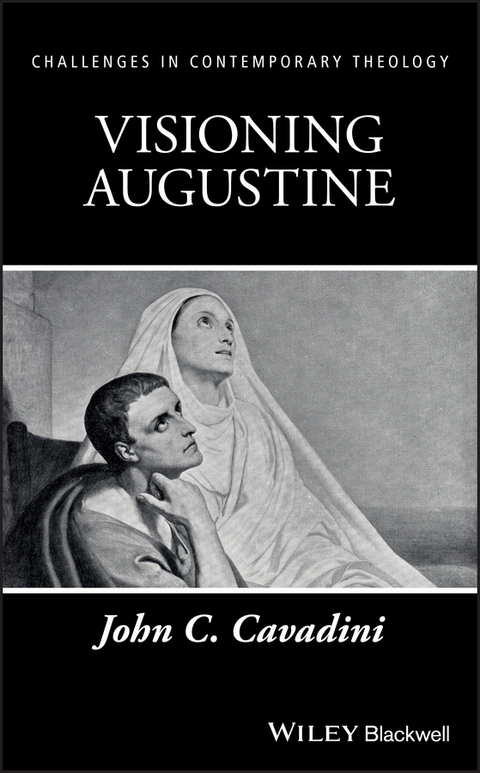
Visioning Augustine (eBook)
John Wiley & Sons (Verlag)
978-1-119-10574-9 (ISBN)
The definitive compendium of Cavadini's essays on Augustine
Visioning Augustine offers readers an expertly selected collection of essays exploring the text and history of the theology of Saint Augustine. Prominent scholar and essayist, John Cavadini, offers modern audiences an innovative framework for understanding Augustine, integrating articles and essays on significant texts, historical and contemporary perspectives and insights into Augustine's development as a theologian. Examining themes such as the transformation of the human will in De doctrina Christiana and Augustine's critique of philosophy in City of God, Cavadini provides clear and accessible smaller-size essays that serve as entry points for those interested in Augustinian scholarship.
The author's meditations on Augustinian texts invite readers to re-evaluate their interpretations and learn about the subtle and sophisticated vocabulary of Augustine. An encounter with Augustine the Christian theologian, Cavadini contends, is not a narrowly focused parochial experience, but instead a challenge to enlarge our horizons.
- Written by one of the most prominent Augustinian scholars and essayists in the field
- Addresses ecumenical and cultural issues that weaken contemporary interest in Christian faith
- Offers modern readers historical context on Augustinian theology
- Provides a single-volume collection of Cavadini's essays on Augustine written over the course of more than two decades
Accessible prose and intellectual sensitivity to modern theological problemsmake Visioning Augustine an indispensable volume for graduate students, scholars and professionals in all areas of Christian theology.
John C. Cavadini is Professor of Theology at the University of Notre Dame, and serves as McGrath-Cavadini Director of the McGrath Institute for Church Life. He has served on the International Theological Commission, is the author of The Last Christology of the West and is editor of Explorations in the Theology of Benedict XVI and Mary on the Eve of the Second Vatican Council.
The definitive compendium of Cavadini s essays on Augustine Visioning Augustine offers readers an expertly selected collection of essays exploring the text and history of the theology of Saint Augustine. Prominent scholar and essayist, John Cavadini, offers modern audiences an innovative framework for understanding Augustine, integrating articles and essays on significant texts, historical and contemporary perspectives and insights into Augustine s development as a theologian. Examining themes such as the transformation of the human will in De doctrina Christiana and Augustine s critique of philosophy in City of God, Cavadini provides clear and accessible smaller-size essays that serve as entry points for those interested in Augustinian scholarship. The author s meditations on Augustinian texts invite readers to re-evaluate their interpretations and learn about the subtle and sophisticated vocabulary of Augustine. An encounter with Augustine the Christian theologian, Cavadini contends, is not a narrowly focused parochial experience, but instead a challenge to enlarge our horizons. Written by one of the most prominent Augustinian scholars and essayists in the field Addresses ecumenical and cultural issues that weaken contemporary interest in Christian faith Offers modern readers historical context on Augustinian theology Provides a single-volume collection of Cavadini s essays on Augustine written over the course of more than two decades Accessible prose and intellectual sensitivity to modern theological problemsmake Visioning Augustine an indispensable volume for graduate students, scholars and professionals in all areas of Christian theology.
John C. Cavadini is Professor of Theology at the University of Notre Dame, and serves as McGrath-Cavadini Director of the McGrath Institute for Church Life. He has served on the International Theological Commission, is the author of The Last Christology of the West and is editor of Explorations in the Theology of Benedict XVI and Mary on the Eve of the Second Vatican Council.
About the Author viii
Foreword by Mark Therrien ix
Preface by John C. Cavadini xix
Abbreviations xxiv
1 The Structure and Intention of Augustine's De Trinitate 1
2 The Sweetness of the Word: Salvation and Rhetoric in Augustine's De doctrina christiana 23
3 The Quest for Truth in Augustine's De Trinitate 45
4 Augustine's Book of Shadows 61
5 Simplifying Augustine 81
6 Feeling Right: Augustine on the Passions and Sexual Desire 110
7 The Darkest Enigma: Reconsidering the Self in Augustine's Thought 138
8 The Sacramentality of Marriage in the Fathers 156
9 Eucharistic Exegesis in Augustine's Confessions 184
10 Spousal Vision: A Study of Text and History in the Theology of Saint Augustine 211
11 Trinity and Apologetics in the Theology of St. Augustine 239
12 God's Eternal Knowledge According to Augustine 285
Index 309
"It is Cavadini's own "rhetoric of unsettling," which I think he has learned so well from Augustine, that brings us to these new encounters with his teacher and subject. An unsettled scholar brings an unsettled master to readers who, perhaps, may find themselves unsettled, too. Take, and read." - Kevin L. Hughes, Journal of the American Academy of Religion, September 2020
Foreword: A Quarter of a Century with a Theologian for All Centuries: An Introduction to John C. Cavadini's Visioning Augustine
Mark Therrien
Genius tends to be doubly rare – in its occurrence on the one hand, and in its being understood on the other. The rarity of the latter is too often the case for St. Augustine, the greatest of the Latin Fathers. I remember my introduction to this great Churchman. I learned that he was to blame for his pessimism regarding original sin, guilt, and sex; for his presumptuous psychological speculations on the Trinity; for his Platonist intellectualizing of the Gospel; and, finally, for his supposed genesis of later theories of double predestination (inter alia). But then, when I actually read Augustine under the tutelage of the author of the current collection of essays, I found myself encountering a very different Augustine. Far from a bleak pessimist, Prof. Cavadini helped me to discover an exegete who believed in the essential goodness of creation and who preached a God who freely made man, even while knowing that this same man would send him to the cross. Instead of someone suffering from a neurosis about human intimacy, I found, with Prof. Cavadini's help, a preacher whose vision of Christian marriage and sex was profound – indeed, who knew them to be so lofty that he also realized the extent to which the tragedy of sin had marked them and thus required redemption by Christ. Rather than a navel‐gazer discovering the divine essence through audacious reflections on his own “self,” Prof. Cavadini led me to see a priest, on his knees, gazing at the wounds that he knew himself to have inflicted. Far from a philosopher dreaming about Platonic ideas in the ether, we met a theologian who spoke powerfully of history – and of the fact that, in Jesus Christ, God had entered into it. And, finally, I did indeed find the massa damnata of the City of God. However, with Prof. Cavadini, I also found a broken but redeemed pastor who knew from his own experience the power of grace to transform even the hardest of hearts, and who in his homilies tries passionately to persuade the members of his flock to accept this grace so that they might find themselves in the City and not with the massa – even as he himself realized the full gravity of the Gospel's teaching about the narrow way, and that all of them might not make it.
Prof. Cavadini's Fall 2015 Seminar on Augustine was thus a formative moment in my graduate career, and one for which I remain grateful. In what follows, then, it is my honor to provide a synopsis of and introduction to the chapters in this volume, in which Prof. Cavadini has set out for us a new framework for reading Augustine – thus adding his voice to the symphony of scholarly efforts to recover the theology of this great pater patrum of the Church Universal.
I History Has Meaning: Augustine's Development as a Theologian of the Incarnation
The chapters in this volume start off in the early 1990s with much on De Trin., a work that was not really in vogue then. As noted in the first chapter, titled “The Structure and Intention of Augustine's De Trinitate,” few at the time wanted to deal with this work, because it was, supposedly, too speculative and abstract: it was read as being about how to make a philosophical (in particular, Plotinian) ascent to God. On the one hand, this reading is correct. De Trin. is about this kind of ascent in a way, but not as many have understood it. De Trin. is indeed about making an ascent, but what Augustine shows is that our attempts to ascend on our own (i.e. that which philosophy attempts to do) are totally futile. There are, in fact, two attempts to make an ascent in De Trin. – both of them fail. These failures are not accidental, but rather the point of the work, as Augustine himself says in the comments that he added to the beginning of the work later on. Through these failed attempts at a philosophical ascent, Augustine shows us that we cannot ascend on our own, but rather need Christ as our way to reach God as our goal. But what Augustine also realizes by the time of De Trin. is not only that Christ is the way by which we come to God, but also the goal himself. Christ is God incarnate, and therefore the goal of our ascent is not a God of metaphysical speculation – an essence somewhere behind and beyond the Trinity – but rather the real God: the God who is eternally Love, and who is made known to us only through the historical, temporal economy of our incarnate Lord, Jesus Christ. Thus, in De Trin., Augustine shows a stronger interest in the historical and temporal. As he shows, we do not have to flee from that which is temporal in order to know God (as Augustine seems once to have thought). Rather, we come to know God in the temporal and historical. God has acted in history, and so history has meaning such that it cannot be sloughed off as we ascend to some impersonal divine heights.
This change in perspective is key for understanding Augustine and his development as a theologian. It is also something that helps us to understand his other works. In this vein, the second chapter, titled “The Sweetness of the Word: Salvation and Rhetoric in Augustine's De doctrina christiana,” shows how this transformed perspective shapes Augustine's soteriology. In his earlier works, Augustine was mostly concerned with Christ as a teacher of interior knowledge – even when, as is the case in one early work, he does speak about Christ’s passion. By the time of De doctrina, however, Augustine is concerned with the ins and outs of daily life, we might say; namely: the transformation of human affect or emotion, which takes place through the transformation of the human will. This transformation happens only through the grace of Christ, by means of looking to his passion and cross. The same theme is discussed in Chapter 3, titled “The Quest for Truth in Augustine's De Trinitate,” which also expands upon how Augustine thinks about the relation of the human being to his or her culture. Our transformation in Christ is not something that matters for us alone. Rather, all human experience is cultural. In De Trin., Augustine traces the roots of culture back, first of all, to our pre‐linguistic inner word, and shows how our will shapes this word either in pride or love, such that its exterior expression leads to a culture that is either truly bound together in charity or perverted by pride. We are not reducible to our cultures, but are in fact the generators of culture. On the other hand, the wrong “encoding” of our inner word in its exterior forms generates cultures that are marked by ungodly pride, which ensnare us in turn. For Augustine, it was for this reason that the Word became incarnate: so that we could be conformed to his example and so that he could persuade us by his blood. In his earlier works, Augustine perhaps thought too readily that the disciplines of the liberal arts and philosophy could be used to ascend to God. By the time of De Trin. and De doctrina, however, he realizes that these disciplines themselves are (in their current states) generated from our sinfully disposed wills, and thus require healing. To be sure, Augustine does not write culture off as meaningless. Rather, he realizes more acutely that it needs healing through Christ, to whatever extent this healing is possible in this life.
II Reading Scripture: Augustine on the Re‐Creation of the Person in the Totus Christus
In De Trin., Augustine's new focus on Christ as the goal and as the end of our journey led him to emphasize the perpetual validity of the historical economy as that wherein God has worked our salvation. Within this perspective, Christ as a historical agent becomes central in Augustine's thought. Christ saves us not only by living and dying for us, but also by providing us with a model of godly human life. But to know what we must become in Christ, we must also see that from which Christ has rescued us. In this vein, Chapter 4, titled “Augustine's Book of Shadows,” on Book Two of the Conf., shows how, for Augustine, Scripture's narrative is also our own narrative. This book, which is prima facie about Augustine's sexual improprieties and his infamous theft of pears, has been the subject of much psychologizing on Augustine. Is not its rhetoric just too much? No, in fact, for what Augustine narrates is not chiefly his acts of licentiousness or thievery (although he does tell us of them), but rather his own descent into shadowy nothingness. He is thus, paradoxically, narrating a non‐narrative of “total” insubstantiality, which is only possible by virtue of the fact that he actually has a real story now; namely, that of receiving God's grace and mercy, and so being given back himself. Book Two of the Conf., beyond tales of sex and pears, is Augustine's exegesis of Genesis in light of his own life viewed from the perspective of Christ's story, according to which Christ obliterates the fallen solidarity of Genesis and restores humanity into a new solidarity with and in himself. This understanding of Genesis and its narrative of the Fall as key to understanding the person and work of Christ, and thus our own lives, is a key feature of Augustine's theology. Understanding what was lost in the Fall is particularly important for Augustine – not because of a gloomy pessimism, but...
| Erscheint lt. Verlag | 11.2.2019 |
|---|---|
| Reihe/Serie | Challenges in Contemporary Theology |
| Challenges in Contemporary Theology | Challenges in Contemporary Theology |
| Sprache | englisch |
| Themenwelt | Geschichte ► Teilgebiete der Geschichte ► Religionsgeschichte |
| Religion / Theologie ► Christentum ► Kirchengeschichte | |
| Schlagworte | Augustine analysis • Augustine apologetics • Augustine apology • Augustine articles • Augustine city of god • Augustine collection • Augustine compendium • Augustine critique • Augustine essays • Augustine eucharistic exegesis • Augustine God's eternal knowledge • Augustine history • Augustine interpretation • Augustine marriage • Augustine meditations • Augustine passions • Augustine philosophy • Augustine rhetoric • Augustine sacraments • augustine's confessions • Augustine texts • Augustine theology • Augustine Trinity • Augustine writings • Augustinian articles • Augustinian essays • Augustinian interpretations • Augustinian meditations • Augustinian Philosophy • Augustinian rhetoric • Augustinian texts • Augustinian theology • Augustinian thought • Augustinian works • De doctrina christiana • De trinitate • Moraltheologie, christliche Ethik • Moral Theology / Christian Ethics • Religion & Theology • Religion u. Theologie • St. Augustine • Systematic Theology • Systematische Theologie • Theologie • Theology |
| ISBN-10 | 1-119-10574-9 / 1119105749 |
| ISBN-13 | 978-1-119-10574-9 / 9781119105749 |
| Informationen gemäß Produktsicherheitsverordnung (GPSR) | |
| Haben Sie eine Frage zum Produkt? |
 EPUB (Adobe DRM)
Kopierschutz: Adobe-DRM
Adobe-DRM ist ein Kopierschutz, der das eBook vor Mißbrauch schützen soll. Dabei wird das eBook bereits beim Download auf Ihre persönliche Adobe-ID autorisiert. Lesen können Sie das eBook dann nur auf den Geräten, welche ebenfalls auf Ihre Adobe-ID registriert sind.
Details zum Adobe-DRM
Dateiformat: EPUB (Electronic Publication)
EPUB ist ein offener Standard für eBooks und eignet sich besonders zur Darstellung von Belletristik und Sachbüchern. Der Fließtext wird dynamisch an die Display- und Schriftgröße angepasst. Auch für mobile Lesegeräte ist EPUB daher gut geeignet.
Systemvoraussetzungen:
PC/Mac: Mit einem PC oder Mac können Sie dieses eBook lesen. Sie benötigen eine
eReader: Dieses eBook kann mit (fast) allen eBook-Readern gelesen werden. Mit dem amazon-Kindle ist es aber nicht kompatibel.
Smartphone/Tablet: Egal ob Apple oder Android, dieses eBook können Sie lesen. Sie benötigen eine
Geräteliste und zusätzliche Hinweise
Buying eBooks from abroad
For tax law reasons we can sell eBooks just within Germany and Switzerland. Regrettably we cannot fulfill eBook-orders from other countries.


