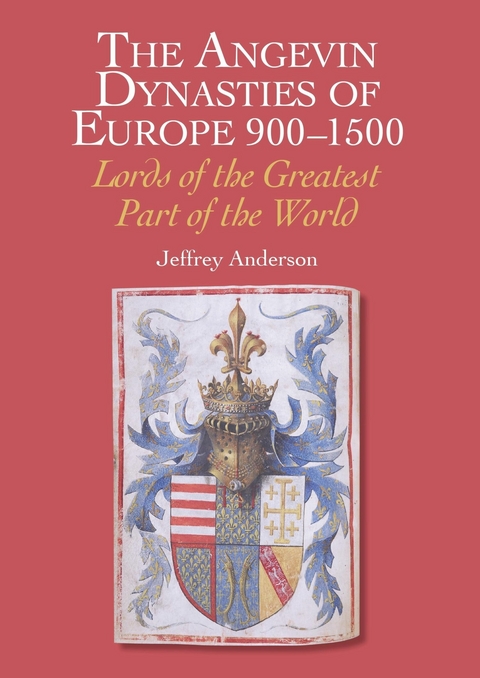
Angevin Dynasties of Europe 900-1500 (eBook)
360 Seiten
Robert Hale Non Fiction (Verlag)
978-0-7198-2926-0 (ISBN)
Jeffrey Anderson has an MA in medieval history from Durham University, where his thesis was on the financial organization of the Angevin kings of England, and an MA in history from the University of Michigan based on his first research on King Rene of Anjou. He taught Greek, Roman and medieval history as a postgraduate and now works for a City law firm.
From their small county in the heart of France, the lords of Anjou - the Angevins - produced dynasties that became kings of Jerusalem, England, Sicily, Hungary and Poland from 900 - 1500. They were described by a contemporary as 'lords of the greatest part of the world'. Here is their extraordinary story, including figures such as Geoffrey Plantagenet, Empress Matilda, Eleanor of Acquitaine, Charles of Anjou, Queen Johanna of Naples, Louis the Great of Hungary and Saint Jadwiga of Poland.
DIGESTING THE COMPLETE HISTORY of medieval Europe from 900 to 1500 in one volume is perhaps not appealing to everyone, but that is not the purpose here. This book will focus narrowly on the international and cultural connections of the Angevins, albeit over a long period and an extraordinary geographical range, and how they interacted with each other and the other ruling houses of Europe.
It is important to set the parameters of the story first, and that will involve a blizzard of dates, names and places, but we can then move on as quickly as possible. Firstly, Anjou. This was the French province centred on the Loire between Tours and Nantes with its capital at Angers, today probably best known for being the westernmost edge of the great parade of chateaux along the Loire, with Saumur perhaps being its most famous. Anjou corresponds roughly to the current, confusingly named, département of Maine et Loire – confusing since Maine is another historic province with its capital at Le Mans, a region just north of Anjou that would be taken by the Angevins. For reasons best known to the French authorities, historic Maine forms the current départements of Sarthe and Mayenne. Three historic provinces critical to early Angevin history – Anjou, Maine and Blois – have names referring to their pre-Roman tribal history, giving people from them these designations: Angevins from Anjou, Cenomannians from Maine and Blésois from Blois.
There were three Angevin dynasties in the period 900–1500: the original dynasty founded in the 9th century, which ultimately became kings of Jerusalem, took control of England and lost Anjou in 1204, after which historians refer to them as Plantagenets; next, Charles of Anjou and his descendants who in the 13th and 14th centuries became kings of Sicily, Jerusalem, Hungary and Poland; and finally the ‘Second House of Anjou’, which was founded by Louis I when he received Anjou in 1350 and essentially ended with King René who died in 1480, after which Anjou reverted to the French Crown.
The initial Angevin line, who were first called counts, began in the 9th and 10th centuries with near-legendary figures like Ingelgarius, Fulk the Red and Fulk the Good, who, although we know they existed, largely figure in fanciful tales. In this period, Anjou was a dynamic county that was one of the main political units in what would become France. After the anarchy of the later 9th century, Viking raiders had settled down to create the ‘land of the Northmen’ – Normandy – and established what became the most acquisitive and successful power of the 11th and early 12th centuries, while the French kings became so imbecilic that their throne was usurped by a new line that ruled a tiny province centred on Paris. Anjou too emerged as a compact and well governed territory ruled by a series of colourful, ruthless and successful leaders who would ultimately become kings themselves.
Angevin history leaps into focus in 987 with Fulk Nerra, a well-documented figure of European significance because of his multiple pilgrimages to Jerusalem, his pioneering construction of castles and his annexation of territory that would become a permanent part of Anjou. Fulk Nerra’s successors in the mid- and late 11th century, Geoffrey Martel and Fulk Réchin, had the misfortune to have as a neighbour Duke William the Bastard of Normandy who would become King William the Conqueror of England, and both were repeatedly bested by the Normans.
Anjou itself seemed to be in peril by the end of Fulk Réchin’s reign, but it was from this nadir that Angevin fortunes had an astonishing reversal. Fulk Réchin’s son, Fulk V, arranged not one but two historic marriages: his son Geoffrey, the first to adopt the nickname ‘Plantagenet’, married Matilda, heiress to the English throne, and Fulk himself married Melisende, heiress to the kingdom of Jerusalem that had been established by the First Crusade. The kingdom of Jerusalem was an embattled Christian outpost that needed both clear succession rules and a king to lead the army, so it accepted female succession but gave full royal recognition to the queen’s husband, and Fulk became king of Jerusalem. Geoffrey Plantagenet and Matilda had to fight for Normandy and England, and although Matilda’s cousin Stephen of Blois usurped the English throne and held it for nearly twenty years, ultimately in 1154 Matilda and Geoffrey’s son succeeded as Henry II King of England, Duke of Normandy and Count of Anjou. Moreover, he married Eleanor of Aquitaine, heiress to most of southwestern France, and together they ruled an ‘Angevin Empire’ that stretched from Scotland to the Pyrenees.
This initiated an Angevin dynasty in England that provided three of the most famous (or in one case, notorious) names in English history: Henry II, Richard the Lionheart and King John. These kings presided over developments that still shape the modern world, and this was a direct result of the methods needed to rule an enormous empire. Although they did move around their domains constantly, they could not possibly visit everywhere frequently, and so were forced to use written documents to send their authority impersonally throughout their dominions, initiating, for better or worse, much of the bureaucracy that is still with us. This also necessitated a more permanent household establishment, and London emerged as the capital of England with its administrative centre at Westminster.
In Jerusalem, the Angevin dynasty ended when the leper king Baldwin IV died without heirs and his sister’s husband became the new king, only to lose the kingdom to the great Muslim hero Saladin in 1187. The Crusades continued, most notably for our purposes with the Third Crusade of Richard the Lionheart, but they evolved from religiously motivated wars against Muslims to religiously sanctioned wars against a variety of people – other Christians, such as heretics and political opponents, as well as Muslims and Turks. Most notoriously, in 1204 the Fourth Crusade was diverted to conquer the Christian city of Constantinople and established a Latin Empire there, and the popes began to use Crusades as a routine means of attacking their political enemies.
From the peak of the Angevin Empire, the Angevins nearly lost everything. Richard’s successor, King John, lost Normandy and Anjou to the French king, and the English royal line after John is called ‘Plantagenet’ to distinguish it from subsequent rulers of Anjou. John’s loss of his Empire initiated a complex series of responses. The formalization of royal authority begun by Henry II easily slipped into despotism, and this, joined to the need for vast sums of money to defend the Angevin Empire plus King John’s inflexible character, culminated in 1215 with revolt and the drafting of Magna Carta, the first document formally curbing royal power, and establishing the principles of limited government and the ultimate responsibility of the king to his subjects. Magna Carta was a consequence of first Richard’s, then John’s, rapacious behaviour in England to raise sufficient funds to defend the Angevin Empire, and then to attempt to recapture it when it had been lost. The total failure of these schemes despite their vast expense stimulated the barons of England to rise up and demand that the king respect their wishes, the first step on the road to English constitutional monarchy and democracy.
In the 13th century the political entities and struggles that would define Europe for centuries become more clearly defined. France, England, the Holy Roman Empire, Aragon and the papacy came into direct competition, and the focal point of this struggle was Charles of Anjou. Charles was the younger brother of the French king – and future saint – Louis IX, although France and England were so intertwined that Charles was also the great-grandson of Henry II and Eleanor of Aquitaine. Although he had gained Provence by marriage and been given Anjou by Louis, Charles became involved in the great Crusade of the papacy against its enemies in Italy, and at the pope’s request he conquered southern Italy and Sicily in 1266.
Charles, more than almost any other medieval figure, had a conscious plan of empire building. He extended his rule over Albania and Greece, and gained the throne of Jerusalem – now an empty title, as the Christians held only one last outpost in the Holy Land – and an interest in the Latin Empire of Constantinople, and prepared for an invasion of the eastern Mediterranean. His great ambition collapsed in 1282 with the revolt known as the Sicilian Vespers, when the people of Sicily, supported by Aragon, rose up against the Angevins. Sicily fell to Aragon, the new great power of the Mediterranean, and the Angevin kingdom of Naples was confined to southern Italy, now ruled by Charles’s son, Charles II.
Angevin Naples initially prospered. Charles II’s eldest surviving son Louis was a Franciscan who renounced his inheritance and was so renowned for piety in his lifetime that he was recognized as a saint, leaving the next son, Robert, to become king of Naples. Robert ‘the Wise’ embodied all the qualities of the philosopher king, composing numerous sermons in Latin, publicly examining the poet and humanist Petrarch on his classical learning before proclaiming him the first poet laureate since Roman times, and patronizing two towering artists of the 14th century, Giotto and Simone Martine.
Naples in the 14th century was the greatest metropolis of...
| Erscheint lt. Verlag | 31.7.2019 |
|---|---|
| Zusatzinfo | 2 x plate sections colour and b&w photos |
| Verlagsort | London |
| Sprache | englisch |
| Themenwelt | Sachbuch/Ratgeber ► Geschichte / Politik ► Mittelalter |
| Geschichte ► Allgemeine Geschichte ► Mittelalter | |
| Geisteswissenschaften ► Geschichte ► Regional- / Ländergeschichte | |
| Geschichte ► Teilgebiete der Geschichte ► Kulturgeschichte | |
| Schlagworte | Angevin • Anjou • Anjou. • Charles of Anjou • Crusades • Edward III of England • Eleanor of Aquitaine • Empress Matilda • Geoffrey Plantagenet • Henry VI of England • Hundred Year’s War • Hungary • Joan of Arc • King René • Louis the Great • Medieval • Naples • Normandy • Philip II of France • Plantagenet • Queen Johanna • Queen Margaret • Richard I of England • Richard the Lionheart • Saint Jadwiga • Sicilian Vespers • sicily • Sigismund of Luxembourg • Yolanda of Aragon Charles VII of France |
| ISBN-10 | 0-7198-2926-7 / 0719829267 |
| ISBN-13 | 978-0-7198-2926-0 / 9780719829260 |
| Informationen gemäß Produktsicherheitsverordnung (GPSR) | |
| Haben Sie eine Frage zum Produkt? |
 EPUB (Wasserzeichen)
DRM: Digitales Wasserzeichen
Dieses eBook enthält ein digitales Wasserzeichen und ist damit für Sie personalisiert. Bei einer missbräuchlichen Weitergabe des eBooks an Dritte ist eine Rückverfolgung an die Quelle möglich.
Dateiformat: EPUB (Electronic Publication)
EPUB ist ein offener Standard für eBooks und eignet sich besonders zur Darstellung von Belletristik und Sachbüchern. Der Fließtext wird dynamisch an die Display- und Schriftgröße angepasst. Auch für mobile Lesegeräte ist EPUB daher gut geeignet.
Systemvoraussetzungen:
PC/Mac: Mit einem PC oder Mac können Sie dieses eBook lesen. Sie benötigen dafür die kostenlose Software Adobe Digital Editions.
eReader: Dieses eBook kann mit (fast) allen eBook-Readern gelesen werden. Mit dem amazon-Kindle ist es aber nicht kompatibel.
Smartphone/Tablet: Egal ob Apple oder Android, dieses eBook können Sie lesen. Sie benötigen dafür eine kostenlose App.
Geräteliste und zusätzliche Hinweise
Buying eBooks from abroad
For tax law reasons we can sell eBooks just within Germany and Switzerland. Regrettably we cannot fulfill eBook-orders from other countries.
aus dem Bereich