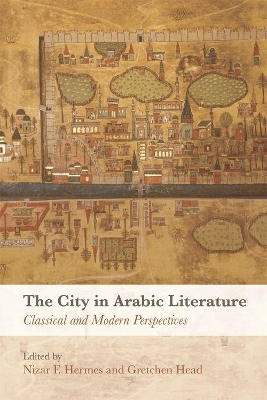
The City in Arabic Literature
Edinburgh University Press (Verlag)
978-1-4744-5582-4 (ISBN)
The theme and motif of the city has had an enduring presence in the Arabic-Islamic tradition, from the classical and post-classical literary corpus to modern and post-colonial Arabic poetry and prose. Cities such as Mecca, Baghdad, Cairo, Damascus, Beirut, Qayrawan, Marrakesh and Cordoba have served as virtual (battle)grounds for some of the Arab world's most complex intellectual, sociocultural, and political issues. The Arab city has been transformed from a mere physical structure and textual space into an (auto)biographical, novelistic, and poetic arena—often troubled and contested—for debating the encounter, competition and conflict between the rural and the urban, the traditional and the modern, the meditative and the satiric, the individual and the communal, and the Self and Other(s).
Nizar F. Hermes is Assistant Professor of Arabic Literature and Culture at the University of Virginia. He is author of The [European] Other in Medieval Arabic Literature and Culture, Ninth-Twelfth Century AD (2012). Gretchen Head is Assistant Professor of Literature in the Humanities Division at Yale-NUS College in Singapore.
Editors’ Preface
Chapter 1 The Untranslatability of the Qurʾānic City by Mohammad Salama
Chapter 2 Local Historians and their Cities: the Urban Topography of al-Azdī’s Mosul and al- Sahmī’s Jurjan by Harry Munt
Chapter 3 Against Cities: On Hijā’ al-Mudun in Arabic Poetry by Huda Fakhreddine and Bilal Orfali
Chapter 4 The Literary Geography of Meaning in the Maqāmāt of al-Hamadhānī and al-Hòarīrī by Sarah R. bin Tyeer
Chapter 5 "Woe is me for Qayrawan!" Ibn Sharaf's Lāmiyya, the Plight of Refugees and the Cityscape by Nizar F. Hermes
Chapter 6 In Memory of al-Andalus: Using the Elegy to Reimagine the Literary and Literal Geography of Cordobaby Anna Cruz
Chapter 7 The Mamluk City as Overlapping Personal Networksby Kelly Tuttle
Chapter 8 Citystruckby Adam Talib
Chapter 9 Between Utopia and Dystopia in Marrakechby Gretchen Head
Chapter 10 Revolutionary Cityscapes: Yūsuf Idrīs and the National Imaginaryby Yasmine Ramadan
Chapter 11 Lost Cities, Vanished Worlds: Configurations of Urban Autobiographical Identity in the Arabic Literature of the 1980s by Valerie Anishchenkova
Chapter 12 The Sufis of Baghdad: A Topographical Index of the Cityby Boutheina Khaldi
Chapter 13 Basòrayātha: Self-Portrait as a Cityby William Maynard Hutchins
Chapter 14 Of Cities and Canons in an Age of Comparative Consumptionby Hanadi Al-Samman
Chapter 15 Everyday Writing in an Extraordinary Cityby Ghenwa Hayek
Chapter 16 Translating Cairo’s Hidden Lines: The City as Visual Text in Magdy El Shafee’s Metroby Chip Rossetti
| Erscheinungsdatum | 30.12.2019 |
|---|---|
| Zusatzinfo | 7 black and white illustrations, 7 black and white line art |
| Verlagsort | Edinburgh |
| Sprache | englisch |
| Maße | 156 x 234 mm |
| Gewicht | 543 g |
| Themenwelt | Geisteswissenschaften ► Religion / Theologie ► Islam |
| Geisteswissenschaften ► Sprach- / Literaturwissenschaft ► Anglistik / Amerikanistik | |
| Geisteswissenschaften ► Sprach- / Literaturwissenschaft ► Literaturwissenschaft | |
| ISBN-10 | 1-4744-5582-4 / 1474455824 |
| ISBN-13 | 978-1-4744-5582-4 / 9781474455824 |
| Zustand | Neuware |
| Informationen gemäß Produktsicherheitsverordnung (GPSR) | |
| Haben Sie eine Frage zum Produkt? |
aus dem Bereich